

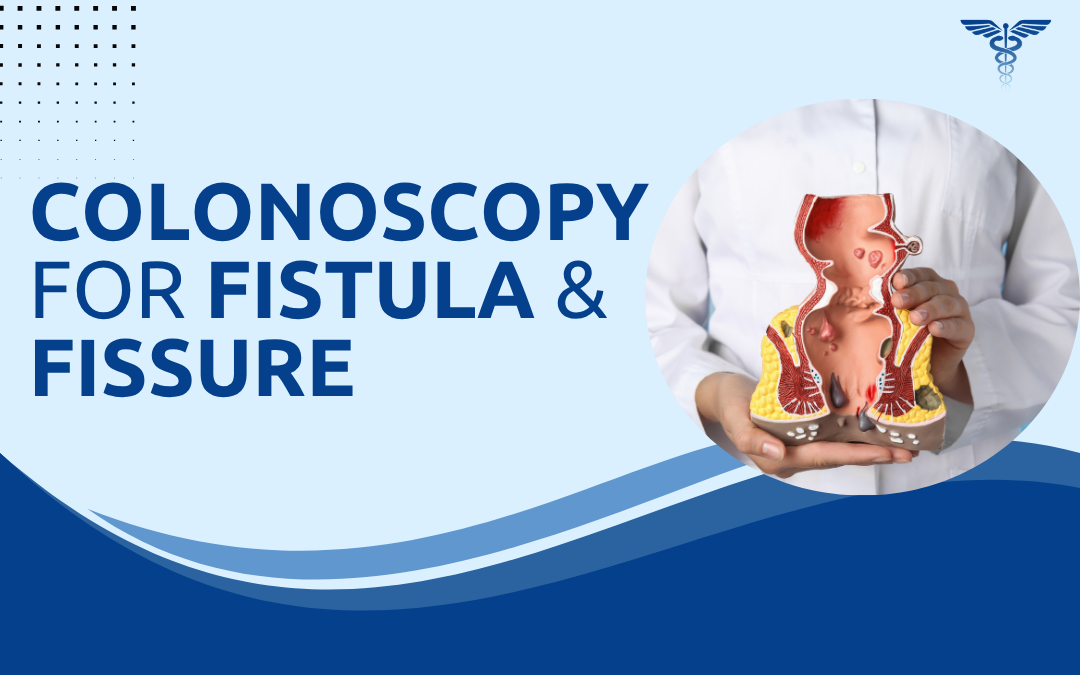
Colonoscopy doesn’t diagnose a fistula or fissure directly; MRI, endoanal ultrasound, or clinical examination does that. What colonoscopy establishes is whether the problem is local or part of a broader condition like Crohn’s disease or ulcerative colitis. That distinction changes the entire treatment plan. A fistula from a gland infection is managed very differently from one driven by inflammatory bowel disease, and missing that underlying diagnosis leads to recurrence regardless of how well the local surgery is performed.
According to Dr. Rajeev Premnath, a trusted General and Laparoscopic Surgeon, “Patients sometimes think a colonoscopy will find the fistula the way an MRI does it won’t. What it tells me is whether there’s inflammation higher up in the bowel that explains why this fistula formed, or whether I’m dealing with a straightforward local infection. That changes the entire treatment plan, not just the surgery.”
What Can a Colonoscopy Actually Show in Fistula and Fissure Cases?
Colonoscopy contributes specific, useful information in fistula and fissure assessment, even though it is not the imaging modality used to map the tract itself.
- Underlying inflammatory bowel disease: Colonoscopy can identify mucosal inflammation, ulceration, or strictures in the rectum and colon that point to Crohn’s disease or ulcerative colitis as the actual driver behind a fistula, particularly in patients with multiple, recurrent, or unusually located fistulas.
- Higher detection rates in fistula patients: Patients presenting with an anal fistula have been shown to have significantly higher rates of detectable bowel inflammation and inflammatory bowel disease on colonoscopy compared with patients without a fistula, which is why it is selectively recommended rather than skipped as irrelevant.
- Ruling out malignancy: In patients with atypical, non-healing, or unusually located fistulas especially in older patients or those with alarm symptoms like bleeding or weight loss colonoscopy helps exclude rectal or anal cancer as an underlying cause.
- Assessing extent of disease: When Crohn’s disease is suspected, colonoscopy can determine how much of the terminal ileum and colon is involved, which directly influences whether medical therapy needs to accompany or precede any surgical treatment of the fistula.
Colonoscopy is reserved for specific indications recurrent fistulas, multiple tracts, associated bowel symptoms, or atypical presentations. It isn’t performed routinely for every simple, low fistula or fissure. Understanding the pattern of symptoms is what determines which investigations are needed, and that starts with understanding fistula treatment and how presentations are assessed.
What Is Actually Used to Diagnose the Fistula or Fissure Itself?
The tract and its relationship to the sphincter muscles need imaging designed specifically for that anatomy, not a colonoscope.
- Clinical examination: A significant proportion of fissures and many low fistulas can be identified through careful visual inspection and digital examination alone, often making further imaging unnecessary for straightforward cases.
- MRI (pelvic MRI or MRI fistulogram): This is considered the reference standard for mapping the full path of a fistula, its relationship to the sphincter complex, and any secondary tracts or associated abscesses, and is particularly valuable for complex or recurrent fistulas.
- Endoanal ultrasound: This provides high-resolution imaging of the sphincter muscles and intersphincteric space, and in several comparative studies has shown accuracy at least comparable to MRI for intersphincteric and transsphincteric tracts specifically.
- Fistulography: Less commonly used today, this involves injecting contrast dye into the external opening of a fistula and taking an X-ray to outline the path of the tract, mainly reserved for specific complex or unusual presentations.
Choosing between these depends on the fistula’s suspected complexity and location, which is why an accurate initial clinical assessment matters as much as the imaging itself. Our blog on Can Fistula Surgery Cause Incontinence? explains why correctly mapping the tract’s relationship to the sphincter before surgery is so central to protecting continence.
Why Choose Dr. Rajeev Premnath?
Dr. Rajeev Premnath is a General and Laparoscopic Surgeon with MBBS, MS (Gen Surg.), FRCS (Glasg.), FEBS, FICS, FACS, FIAGES, FMAS, and a Diploma in Laparoscopy from France. He has been managing anal fistulas and fissures at Ramakrishna Super Speciality Hospital for over 20 years, with a structured approach to identifying when a fistula or fissure needs colonoscopy to rule out an underlying condition versus when it can be treated as a straightforward local problem.
Patients presenting with recurrent, multiple, or atypical fistulas here are assessed for an underlying cause before treatment is finalised, rather than being taken straight to surgery for a problem that may need medical management alongside it.
Recurring fistula, fissure, or unexplained anal symptoms?
FAQs
Does colonoscopy detect anal fistulas or fissures directly?
No, not directly. Colonoscopy is not designed to map a fistula tract or visualise a fissure in detail. It is used to check for underlying conditions in the colon and rectum, such as Crohn’s disease, that may be causing the fistula.
What test is used to map an anal fistula?
Pelvic MRI is considered the reference standard for mapping a fistula’s full path and its relationship to the sphincter muscles, with endoanal ultrasound as a comparably accurate alternative for many cases.
Can a colonoscopy detect Crohn's disease causing a fistula?
Yes. Colonoscopy can identify mucosal inflammation, ulceration, or strictures in the colon and rectum that point to Crohn’s disease as the underlying cause of a fistula.
Is colonoscopy needed to diagnose an anal fissure?
Usually not. Most anal fissures are diagnosed through clinical examination alone. Colonoscopy is only considered if there are additional symptoms suggesting a broader bowel condition.