

Fistula surgery carries a real risk of affecting bowel control and how significant that risk is depends entirely on where the tract runs in relation to the sphincter muscles. Simple low intersphincteric fistulas treated with fistulotomy have a low incontinence risk because only a small amount of internal sphincter is divided. Complex trans-sphincteric fistulas are a different situation dividing muscle to lay open the tract can cause permanent loss of gas, liquid or solid stool control. The technique chosen should be driven by how much sphincter is at risk, not by which procedure is easiest to perform.
According to Dr. Rajeev Premnath, a trusted General and Laparoscopic Surgeon in Bangalore, “The sphincter can’t be repaired easily once it’s been divided, which is why knowing the tract’s relationship to the muscle before surgery is non-negotiable.”
How Does Fistula Surgery Put the Sphincter at Risk?
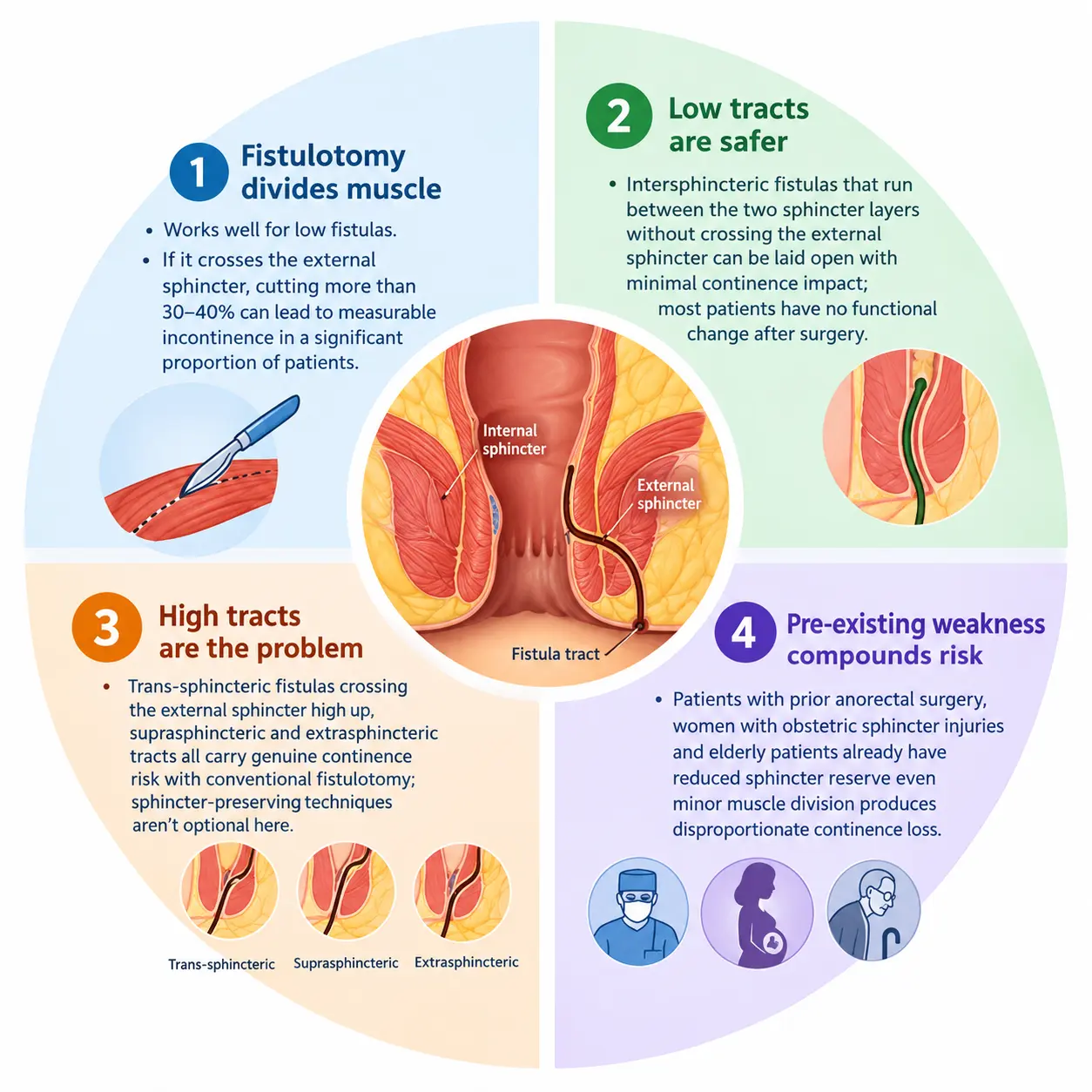
Pre-operative MRI and endoanal ultrasound map the tract’s exact relationship to the sphincter and decide which fistula treatment in Jayanagar, Bangalore is appropriate before any incision is made.
Which Fistula Techniques Protect Bowel Control?
Sphincter-preserving procedures were developed because fistulotomy’s incontinence rates for complex tracts are unacceptably high; these techniques close the fistula without cutting through muscle.
- LIFT procedure: Accesses the fistula between the two sphincter layers, ties off the tract and clears the outer portion without dividing any external sphinctermcontinence disturbance rates with LIFT are consistently the lowest across published studies.
- VAAFT: Video-assisted anal fistula treatment destroys the tract lining under direct vision and closes the internal opening with no sphincter division published data show no worsening of continence in VAAFT patients, making it the preferred choice for complex and recurrent high tracts.
- Seton placement first: A loose seton thread placed through the tract drains infection, reduces inflammation and allows tissues to mature before definitive repair, safer than acute muscle division in one sitting for high tracts.
- Technique by tract level: Low fistulas go to fistulotomy. Trans-sphincteric fistulas crossing significant external sphincter go to LIFT or VAAFT. It’s anatomy, not preference; getting it wrong means recurrence or permanent incontinence.
Most patients treated with sphincter-preserving techniques maintain full bowel control. The risk is real but largely avoidable when the procedure is matched to the tract.
Why Choose Dr. Rajeev Premnath?
Dr. Rajeev Premnath has over 20 years of experience as a General and Laparoscopic Surgeon, holding MS (Gen Surg.), FRCS (Glasg), FEBS, FICS, FACS, FIAGES and FMAS, with international training at IRCAD France and the National University of Health, Singapore. He heads the Day Care Surgery Department at Ramakrishna Specialty Hospital, Bangalore, and was the first surgeon in Karnataka to perform VAAFT bringing sphincter-preserving fistula surgery to patients where conventional fistulotomy would carry unacceptable continence risk.
Patients here get pre-operative MRI review, a clear explanation of what the tract anatomy means for their continence risk and a surgical plan that prioritises sphincter preservation wherever possible. The goal is cure without a trade-off the patient wasn’t told about.
Worried about bowel control after fistula surgery and looking for a sphincter-preserving option?
FAQs
Does fistula surgery always affect bowel control?
No, low intersphincteric fistulas carry minimal risk; complex trans-sphincteric tracts carry a significant one.
Which fistula surgery best protects the sphincter?
VAAFT has the lowest reported continence disturbance rates; LIFT is also sphincter-preserving for trans-sphincteric fistulas.
What is a seton and how does it protect continence?
A thread passed through the tract that drains infection and allows gradual safe muscle division before definitive repair.
Can bowel control loss from fistula surgery be permanent?
Yes, significant external sphincter division can cause permanent incontinence which is why sphincter-preserving techniques exist.