


A giant inguinoscrotal hernia develops when an inguinal hernia enlarges over years until bowel, omentum, or bladder descends into the scrotum in large volumes. By the time patients present, operative complexity is completely different from standard hernia repair. Contents outside the abdominal cavity long enough create a physiological problem when returned not just a technical one.
According to Dr. Rajeev Premnath, a trusted General and Laparoscopic Surgeon in Bangalore, “This is not a bigger version of the same operation. Bowel that’s been in the scrotum for years has lost its place in the abdomen. Pushing everything back creates pressure the diaphragm can’t accommodate. Pneumoperitoneum conditioning, staged repair, nutritional optimisation these aren’t optional. They’re what separates a safe recovery from an ICU admission.”
Who Qualifies for Antibiotic Treatment of Appendicitis?
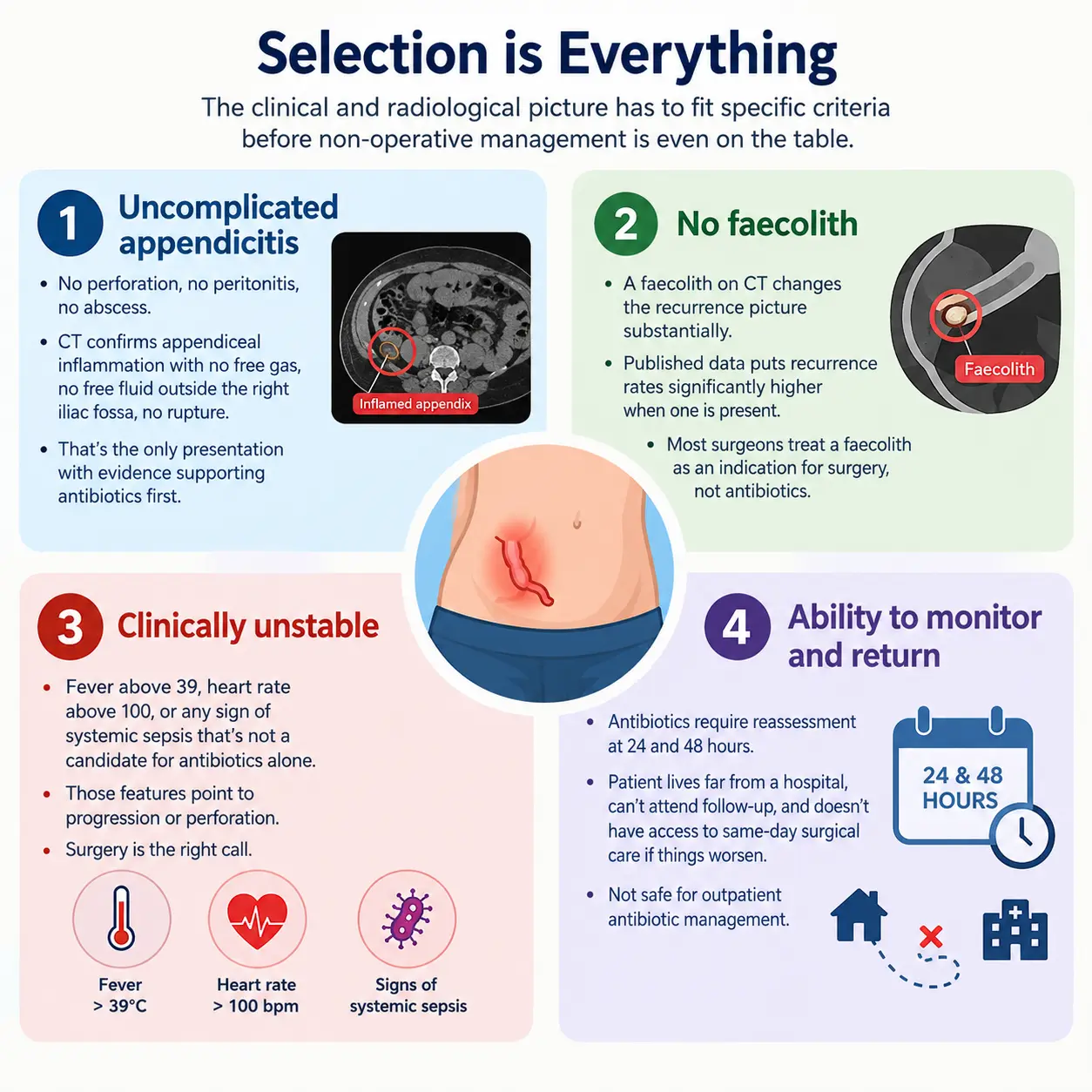
Not every case of appendicitis qualifies. Criteria eliminate a significant proportion. For a full overview of appendix treatment options, visit our appendix treatment page.
What Are the Outcomes and Risks of Choosing Antibiotics Over Surgery?
The evidence supports offering it. The evidence is also clear about the limits.
- Short-term success: 70% to 80% of patients with uncomplicated appendicitis on IV antibiotics avoid surgery during the index admission. Most turn the corner in 48 to 72 hours. Discharge once eating normally and inflammatory markers are dropping.
- Recurrence: 20% to 30% develop recurrent appendicitis within a year. Most recurrences in the first six months. Laparoscopic appendectomy manages them without higher complication rates than primary surgery, provided it isn’t an emergency.
- Risk of deterioration: A small proportion worsen despite antibiotics. Perforation. Abscess. Emergency surgery in less controlled conditions. That’s the real downside. Which is why 48-hour monitoring isn’t optional; it’s what catches the ones who are going the wrong way.
- Long-term picture: APPAC trial five-year data puts cumulative recurrence at around 40%. This isn’t a one-and-done decision for most patients. Some will need surgery eventually. Better to plan that proactively than arrive at it in an emergency.
Non-operative management is a genuine option, not a shortcut. Our blog on appendix surgery recovery covers what laparoscopic appendectomy involves when surgery becomes necessary.
Why Choose Dr. Rajeev Premnath?
Dr. Rajeev Premnath is a General and Laparoscopic Surgeon with MBBS, MS (Gen Surg.), FRCS (Glasg.), FEBS, FICS, FACS, FIAGES, FMAS, and a Diploma in Laparoscopy from France, with over 20 years of experience in laparoscopic appendectomy and non-operative management of appendicitis at Ramakrishna Super Speciality Hospital, Jayanagar, Bangalore.
CT findings, faecolith status, clinical stability, and patient preference all of it gets reviewed before any treatment decision is made. The right approach for that specific presentation, not a default to surgery or antibiotics without a clinical reason.
Diagnosed with appendicitis and want to understand whether antibiotics are an option?
FAQs
Can appendicitis be treated with antibiotics instead of surgery?
Yes in selected cases. Uncomplicated appendicitis without perforation, faecolith, or peritonitis resolves with antibiotics in around 70% to 80% of patients short-term.
Who is not suitable for antibiotic treatment of appendicitis?
Patients with a faecolith, perforation, peritonitis, abscess, or systemic sepsis. None of these are candidates for non-operative management.
What is the recurrence rate after antibiotic treatment for appendicitis?
Around 20% to 30% within one year, rising to approximately 40% at five years. A real long-term risk patients need to understand before choosing antibiotics.
Is surgery still needed if antibiotics work initially?
Not immediately. But ongoing surveillance is needed and an interval appendectomy decision should be made proactively before recurrence forces an emergency.