

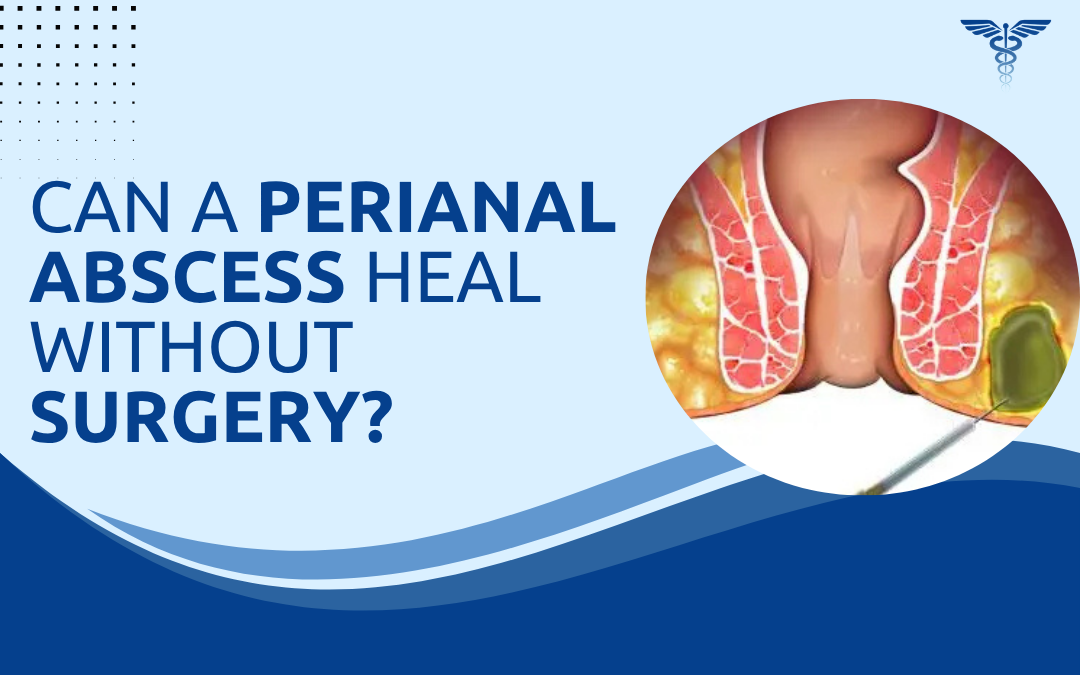
A perianal abscess does not resolve on its own in most cases. It is a collection of pus in the tissue around the anus, driven by infection that has no natural exit. Without drainage, the pressure builds, the infection spreads into surrounding tissue planes, and the risk of systemic sepsis or fistula formation rises with every day of delay. Antibiotics alone cannot penetrate a walled-off pus collection effectively enough to clear it.
According to Dr. Rajeev Premnath, a trusted General Surgeon in Bangalore, “Patients sometimes come having taken a week of antibiotics prescribed elsewhere and wonder why they’re worse. The antibiotic treats the infection around the abscess, not the abscess itself. The pus needs to come out. The sooner it does, the smaller the procedure and the better the outcome.”
Why Can't Antibiotics Alone Treat a Perianal Abscess?
A walled-off pus collection has no blood supply through which antibiotics can act, making drainage the only effective intervention.
- Penetration failure: Antibiotics circulate through living tissue via blood supply, and a formed abscess cavity is surrounded by fibrous tissue that blood cannot reliably enter, leaving the pus collection entirely untouched by the medication.
- Delayed harm: Each day without drainage allows the collection to enlarge under increasing pressure, tracking along tissue planes and causing damage that a prompt incision would have avoided entirely.
- Adjunct role: Antibiotics are indicated post-drainage in patients who are immunocompromised, diabetic, or have significant surrounding cellulitis extending beyond the abscess margin, where the spreading component needs systemic treatment alongside the drained cavity.
- Resistance risk: Repeated antibiotic courses without drainage select for resistant organisms in the abscess, complicating both culture results and post-drainage management when surgery eventually becomes unavoidable.
Antibiotic therapy without drainage does not resolve perianal abscess and increases the likelihood of deeper infection and fistula formation. Patients who develop a fistula after delayed treatment require dedicated fistula treatment as a separate surgical episode from the abscess itself.
What Happens If a Perianal Abscess Is Left Untreated?
Untreated perianal abscess expands and either ruptures spontaneously or tracks into deeper anatomical spaces, both outcomes carrying serious consequences.
- Spontaneous rupture: The abscess eventually breaches the overlying skin under internal pressure, providing temporary relief but leaving an incompletely drained cavity that remains infected and forms the anatomical basis for a chronic fistula tract.
- Deep extension: Infection follows the path of least resistance into the ischiorectal fossa, the intersphincteric plane, or across the midline into a horseshoe configuration requiring considerably more complex surgical drainage than the original superficial collection.
- Fistula formation: Up to one in three patients with a perianal abscess will develop a perianal fistula, an abnormal epithelialised tract between the anal canal and perianal skin, and patients with this complication require assessment by an experienced proctologist to determine whether fistulotomy, VAAFT, or a staged repair is appropriate.
- Sphincter damage: Infection spreading through the intersphincteric or ischiorectal spaces can involve the external sphincter complex, and the resulting tissue destruction or subsequent surgical management of a neglected abscess carries measurable risk to continence that early drainage avoids.
Prompt drainage when the abscess first presents remains the most effective way to limit tissue destruction, reduce fistula risk, and preserve sphincter integrity. Our blog on Laser Fistula Surgery vs VAAFT covers what surgical options exist once a fistula has already formed.
Why Choose Dr. Rajeev Premnath?
Dr. Rajeev Premnath is a General and Laparoscopic Surgeon with MBBS, MS (Gen Surg.), FRCS (Glasg.), FEBS, FICS, FACS, FIAGES, FMAS, and a Diploma in Laparoscopy from France. He has been managing anorectal conditions including perianal abscesses and fistulas at Ramakrishna Super Speciality Hospital for over 20 years, including cases presenting late with spreading infection or established fistula tracts requiring staged repair.
Perianal abscesses here are assessed for location, depth, and complexity before a drainage plan is made. Superficial abscesses are drained under local anaesthesia without delay. Deeper or horseshoe collections are managed in theatre. Fistula assessment follows drainage once the acute infection has settled.
Perianal pain, swelling, or throbbing near the anus?
FAQs
Can a perianal abscess heal without surgery?
In most cases, no. A formed abscess requires drainage to resolve. Antibiotics alone cannot clear a walled-off pus collection and only delay the necessary procedure.
What happens if a perianal abscess is left untreated?
It either ruptures spontaneously, which does not guarantee complete drainage and raises fistula risk, or tracks into deeper tissue planes, producing a more complex infection requiring more extensive surgery.
Can antibiotics cure a perianal abscess?
Antibiotics treat the surrounding infection but cannot penetrate the abscess cavity effectively. They are used as an adjunct to drainage, not instead of it.
Will a perianal abscess lead to a fistula?
Up to one in three patients develop a perianal fistula after an abscess. The risk is higher with delayed drainage, spontaneous rupture, and recurrent infection. Fistula assessment is done after the acute episode has settled.