

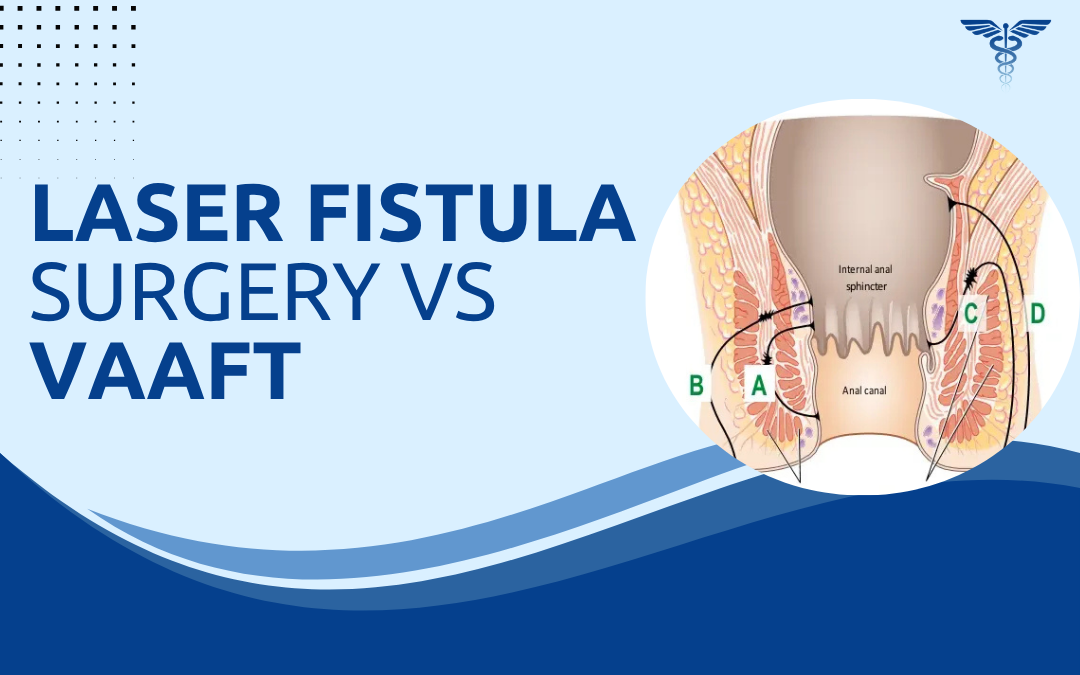
VAAFT has better results in comparative data. Network meta-analysis across 3,520 patients shows VAAFT failure rate at 22.3 percent versus 43.9 percent for laser fistula closure. Both are sphincter-sparing, both preserve continence, and both are day-care procedures. The difference is in how they work. Laser ablates the tract thermally. VAAFT uses a miniature endoscope to visualise the entire tract, identify secondary branches, and close the internal opening under direct camera view. That visualisation advantage is what drives the outcome difference.
According to Dr. Rajeev Premnath, one of the best proctologist in Bangalore, “Laser fistula closure works well for simple single-tract fistulas. VAAFT’s advantage is direct visualisation. When there are secondary tracts that imaging didn’t fully capture, VAAFT finds them and closes them. That’s where laser treatment fails and VAAFT doesn’t.”
How Do Laser Fistula Surgery and VAAFT Compare?
Same sphincter-sparing category, different mechanisms and different success rates across fistula complexity levels.
|
Feature |
Laser (FiLaC) |
VAAFT |
|
Mechanism |
Thermal ablation |
Camera-guided closure |
|
Failure rate |
43.9% |
22.3% |
|
Secondary tract detection |
No |
Yes |
|
Continence impact |
None |
None |
- Mechanism: Laser inserts a radial fibre into the tract and ablates it thermally. VAAFT passes a miniature fistuloscope through the tract, visualises secondary branches under direct view, and closes the internal opening with a stapler or suture.
- Failure rates: VAAFT failure was 22.3 percent and laser failure was 43.9 percent in a network meta-analysis of 3,520 patients across 49 studies. Laser has the highest failure rate of the four main sphincter-sparing procedures.
- Secondary tract detection: Laser treats the primary tract only. It misses secondary branches not captured on pre-operative imaging. VAAFT identifies and closes secondary tracts intraoperatively, which is the key advantage in complex and recurrent cases.
- Continence: Neither procedure causes continence disturbance. Zero incontinence was reported for both in the meta-analysis data. This is the primary advantage both share over conventional fistulotomy for high tracts.
Procedure selection determines outcome more than surgical skill alone in fistula surgery. A clinical assessment for fistula treatment confirms which approach fits the tract anatomy.
When Is Each Procedure the Right Choice?
Tract anatomy, complexity, and prior treatment history drive the decision.
- VAAFT indications: Complex, high trans-sphincteric, horseshoe, and recurrent fistulas. Particularly where MRI showed branching or where previous treatment failed without a clear identified cause.
- Laser indications: Simple single-tract intersphincteric or low trans-sphincteric fistulas with no secondary branching on MRI. Short well-defined tracts where complexity needs to be minimised.
- Recurrent fistula: VAAFT is the stronger choice. Direct visualisation identifies residual tracts that caused the first treatment to fail. Repeating laser without finding the cause produces the same result.
- Combined approach: Some surgeons use VAAFT and laser together for complex cases. VAAFT provides visualisation, laser provides ablation. Early results show improved outcomes for high-complexity presentations.
When the first treatment failed, understanding why is the starting point before any repeat procedure. Our blog on the LIFT procedure covers another sphincter-saving option and how it compares across fistula types.
Why Choose Dr. Rajeev Premnath?
Dr. Rajeev Premnath performed Karnataka’s first VAAFT surgery for anal fistula, holds MBBS, MS (Gen Surg.), FRCS (Glasg.), FEBS, FICS, FACS, FIAGES, FMAS, and completed VAAFT and EPSiT training directly under Dr. Piercarlo Meinero in Italy. He has been managing simple and complex fistulas at Ramakrishna Super Speciality Hospital for over 20 years with VAAFT, LIFT, laser, and seton all available in the right clinical sequence.
Fistulas here get MRI-mapped before any procedure is selected. Tract anatomy drives the procedure choice, not a default technique applied to every presentation.
Complex fistula with previous failed treatment or multiple tracts on MRI?
FAQs
Which has better results, laser fistula surgery or VAAFT?
VAAFT is often considered more effective than laser fistula surgery, with a lower risk of treatment failure.
What is the difference between laser fistula surgery and VAAFT?
Laser ablates the tract thermally without visualisation. VAAFT uses a camera to map secondary tracts and close the internal opening directly.
Does laser fistula surgery or VAAFT affect continence?
Neither. Both are sphincter-sparing with zero continence disturbance reported in comparative outcome data.
Which fistula types suit VAAFT?
Complex, high trans-sphincteric, horseshoe, and recurrent fistulas where secondary tract visualisation changes the operative outcome.