

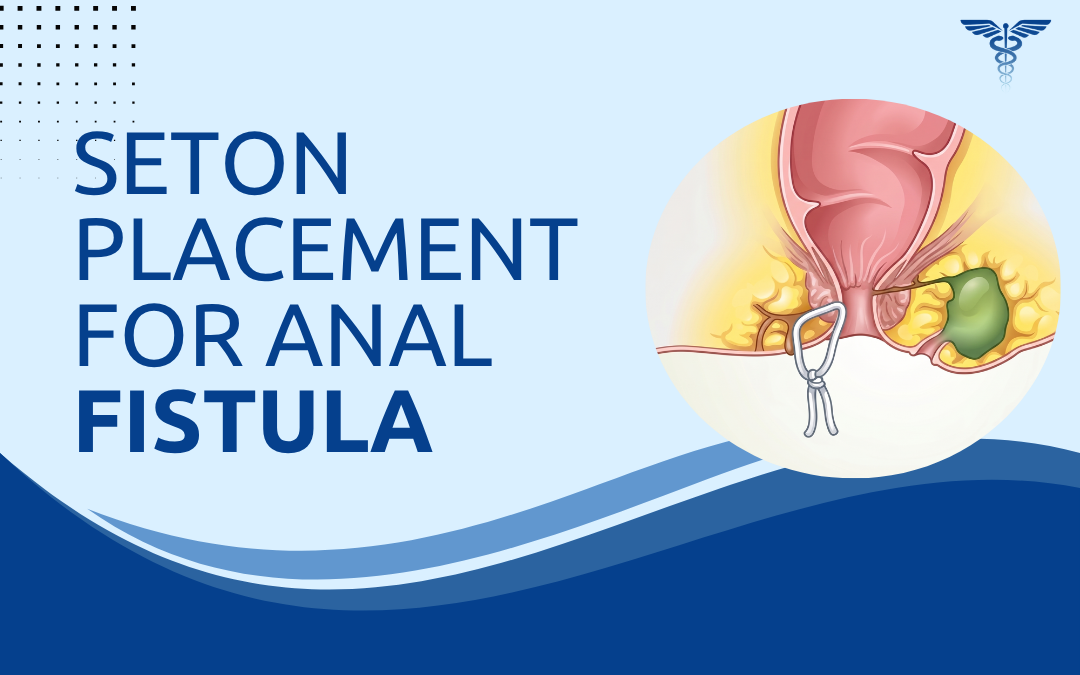
Seton placement for anal fistula is a surgical procedure where a piece of surgical thread, silicone loop or rubber band is passed through the fistula tract to keep it open and draining. It’s primarily used for complex, high or deep fistulas, particularly in Crohn’s disease, to promote continuous drainage and prevent abscess formation. The technique avoids cutting through the sphincter muscle in one stage, significantly reducing the risk of incontinence.
According to Dr. Rajeev Premnath, Proctologist in Bangalore, Setons buy time, the tract stays clean while we plan the definitive repair without risking sphincter damage.
How Does Seton Placement Actually Work?
The seton acts as a controlled drain sitting inside the tract, gradually encouraging the body to deposit scar tissue around the fistula walls.
- Threading: A silicone vessel loop or silk suture gets passed through the entire tract from internal opening to external opening under anaesthesia, and the two ends are tied loosely outside the skin
- Drainage: Because the loop keeps the tract open, pus and infected fluid drain continuously instead of collecting into a painful abscess that would need emergency incision
- Fibrosis: Over weeks the body deposits scar tissue around the seton and that fibrosis anchors the sphincter fibres so they don’t retract when the tract is eventually laid open
- Staging: Some complex tracts need the seton left in for 8 to 12 weeks before a second procedure, and honestly that timeline depends entirely on how your tissue responds
Staged management reduces sphincter injury risk significantly compared to single-stage fistulotomy for high tracts. Learn more about fistula treatment options for complex cases.
When Do Surgeons Recommend Seton Placement?
Not every fistula needs a seton. Simple low tracts get laid open in one sitting. But certain clinical situations make staged drainage the only safe first move.
- High tracts: When the fistula passes through more than 30% of the external sphincter a direct fistulotomy would risk permanent incontinence and no surgeon wants to trade one problem for a worse one
- Recurrence: Patients who’ve had failed surgery before often have distorted anatomy and a seton lets the surgeon properly reassess the tract before committing to a definitive repair
- Active sepsis: If there’s an undrained collection or significant inflammation the seton controls infection first so definitive surgery happens on healthier tissue, similar to how fissure treatment also prioritizes tissue healing before surgical intervention
- Crohn’s disease: Fistulas in Crohn’s patients behave unpredictably and a draining seton can stay in for months while medical therapy brings the inflammation under control
The choice between cutting seton and draining seton depends on tract complexity and how much sphincter sits between the openings. Read more about why fistula recurrence happens after surgery.
Why Choose Dr. Rajeev Premnath?
Dr. Rajeev Premnath is a general and laparoscopic surgeon with over 20 years of experience and international training in minimal access surgery from IRCAD, France. He performed Karnataka’s first VAAFT surgery for anal fistula and routinely manages complex, recurrent and high fistula cases that other surgeons refer out.
His patients consistently report less post-operative pain and faster return to normal routine. And that matters when you’re the one dealing with a tract that won’t close and wondering whether the next surgery will actually work.
Fistula draining for weeks with no sign of closing?
FAQs
What is a seton in fistula surgery?
A thread placed through the fistula tract to drain infection gradually.
How long does a seton stay in place?
Typically 8 to 12 weeks depending on healing response.
Is seton placement painful?
Mild discomfort occurs but most patients manage with basic pain relief.
Can a fistula heal with seton alone?
Some simple fistulas heal but complex ones usually need a second procedure.