

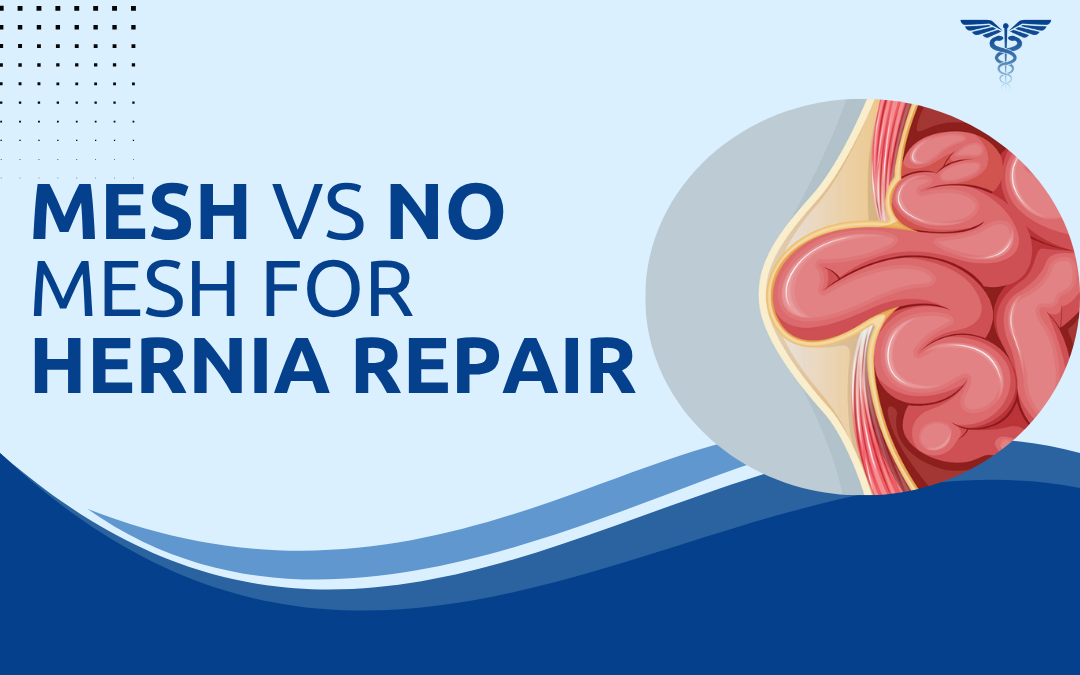
Mesh is better for most hernias. It reinforces the fascial defect rather than pulling weakened tissue together under tension, reducing recurrence rates from eight to fifteen percent with suture repair down to one to three percent with mesh. Mesh doesn’t fail on its own. Poor fixation, early loading, or wound infection disrupt the integration process and that’s what causes recurrence. For most adult hernias, mesh is the current standard of care.
According to Dr. Rajeev Premnath, a trusted Hernia Specialist in Bangalore, “Most patients who come in asking about non-mesh repair are worried about mesh complications they’ve read about online. The evidence is clear that mesh gives significantly lower recurrence with no increase in serious complications when technique is correct and the right mesh is used for the defect.”
How Does Mesh Repair Compare to Suture-Only Repair?
Different approaches, different outcomes, different indications. Mesh is not just a preference, it’s backed by the evidence on recurrence.
|
Feature |
Mesh Repair |
No Mesh Repair |
|
Recurrence rate |
1 to 3% |
8 to 15% |
|
Mechanism |
Reinforces defect |
Closes under tension |
|
Best suited for |
Most adult hernias |
Contaminated field, children |
|
Chronic pain |
Similar or lower |
Similar |
- Recurrence: Mesh repair reduces hernia recurrence by 50 to 75 percent compared to suture-only repair. The difference becomes more pronounced over five years, making long-term outcomes significantly better with mesh.
- Mechanism: Suture repair closes the defect by pulling weakened tissue edges together under tension. Mesh bridges the defect without tension, distributing load across a larger reinforced area. Tension is what drives recurrence in suture repair.
- Pain profile: Chronic pain rates are similar or lower after mesh repair compared to suture repair. The common belief that mesh causes more pain isn’t supported by the evidence. Age under forty is a stronger predictor of chronic post-operative pain than mesh presence.
- Complication profile: Seroma, haematoma, and wound infection rates are similar between mesh and non-mesh repair. Mesh-specific complications such as migration and chronic mesh pain are uncommon with modern lightweight mesh and correct fixation technique.
Mesh is the standard for adult inguinal, ventral, umbilical, and incisional hernia repair. A proper assessment for hernia surgery confirms which approach and mesh type fits the specific defect.
When Is Hernia Repair Done Without Mesh?
Mesh is the default. Specific clinical situations change that calculation.
- Contaminated field: Active infection or bowel involvement at the time of surgery make mesh placement high risk. Synthetic mesh in a contaminated field significantly increases infection and mesh explantation risk. Primary suture repair or biological mesh are the options in this situation.
- Paediatric hernias: Children’s inguinal hernias are indirect and involve a patent processus vaginalis, not a true fascial defect. High ligation of the sac is the correct repair. Mesh is not indicated and is not used in children’s hernia repair.
- Small primary defects: Very small primary umbilical hernias under 1cm in patients with low BMI and no risk factors for recurrence may be closed primarily with suture. Mesh significantly reduces recurrence even at small defect sizes but the absolute risk difference is smaller for tiny defects in low-risk patients.
- Patient-specific factors: Mesh allergy, prior mesh infection, or anatomical constraints that make mesh fixation unreliable in a specific patient’s case are assessed individually. These situations are uncommon. Most patients requesting non-mesh repair on preference alone get counselled on the recurrence data before a final decision is made.
Non-mesh repair is appropriate when the clinical picture specifically indicates it. Our blog on hernia repair covers how repair approach affects recovery and discharge planning for hernia patients.
Why Choose Dr. Rajeev Premnath?
Dr. Rajeev Premnath completed fellowship training in laparoscopy from IRCAD France and SILS certification from NUH Singapore, and holds MBBS, MS (Gen Surg.), FRCS (Glasg.), FEBS, FICS, FACS, FIAGES, FMAS. He has been performing laparoscopic and open mesh hernia repair across all hernia types at Ramakrishna Super Speciality Hospital for over 20 years, including recurrent, complex, and high-risk presentations where mesh selection and fixation technique directly determine the outcome.
Mesh type, fixation method, and defect geometry are assessed for every patient before any operative plan is confirmed. Non-mesh repair is used when the clinical picture specifically supports it, not as a default response to patient preference.
Diagnosed with a hernia and unsure whether mesh repair is right for you?
FAQs
Is mesh better than no mesh for hernia repair?
Yes for most hernias. Mesh reduces recurrence to one to three percent versus eight to fifteen percent with suture repair.
When is hernia repair done without mesh?
In contaminated fields, paediatric hernias, very small primary defects, and specific patient anatomical situations.
What are the risks of mesh in hernia repair?
Mesh infection, migration, seroma, and chronic pain are possible but uncommon with modern lightweight mesh and correct technique.
Can hernia recur after mesh repair?
Yes but rarely. Recurrence occurs in one to three percent and is usually caused by poor fixation or early physical loading.