


A horseshoe fistula is an anal fistula where infection spreads from a posterior midline abscess around the sphincter, forming a curved tract with multiple openings. It’s one of the most complex anal fistulas because the deep perianal spaces are involved and the sphincter sits directly in the path of infection.
As Dr. Rajeev Premnath, General and Laparoscopic Surgeon in Bangalore, explains: “A horseshoe fistula is a different anatomical problem. The infection starts in the deep postanal space and tracks around both sides through the ischiorectal fossae. If you drain the external openings without addressing the primary tract, it comes straight back. The key is opening the deep postanal space, dealing with the primary source, and draining the lateral extensions — without dividing the sphincter unnecessarily.”
What Is a Horseshoe Fistula and How Does It Form?
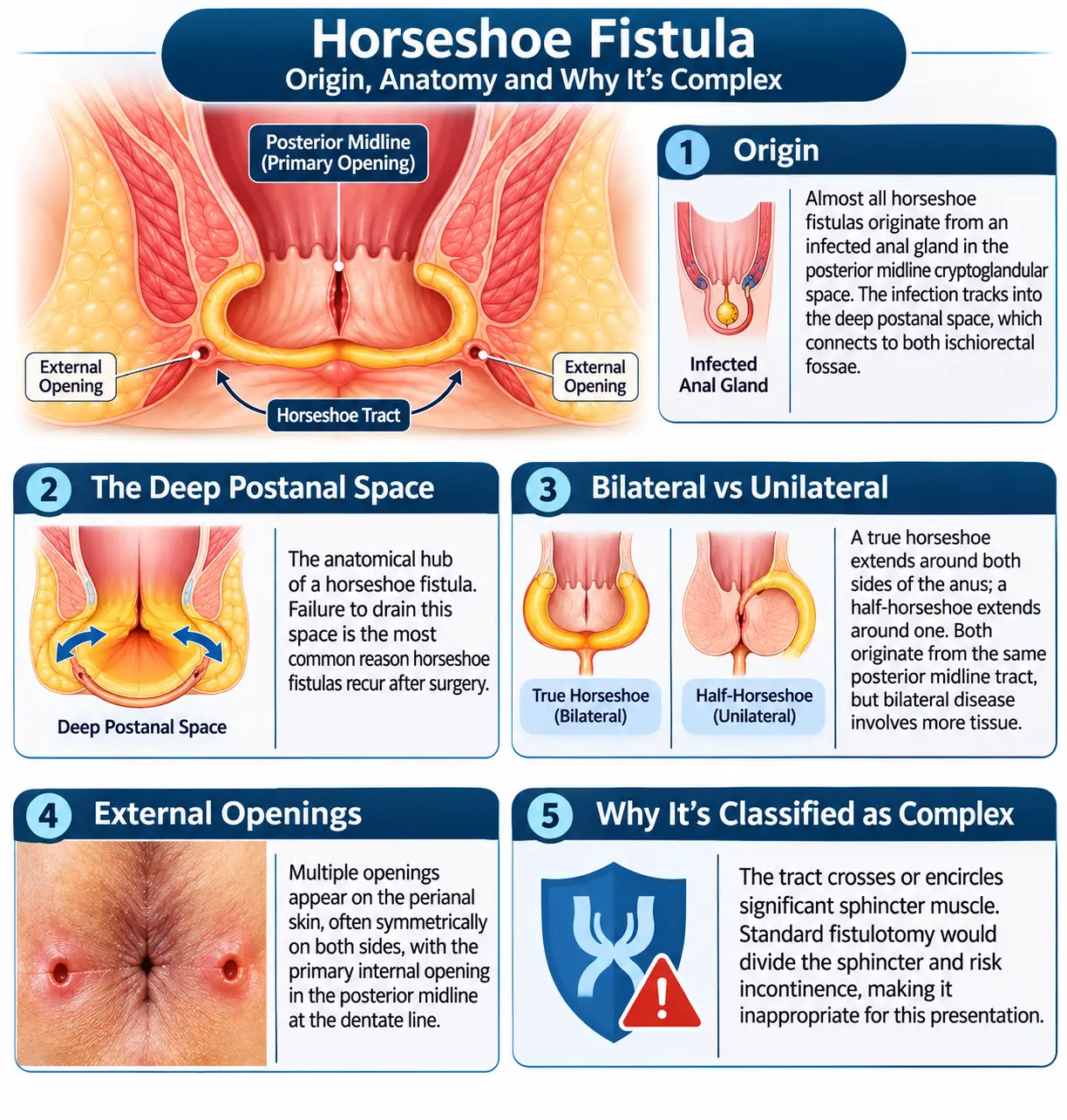
For a full overview of fistula types and treatment, our fistula treatment section covers what a full workup involves.
How Is a Horseshoe Fistula Diagnosed and What Does Treatment Involve?
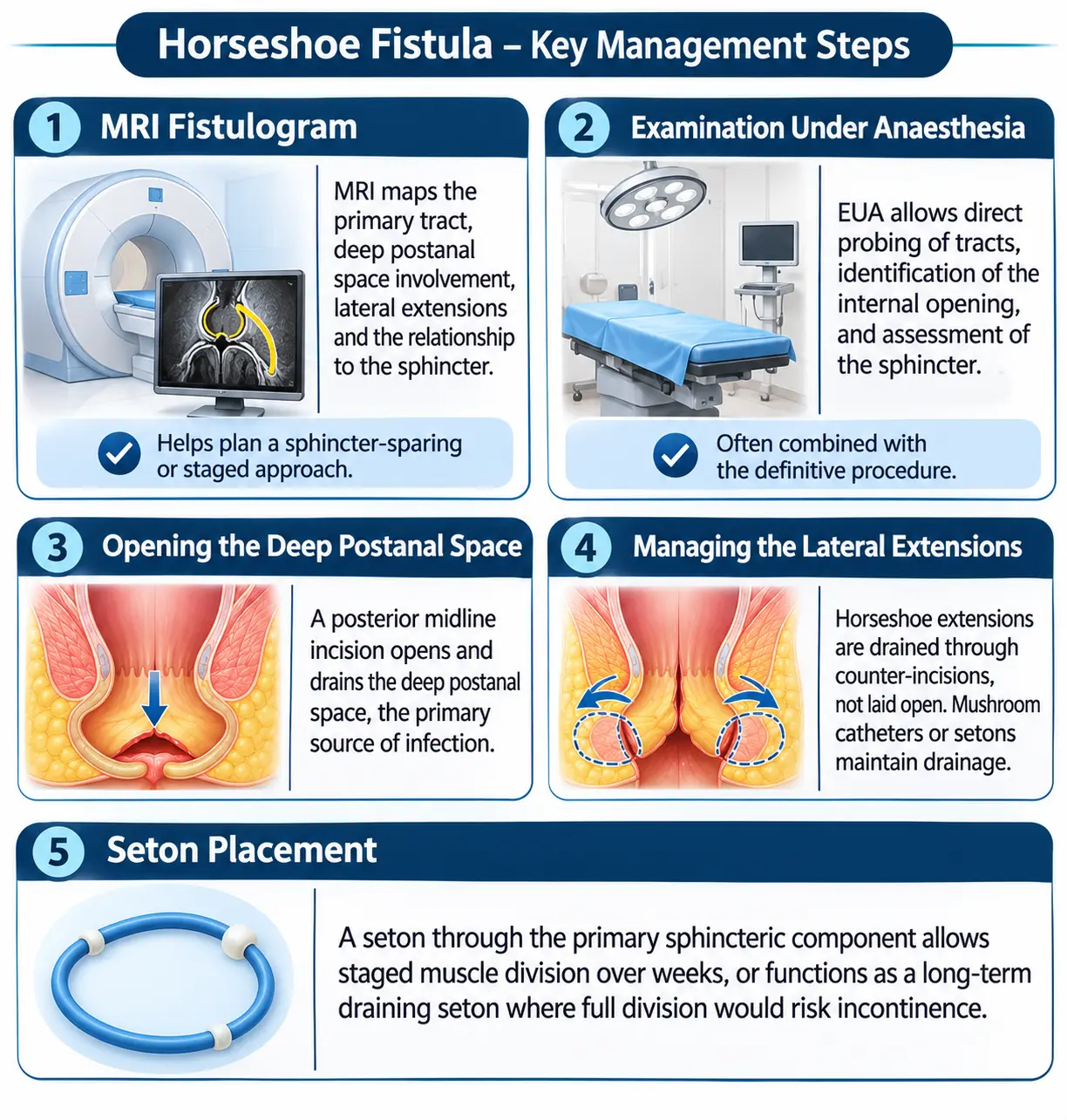
For what fistula surgery recovery involves week by week, our blog on VAAFT fistula surgery recovery gives a detailed post-operative guide.
What Determines the Right Treatment Approach?
- Bilateral vs Unilateral Disease: Bilateral horseshoe fistula requires bilateral counter-incisions alongside central posterior drainage. Unilateral disease needs only one lateral counter-incision, a simpler procedure, with reduced wound burden.
- Degree of Sphincter Involvement: A tract below the sphincter can be laid open safely. One that traverses or encircles significant muscle needs a sphincter-preserving approach seton, LIFT, or advancement flap once drainage is established.
- Continence Baseline: Pre-operative continence is assessed formally before surgery. Any posterior midline procedure carries a risk of altered continence, particularly in older patients or those with pre-existing sphincter weakness.
- Staged Approach: Most horseshoe fistulas are managed in stages. The first operation establishes drainage. Definitive management of the primary tract follows weeks to months later once acute infection has resolved.
- Recurrence: Horseshoe fistulas recur more often than simpler fistulas. The most common cause is failure to address the deep postanal space. Recurrent disease warrants a second MRI, and EUA before further surgery is planned.
Perianal discharge from multiple openings around the anus?
FAQs
What makes a horseshoe fistula different from other fistulas?
It wraps around the sphincter from a posterior midline primary tract, involves deep perianal spaces on both sides, and has multiple external openings. Standard fistulotomy would divide the sphincter and cause incontinence.
Can a horseshoe fistula be cured?
Yes, but it usually requires staged surgery and careful sphincter preservation. Recurrence rates are higher than for simple fistulas, particularly if the deep postanal space is not adequately drained.
How many operations does a horseshoe fistula need?
Usually at least two. The first establishes drainage and treats the deep postanal space. The second addresses the primary tract definitively once infection has settled.
Is incontinence a risk after horseshoe fistula surgery?
Yes. Because the tract involves the sphincter complex, there is a real risk of altered continence. Pre-operative assessment and sphincter-sparing techniques reduce but don’t eliminate this risk.