

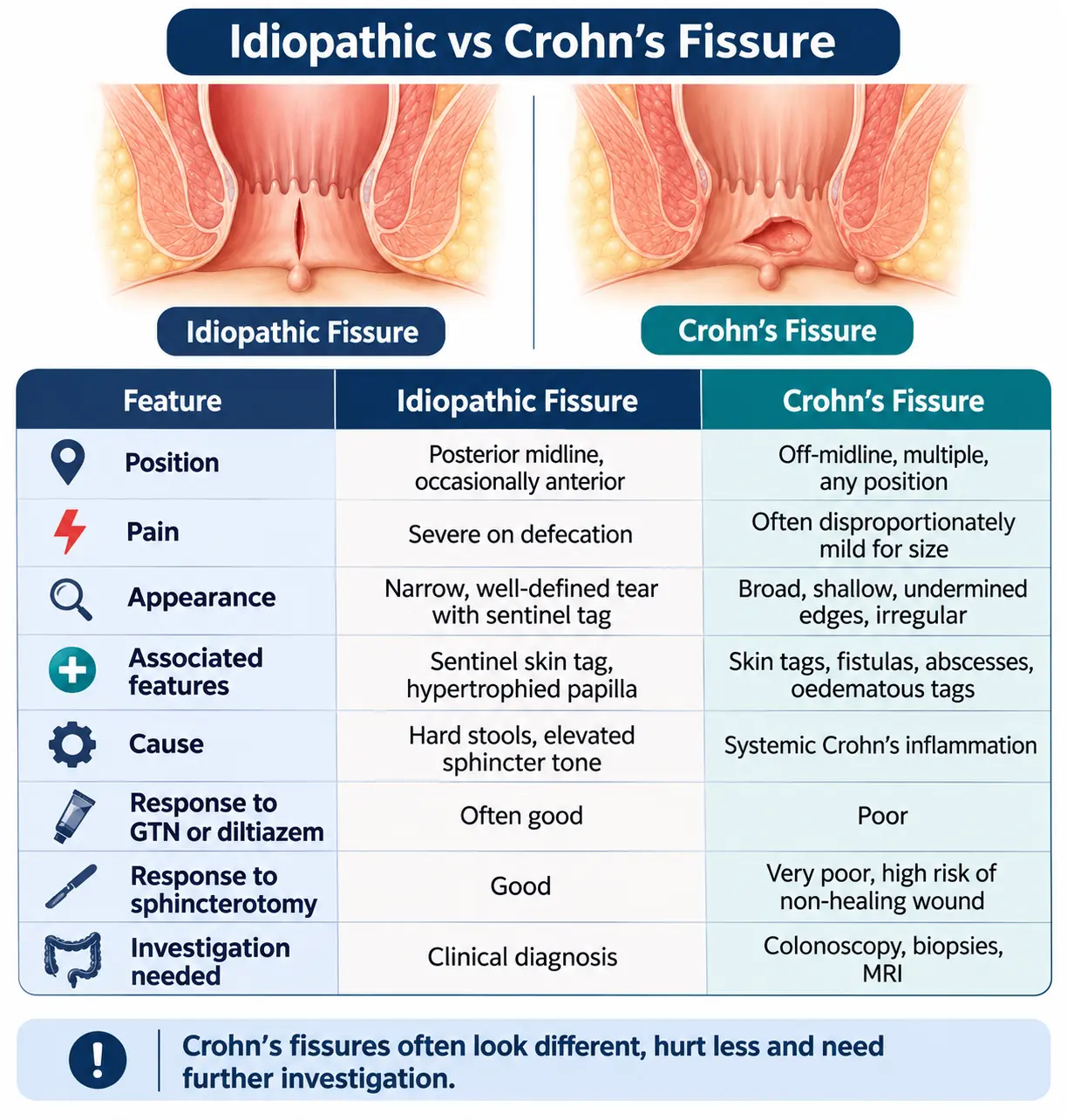
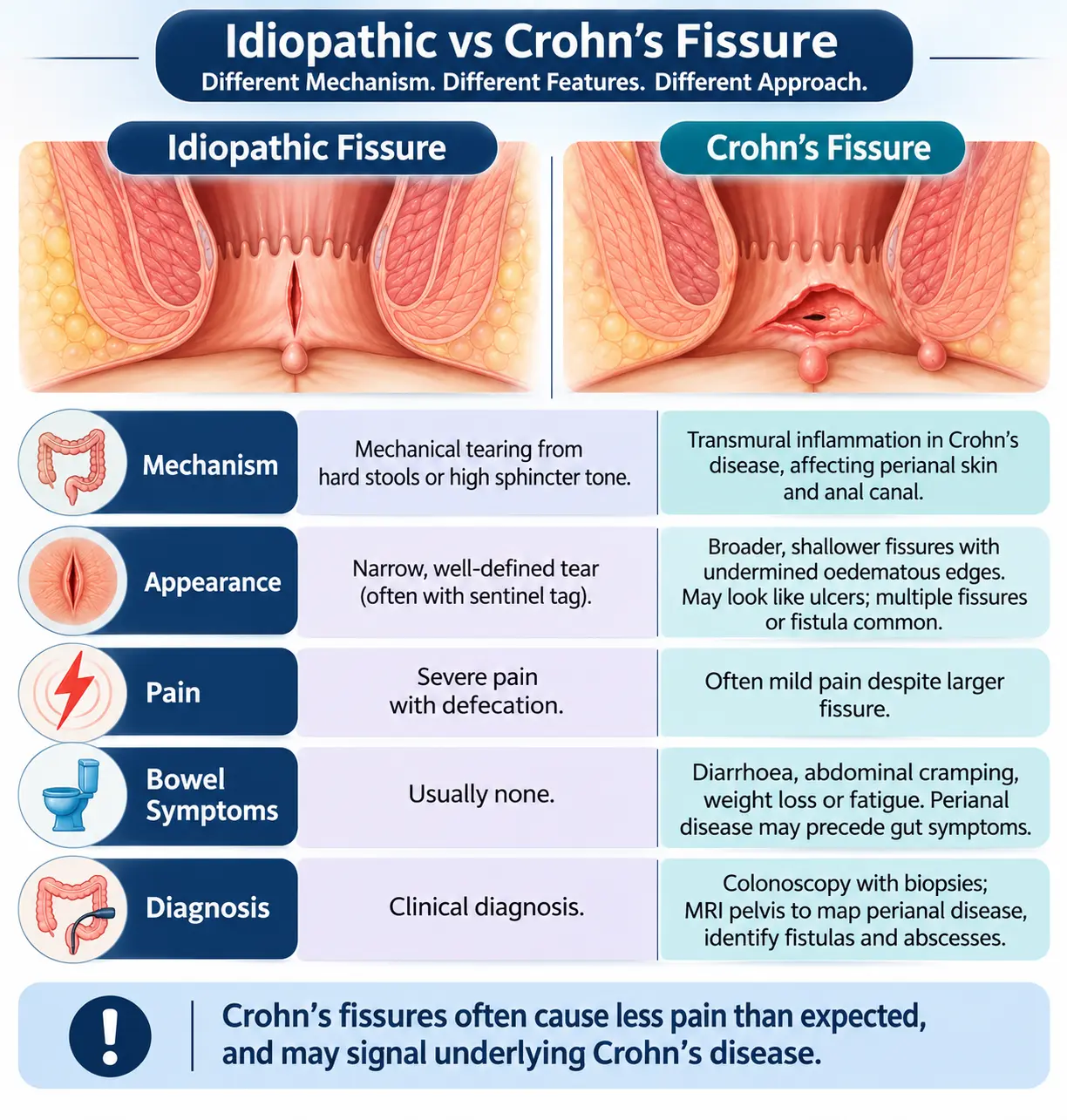
Anal fissures in Crohn’s disease are not the same as idiopathic anal fissures. An idiopathic fissure is a posterior or anterior midline tear driven by hard stools and elevated sphincter tone. A Crohn’s fissure is a manifestation of systemic inflammation, often off-midline, multiple, and painless relative to its size, frequently alongside skin tags, fistulas, and abscesses. Same name, different cause, different appearance, different treatment pathway entirely.
As Dr. Rajeev Premnath, General and Laparoscopic Surgeon in Bangalore, puts it: “An off-midline fissure that isn’t particularly painful, in a patient with any bowel symptoms, should trigger a Crohn’s workup before any local treatment is planned. Doing a lateral internal sphincterotomy on a Crohn’s fissure is one of the worst things you can do; the wound doesn’t heal, breaks down, and leaves a large non-healing perianal wound that’s very difficult to manage. Get the Crohn’s under control medically first.”
How Is a Crohn's Fissure Different From an Idiopathic Fissure?
For an overview of standard fissure treatment, our fissure treatment page covers what a full anorectal assessment involves.
Why Does Crohn's Disease Cause Anal Fissures and What Makes Them Different?
Our blog on can an anal fissure turn into a fistula is relevant for patients where a Crohn’s fissure has developed a fistulous complication alongside it.
What Determines the Right Treatment Approach?
- Medical Management First: Inducing and maintaining remission is the foundation. Biologics, particularly anti-TNF agents like infliximab and adalimumab, have significantly improved perianal disease outcomes including fissure healing.
- Topical Treatment: GTN and diltiazem offer limited evidence in Crohn’s fissures but are used for symptom relief alongside systemic therapy. They address sphincter tone, not the underlying inflammation.
- Avoid Sphincterotomy: Lateral internal sphincterotomy is contraindicated. Impaired wound healing from active inflammation turns a non-healing perianal wound into a significant management problem.
- Drain Acute Sepsis: Any abscess component needs surgical drainage. Definitive fistula repair is deferred until disease is controlled.
- Examination Under Anaesthesia: EUA allows full mapping of perianal disease, biopsy of atypical areas, drainage of occult sepsis, and seton placement all in one setting. A proctologist experienced in Crohn’s perianal disease is best placed to perform and interpret this accurately.
- Maintenance of Remission: Perianal disease can recur with disease flares even after healing. Long-term gastroenterology follow-up is part of the management plan, not an optional add-on.
Fissure that isn’t healing despite standard treatment?
FAQs
How do I know if my fissure is from Crohn's disease?
An off-midline position, multiple fissures, relatively mild pain for the size, irregular edges, or associated perianal skin tags and fistulas all suggest Crohn’s. A colonoscopy confirms it.
Can a Crohn's fissure be treated with the same creams as an ordinary fissure?
GTN and diltiazem give limited benefit because they target sphincter tone, not the inflammation driving a Crohn’s fissure. Systemic treatment of Crohn’s disease is what heals it.
Why is sphincterotomy dangerous in Crohn's disease?
Crohn’s impairs wound healing. A sphincterotomy wound in Crohn’s tissue often fails to heal and can result in a large, painful, non-healing perianal wound that is very difficult to manage.
Can perianal Crohn's disease appear before gut symptoms?
Yes. Perianal disease, including fissures, fistulas and skin tags, can precede intestinal Crohn’s symptoms by months or even years.