

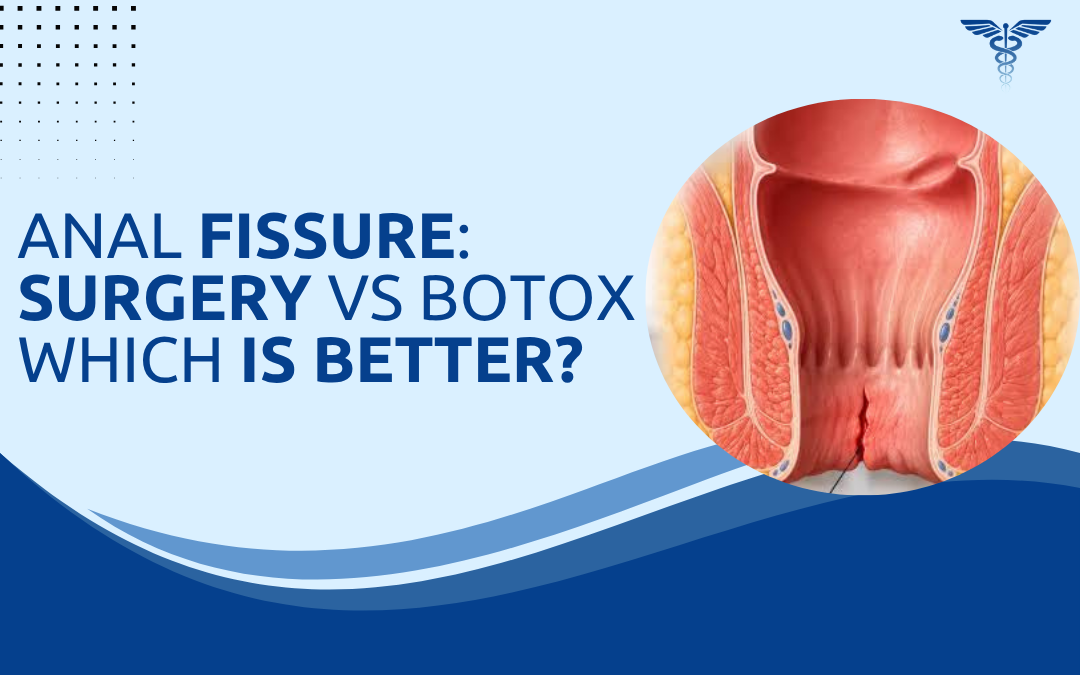
The right choice depends on fissure chronicity, sphincter status, and patient risk profile. Lateral internal sphincterotomy heals over 90% of chronic anal fissures but carries permanent continence risk. Botulinum toxin achieves 60–80% healing, is reversible, and is preferred when sphincter division carries meaningful risk. Both reduce elevated internal sphincter tone the difference is permanence, success rate, and complication profile.
According to Dr. Rajeev Premnath, a trusted piles specialist in Bangalore, “The question isn’t which one is better in the abstract it’s which one is better for this specific patient. A young healthy patient with no continence concerns gets a sphincterotomy and it’s almost certainly fixed in one procedure. A patient who’s had obstetric sphincter injury or previous anorectal surgery gets Botox first protecting continence is the priority. If it doesn’t work, sphincterotomy is still on the table.”
How Do Surgery and Botox Compare for Chronic Anal Fissure?
Both treatments target the same mechanism elevated internal sphincter tone but differ in how they achieve it, how long it lasts, and what happens if things don’t go as planned.
- Mechanism: Sphincterotomy permanently divides a portion of the internal sphincter. Botox temporarily paralyses it for 8–12 weeks long enough for the fissure to heal in most cases.
- Success rate: Sphincterotomy heals over 90% of cases after one procedure. Botox heals 60–80%, leaving a 20–40% chance of needing a second intervention.
- Continence risk: Sphincterotomy carries a 5–10% risk of permanent minor continence change. Botox carries no permanent risk any temporary change resolves as the effect wears off.
- Recovery: Botox is an outpatient injection with no wound and no restrictions. Sphincterotomy is a day-care procedure with 5–7 days of mild discomfort and return to desk work within 1–2 weeks.
The decision between Botox and surgery is made on clinical assessment, not patient preference alone. For the full range of fissure treatment options, visit ourfissure treatment page.
Who Should Choose Botox and Who Should Choose Surgery?
Patient selection determines the right sequence the clinical picture points clearly in most cases.
- Botox first: Patients with pre-existing sphincter weakness, prior obstetric injury, previous anorectal surgery, or IBD where any further sphincter reduction carries disproportionate continence risk.
- Sphincterotomy first: Young, healthy patients with no prior anorectal surgery, no continence concerns, and a clearly chronic fissure one procedure gives the highest chance of permanent cure.
- Failed Botox: Fissures that don’t heal after one or two injections, or recur promptly, indicate refractory sphincter tone sphincterotomy is the logical next step.
- Elderly patients: Age-related sphincter laxity makes Botox the safer choice regardless of fissure chronicity baseline function is already lower, making surgical continence risk outweigh its healing advantage.
The two treatments aren’t mutually exclusive Botox first, sphincterotomy if needed, is a standard sequential approach. Our blog on chronic vs acute anal fissure explains how chronicity determines which treatment is appropriate.
Why Choose Dr. Rajeev Premnath?
Dr. Rajeev Premnath is a General and Laparoscopic Surgeon with MBBS, MS (Gen Surg.), FRCS (Glasg.), FEBS, FICS, FACS, FIAGES, FMAS, and a Diploma in Laparoscopy from France, with over 20 years of experience in proctological surgery including lateral internal sphincterotomy and botulinum toxin injection for chronic anal fissure at Ramakrishna Super Speciality Hospital, Jayanagar, Bangalore.
Each fissure patient receives an individual assessment before any procedure is planned sphincter status, continence baseline, prior surgical history, and fissure chronicity all factor into whether Botox, sphincterotomy, or a sequential approach is recommended.
Chronic fissure not responding to topical treatment and exploring next steps?
FAQs
Is surgery or Botox better for chronic anal fissure?
Surgery has a higher success rate above 90% Botox is preferred when continence risk makes sphincter division unsafe.
How long does Botox last for anal fissure?
The effect lasts eight to twelve weeks enough for the fissure to heal in 60% to 80% of patients.
What is the risk of incontinence after fissure surgery?
A 5% to 10% risk of minor altered continence usually flatus incontinence rather than solid stool incontinence.
Can Botox be repeated if the fissure comes back?
Yes a second injection is an option, though persistent recurrence after Botox is a strong indication for sphincterotomy.