

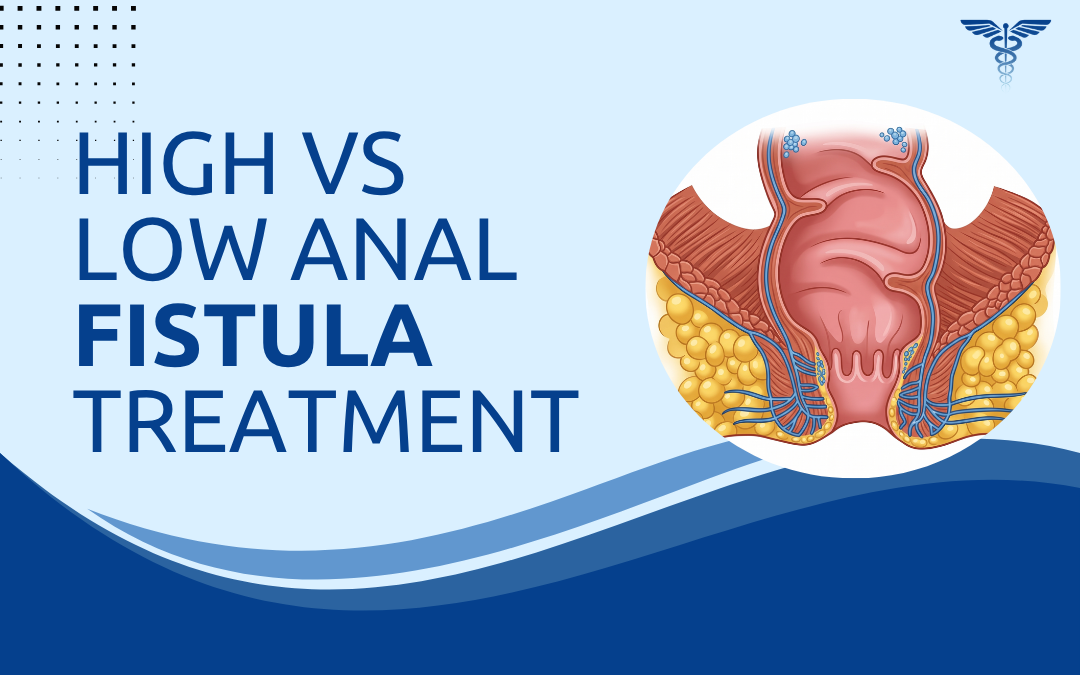
Low anal fistulas involving the lower third of the sphincter are generally treated with fistulotomy, a straightforward procedure that lays the tract open and carries success rates above 90%. High anal fistulas involving the upper two-thirds of the sphincter are more complex and require sphincter-sparing techniques like LIFT, seton placement, VAAFT or laser ablation to avoid permanent incontinence. The classification determines everything.
According to Dr. Rajeev Premnath, best proctologist in Bangalore, Getting the classification right before picking a technique is what separates a lasting result from a repeat surgery.
How Are Low Anal Fistulas Treated?
Low fistulas sit below the dentate line and involve minimal sphincter muscle, so treatment is more direct and recovery faster than most patients initially expect.
- Fistulotomy: The surgeon lays the tract open in one sitting and it heals from the base upward with success rates consistently above 90% for simple low tracts.
- Healing time: Three to four weeks for most patients because the wound stays shallow and sphincter damage is negligible, so continence isn’t a real concern here.
- Complications: Incontinence after fistulotomy for properly classified low tracts is uncommon, reported in fewer than 5% of cases where patient selection was done right.
- Recurrence: Low fistulas come back less often when the internal opening gets correctly identified and fully closed during the first procedure itself, something many patients don’t realise matters this much.
Outpatient fistulotomy remains the standard for uncomplicated low tracts with predictable timelines.
Early clinical assessment confirms the tract classification before deciding on fistula treatment.
What Makes High Anal Fistula Surgery More Complex?
High fistulas cross a significant chunk of the sphincter and a simple cut-through would risk permanent incontinence, so the surgical strategy changes entirely.
- Seton: A surgical thread placed through the tract gradually drains or cuts through muscle over several weeks, giving tissue time to heal in controlled stages rather than all at once and that patience is non-negotiable.
- VAAFT: Video-assisted treatment lets the surgeon visualise the entire tract from inside, destroy the lining under direct vision and close the internal opening without cutting muscle at all.
- LIFT: The tract gets accessed between the two sphincter layers, tied off and removed while both muscles stay completely intact, and this approach works well for patients who also need piles treatment when conditions overlap.
- Staged repair: Some high fistulas genuinely need more than one operation because branching is complex or infection hasn’t settled enough for definitive repair to hold.
No single technique works for every high fistula and the anatomy decides everything. Honestly, that’s the part most patients don’t hear until they’re already in the consultation room.
Understanding why fistula recurrence happens helps patients ask better questions before agreeing to a repeat procedure.
Why Choose Dr. Rajeev Premnath?
Dr. Rajeev Premnath performed Karnataka’s first VAAFT surgery for anal fistula and brings over 20 years of experience across general, laparoscopic and proctological procedures with international training from France, Germany and Singapore. He holds FRCS (Glasgow), FEBS, FACS, FIAGES and a Diploma in Laparoscopy from IRCAD France.
Patients with complex or recurrent fistulas get a proper MRI-correlated assessment before any surgical plan is finalised. That one step changes outcomes more than most people realise. Blunt truth.
Struggling with a fistula that keeps draining or recurring?
FAQs
Is fistulotomy safe for all types of anal fistula?
Fistulotomy is safe only for low fistulas with minimal sphincter involvement.
Can a low fistula turn into a high fistula?
Untreated or recurrent fistulas can extend deeper into the sphincter complex.
Which surgery is best for high anal fistula?
VAAFT and LIFT are preferred sphincter-sparing options for most high tracts.
How long does recovery take after high fistula surgery?
Recovery takes six to twelve weeks depending on technique and tract complexity.