

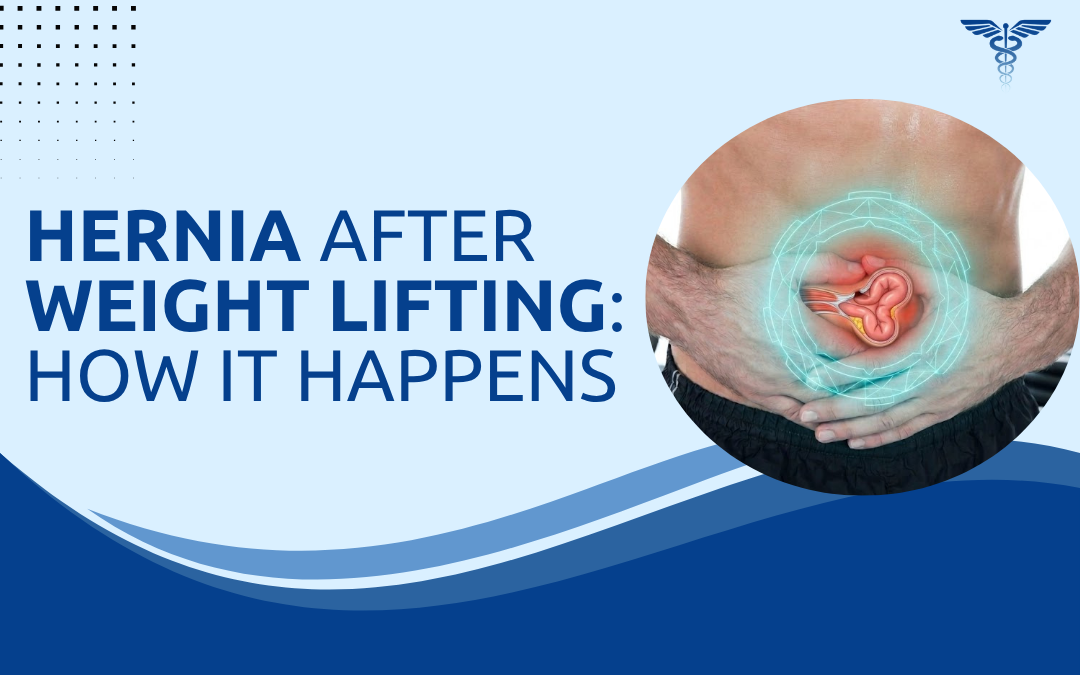
A hernia happens after weight lifting when high intra-abdominal pressure pushes intestines or fatty tissue through a weak spot in the abdominal wall. Repeated strain, often paired with poor lifting technique, gradually thins the muscle layers or causes a sudden tear during a heavy set. Risk factors include heavy compound lifts done with breath-holding errors, pre-existing fascial weakness, and rapid jumps in training volume before the deeper core catches up. Inguinal hernias make up nearly 75% of all hernia cases in active adult males.
According to Dr. Rajeev Premnath, hernia surgery in Bangalore, Most gym-related hernias aren’t from one bad lift. They show up after weeks of pressure on a wall that was already thinning, and patients only catch on once a bulge or pulling sensation appears.
What causes a hernia during heavy lifting?
Hernias don’t strike at random. They show up when abdominal pressure overwhelms a structurally weak patch of muscle wall.
- Pressure spike: Big compound lifts can push intra-abdominal pressure past 200 mmHg within seconds, way beyond what thinning fascia tolerates
- Wall weakness: Genetic predisposition, old surgical scars, or collagen breakdown with age leaves pockets where tissue gives way easily
- Wrong technique: Holding breath incorrectly through a max effort (improper Valsalva) traps pressure with nowhere to escape except the weakest tissue
- Volume creep: Loading up too fast without conditioning the deeper core means the supporting layers haven’t caught up to surface strength
Skip the bracing drills and the wall ends up paying. If the bulge stays reducible and painless, you’ve still caught it early. Specialist evaluation beats waiting it out, and a hernia specialist can confirm whether mesh repair or watchful monitoring fits your case.
Which Hernia Types Are Most Common in Lifters?
Lifters typically develop four specific hernia types, each tied to different anatomy and training patterns.
| Hernia Type | Location | Common Trigger in Lifters | Key Sign |
| Inguinal | Groin region | Heavy squats, deadlifts, Valsalva strain | Soft swelling that worsens with load, most common in male lifters |
| Umbilical | Near belly button | Weak transverse abdominis, post-pregnancy core laxity | Visible bulge at navel, often painless early on |
| Sports Hernia | Lower groin/inguinal floor | Twisting, sprinting, sudden directional loads | Sharp groin pain without a true bulge, technically a soft tissue tear |
| Incisional | Along old surgical scars | Resuming heavy training too soon post-op | Bulge or weakness at scar line during exertion |
Diagnosis: Clinical exam plus ultrasound typically confirms the type within minutes. A laparoscopic surgeon in Bangalore can distinguish a true hernia from a sports hernia, since the pain patterns overlap but the repair approach differs significantly.
For training-specific prevention strategies, our guide on preventing hernia covers load management tweaks that actually hold up long-term.
Why Choose Dr. Rajeev Premnath?
Dr. Rajeev Premnath brings over 20 years of operative experience as a General and Laparoscopic Surgeon, with international training from IRCAD France and the National University of Health Singapore. He performed Karnataka’s first VAAFT procedure and works extensively with 3D and bilayer mesh hernia repair, an approach that cuts recurrence in active patients.
Lifters need surgeons who get return-to-training timelines, not just the operation itself. Recovery plans here are built around your sport, not a generic discharge sheet.
Spotted a soft lump near your groin after deadlift day?
FAQs
Can weight lifting cause a hernia without prior weakness?
Rarely. Hernias almost always need a pre-existing weak spot that lifting then exploits.
How soon after a heavy lift does a hernia appear?
Most lifters notice a bulge or dragging sensation within hours to a few days post-session.
Is it safe to keep training with a small reducible hernia?
Continued lifting usually worsens the defect, so a surgical opinion before resuming heavy work is wise.
Does mesh repair allow return to weight lifting?
Yes, most patients return to full lifting around 6 to 8 weeks after laparoscopic mesh repair.