
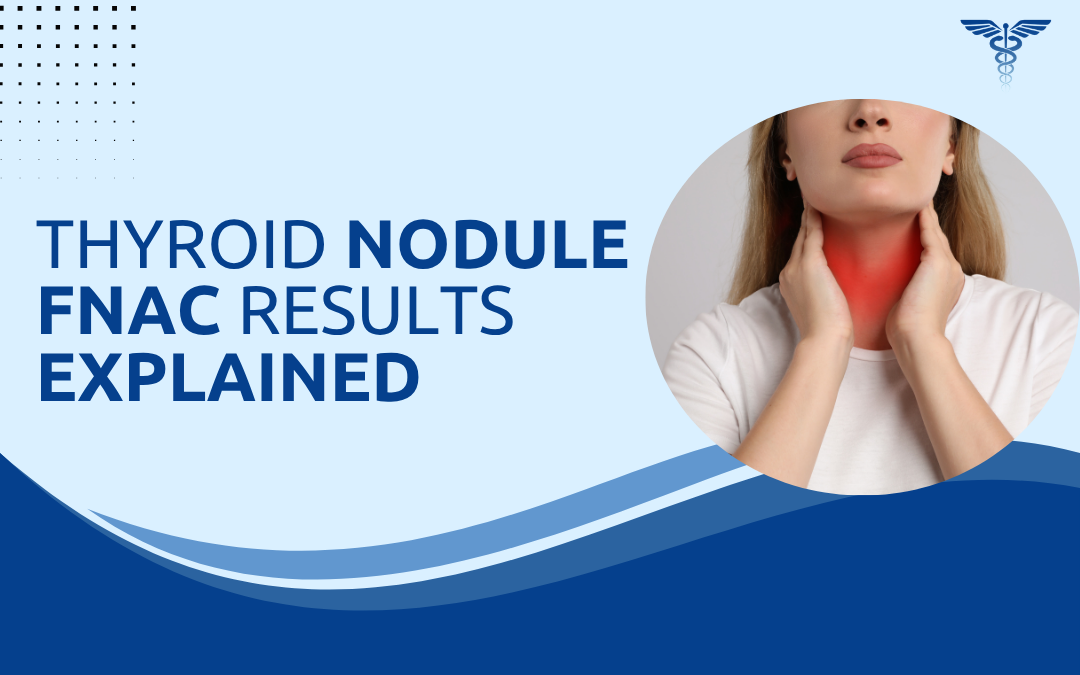
An FNAC thyroid report uses the Bethesda system six categories, each with a cancer risk and a clear next step. Bethesda I means the sample was inadequate and needs repeating. Bethesda II is benign. Bethesda III and IV sit in the indeterminate zone. Bethesda V is suspicious for malignancy. Bethesda VI confirms cancer. Most patients get the report without anyone explaining what the category actually means for them, and that’s the gap this blog fills.
According to Dr. Rajeev Premnath, General and Laparoscopic Surgeon, “A Bethesda III or IV result doesn’t mean cancer it means the cells don’t look clearly normal or clearly malignant, and a repeat test or diagnostic lobectomy is how that ambiguity gets resolved.”
What Does Each Bethesda Category on a Thyroid FNAC Report Mean?
The Bethesda system translates cytology findings into a standardised risk category. Six levels, each with a corresponding malignancy risk percentage and a defined management path.
- Bethesda I: Non-diagnostic: The sample didn’t contain enough thyroid cells to make a call, which happens in roughly 10 to 15 percent of FNACs, often with cystic or very small nodules. It just needs repeating under ultrasound guidance with better needle positioning.
- Bethesda II: Benign: Most reports land here, around 60 to 70 percent, with a cancer risk under 3 percent. A follow-up ultrasound in 12 to 24 months is all that’s needed unless the nodule grows or new symptoms appear.
- Bethesda III: Atypia of undetermined significance: Cells look slightly off but not clearly malignant, carrying a 10 to 30 percent cancer risk. This usually leads to a repeat FNAC, molecular testing, or a diagnostic lobectomy for a definitive answer.
- Bethesda IV: Follicular neoplasm: FNAC can’t distinguish a benign adenoma from a carcinoma here because capsular invasion only shows on the surgical specimen. A diagnostic lobectomy is almost always the recommended next step.
The Bethesda system doesn’t diagnose cancer. It stratifies risk so the right next step is matched to the right patient rather than everyone going straight to surgery. Thyroid Surgery: Minimally Invasive Solutions
What Happens After a Suspicious or Malignant Thyroid FNAC Result?
Bethesda V and VI carry the highest malignancy risk and move the clinical conversation from monitoring to surgical planning. But the type and extent of surgery depends on more than just the FNAC result.
- Bethesda V: Suspicious for malignancy: With a cancer risk of 60 to 75 percent, most surgeons recommend total thyroidectomy or a diagnostic lobectomy, with final surgical extent sometimes confirmed intraoperatively by frozen section.
- Bethesda VI: Malignant: Confirmed cancer on cytology, most commonly papillary thyroid carcinoma. Total thyroidectomy with or without central neck dissection proceeds based on tumour size, imaging findings and the patient’s overall picture.
- Ultrasound TI-RADS score matters: A Bethesda result never travels alone. A Bethesda III on a TI-RADS 2 ultrasound is managed very differently from the same result on a TI-RADS 5 nodule with microcalcifications and irregular margins.
- Molecular testing is shifting Bethesda III and IV decisions: Genomic classifiers like Afirma or ThyroSeq run on the FNAC sample and can reclassify indeterminate nodules with greater accuracy, reducing unnecessary surgery where the test is available.
A benign FNAC result doesn’t mean the nodule is permanently safe. Surveillance matters because nodule behaviour can change over time, especially in nodules above 2 cm. Patients whose results do point toward surgery can read about what day care thyroid surgery involves and whether same-day discharge applies to their case.
Why Choose Dr. Rajeev Premnath?
Dr. Rajeev Premnath has over 20 years of experience as a General and Laparoscopic Surgeon, holding MS (Gen Surg.), FRCS (Glasg), FEBS, FICS, FACS, FIAGES and FMAS, with international training at IRCAD France and the National University of Health, Singapore. He heads the Day Care Surgery Department at Ramakrishna Specialty Hospital, Bangalore, and regularly manages thyroid nodule evaluation and surgery, including indeterminate FNAC cases where the call between surveillance, repeat biopsy and diagnostic lobectomy needs careful judgment.
Patients who bring their FNAC report to a consultation here don’t get a generic referral letter. They get the Bethesda category explained, the ultrasound reviewed alongside it, and a clear answer on whether surgery is the right next step or not. That’s what makes the conversation useful.
Got your FNAC report and not sure what your Bethesda category means for next steps?
FAQs
What is the Bethesda system for thyroid FNAC?
It’s a six-category classification that assigns cancer risk to thyroid nodule cytology results and guides next steps.
Does a Bethesda III result mean I have thyroid cancer?
No, Bethesda III carries a 10 to 30 percent cancer risk and usually needs repeat FNAC or molecular testing first.
What happens after a Bethesda VI thyroid FNAC result?
Bethesda VI confirms malignancy and surgical planning for thyroidectomy begins, with extent decided by tumour features.
Can a benign FNAC result be wrong?
Yes, false negatives occur in roughly 3 percent of cases, which is why ultrasound surveillance continues even after a benign result.