
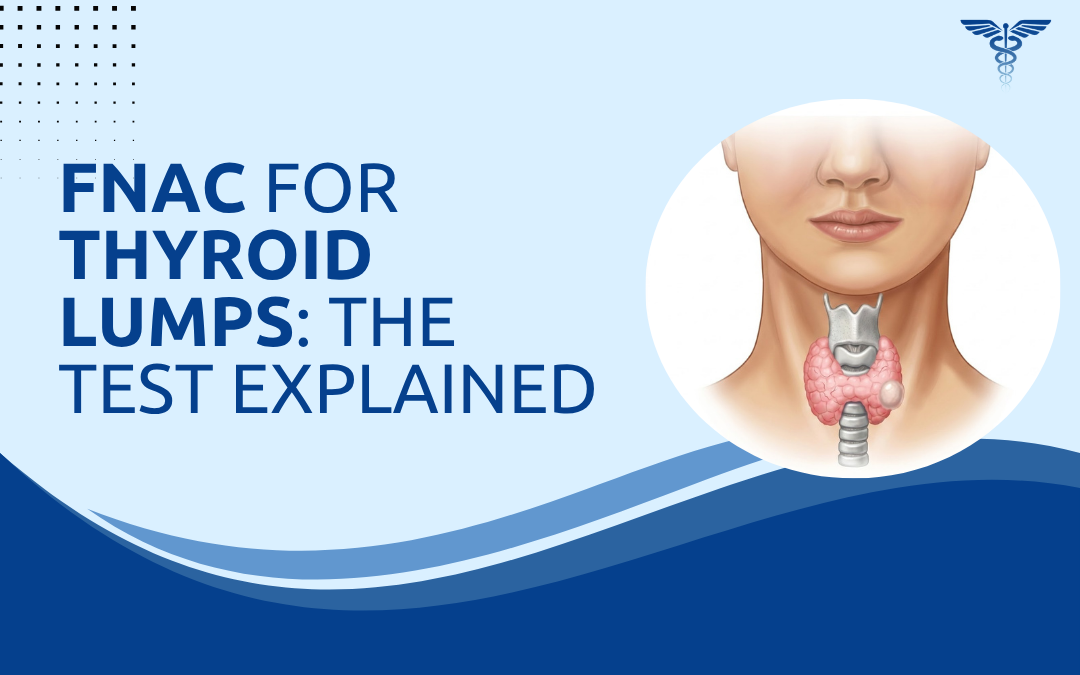
Fine Needle Aspiration Cytology (FNAC) for thyroid lumps is a quick, minimally invasive, outpatient procedure, often ultrasound-guided, that uses a thin needle to sample cells from a nodule to determine if it is benign or malignant. The procedure takes less than 20 minutes, usually requires no anaesthesia or just a local numbing agent, and allows patients to return home immediately.
According to Dr. Rajeev Premnath,general and laparoscopic surgeon in Bangalore, the test is far less uncomfortable than patients expect, and the cytology report typically settles 70 to 80 percent of cases without needing surgery at all.
How is FNAC for a thyroid nodule actually performed?
The procedure is brief and minimally invasive. Patients remain seated throughout, the test takes a few minutes, and the needle used is finer than a standard blood-draw needle.
- Positioning: patient lies flat, a small pillow goes under the shoulders so the neck tilts back a bit and the thyroid pushes forward where the needle can reach it cleanly
- Local cleaning: antiseptic over the skin, that’s the only prep, no sedation, no general anaesthesia, sometimes not even a local because the needle’s that fine
- Sampling: a 23 to 27 gauge needle goes in under live ultrasound view, two to four passes, each one pulling cells from a slightly different part of the lump for better yield
- Slide preparation: fluid gets smeared onto glass slides right there in the room, fixed quickly and sent off, where a cytopathologist reads them under microscope
Whole thing wraps in 10 to 15 minutes. Most people walk out without needing a band-aid. If the nodule’s been flagged TI-RADS 3 or higher on ultrasound, FNAC is what comes next before anyone starts talking thyroid surgery.
What does the FNAC report tell you, and what comes next?
The report comes back in something called Bethesda categories. Six of them. And whichever one your nodule lands in, that’s what shapes everything from there.
- Benign: Bethesda II is where most reports land, roughly 60 to 70 percent of them, meaning the nodule isn’t cancerous, and a follow-up scan in 12 to 24 months is the only ask
- Indeterminate: Bethesda III and IV sit in the grey zone, cells look slightly off but not clearly malignant, so a repeat FNAC, molecular testing or a general surgical evaluation figures out whether a diagnostic lobectomy makes sense
- Suspicious: Bethesda V means a 60 to 75 percent chance of cancer, and surgery usually goes ahead without waiting for further confirmation
- Malignant: Bethesda VI confirms thyroid cancer outright, and total thyroidectomy, sometimes with neck dissection, becomes the plan
After the FNAC itself? A bit of soreness for a few hours, maybe a small bruise, that’s about it. And for patients whose report does point toward surgery, day care thyroid surgery has changed how disruptive the whole process feels.
Why Choose Dr. Rajeev Premnath?
Dr. Rajeev Premnath brings over 20 years of experience as a General and Laparoscopic Surgeon, and heads Day Care Surgery at Ramakrishna Specialty Hospital. International training in minimal access surgery in France and Singapore. Same precision he’s known for in laparoscopic work, applied to thyroid evaluation.
What patients keep mentioning? How clearly he explains the FNAC report. No rush toward the operating room. Surgery only gets recommended when the cytology genuinely calls for it. That’s why so many cases end up resolved without anything beyond a simple follow-up.
Worried about a lump in the neck and unsure if it needs surgery?
FAQs
What is the most common reason for FNAC of the thyroid?
Suspicious thyroid nodules picked up on ultrasound, especially ones bigger than 1 cm with worrying features.
Is FNAC for thyroid painful?
About the same as a routine blood draw, and most patients get through it without any pain medication.
How long does the FNAC report take?
Cytology results are usually ready within 2 to 5 working days from when the sample’s taken.
Can FNAC miss thyroid cancer?
Ultrasound-guided FNAC sits at 95 to 97 percent accuracy, though rare false negatives can happen with very small or cystic nodules.