

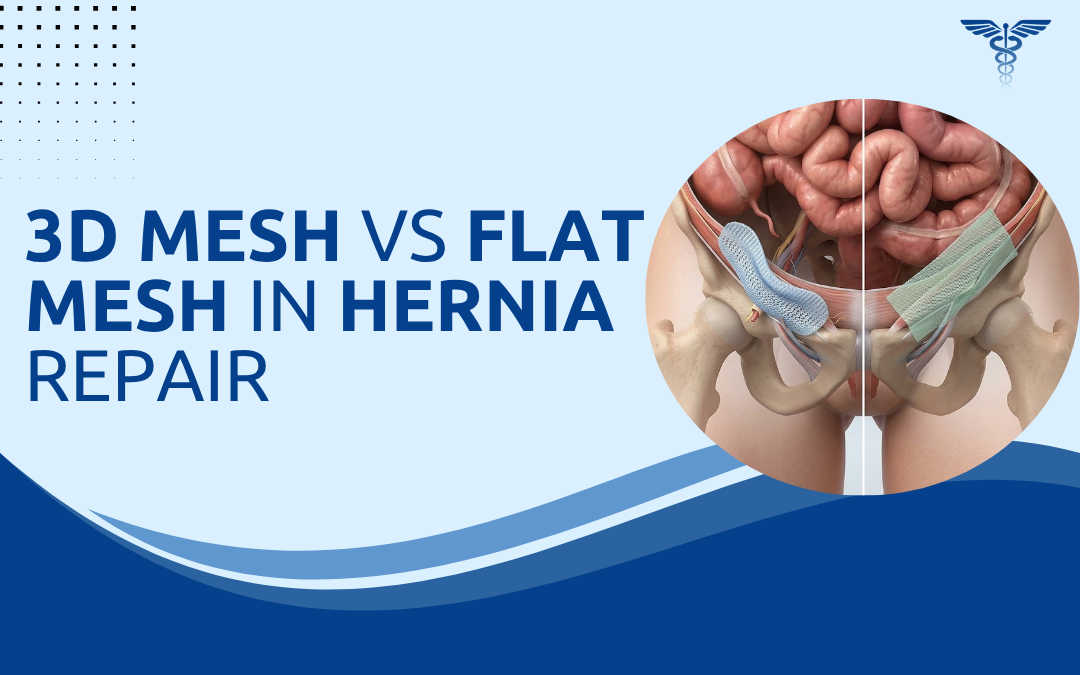
3D mesh generally works better than flat mesh in hernia repair because it lowers chronic pain risk, reduces complications and shortens recovery time. The contoured shape fits the inguinal anatomy without sutures or tacks, which limits mesh migration and prevents the wrinkle issues that flat mesh sometimes shows over months.
According to Dr. Rajeev Premnath, Hernia Specialist in Bangalore, In groin hernias the 3D bilayer mesh fits the anatomy without sutures in most cases, which reduces chronic post-op pain compared to a flat tack-fixed mesh.
How Are 3D Mesh and Flat Mesh Different in Hernia Repair?
3D mesh outperforms flat mesh on shape, fixation, layer coverage and tissue contact.
| Parameter | Flat Mesh | 3D Mesh |
| Shape | Single planar sheet, trimmed to size during surgery | Preformed with curved profile matching inguinal canal anatomy |
| Fixation | Requires tacks, sutures, or glue to stay in place | Self-fixing through contour grip on surrounding tissue |
| Layers | Covers defect from one side only | Bilayer design protects both preperitoneal and anterior planes simultaneously |
| Coverage | Can shrink or wrinkle over months | Maintains shape as tension distributes evenly across the dome contour |
| Tissue Contact | Limited contact, dependent on manual placement | Anatomical fit ensures consistent tissue contact across the repair zone |
These design differences shape post-op pain and how quickly patients walk again. It’s especially obvious during day care inguinal hernia surgery.
Skip the bracing drills and the wall ends up paying. If the bulge stays reducible and painless, you’ve still caught it early. Specialist evaluation beats waiting it out, and a hernia specialist can confirm whether mesh repair or watchful monitoring fits your case.
Which Mesh Type Gives Better Long-Term Results?
3D mesh delivers better long-term results across recurrence, chronic pain and recovery time. But context still matters.
- Recurrence: 3D bilayer mesh holds an edge in larger or recurrent inguinal defects where flat mesh tends to migrate, though both types report recurrence under 2% in trained hands
- Pain: Sutureless 3D mesh placement keeps chronic groin pain risk noticeably lower, while flat mesh fixed with metal tacks can push that figure toward 5 to 10%
- Healing: Patients with a 3D mesh often resume desk work in three to four days, whereas flat-mesh repairs may take longer if the case involved a high risk inguinal hernia surgery
- Cost: A 3D mesh costs more upfront, no question, but lower revision risk and shorter time off work usually balance that gap across the long run for most patients
Choosing between them isn’t one-size-fits-all and depends on hernia size, prior repairs and lifestyle, which is also covered in this guide on hernia prevention.
Why Choose Dr. Rajeev Premnath?
Dr. Rajeev Premnath is a General and Laparoscopic Surgeon with 20+ years of practice and Diploma-level laparoscopic training from IRCAD France. He performs both 3D and bilayer mesh hernia repair using techniques refined across centres in France, Italy and Germany.
Most patients walk out the same day, drive within a week and return to desk work inside four days. Recurrence in his recorded inguinal cases stays under 1%, even in larger or recurrent defects. That’s not marketing fluff, just outcomes worth checking.
Unsure which mesh fits your hernia type?
FAQs
Is 3D mesh always better than flat mesh?
Mostly yes, though flat mesh still works well for small primary inguinal defects.
Does 3D mesh cause less pain after surgery?
Yes, because it usually self-fixes without sutures or metal tacks pressing nerves.
How long does mesh hernia repair take to heal?
Most patients resume desk work in three to four days and full activity in three weeks.
Can 3D mesh be used in laparoscopic hernia surgery?
Yes, contoured 3D and bilayer meshes are routinely used in laparoscopic and open inguinal repairs.