

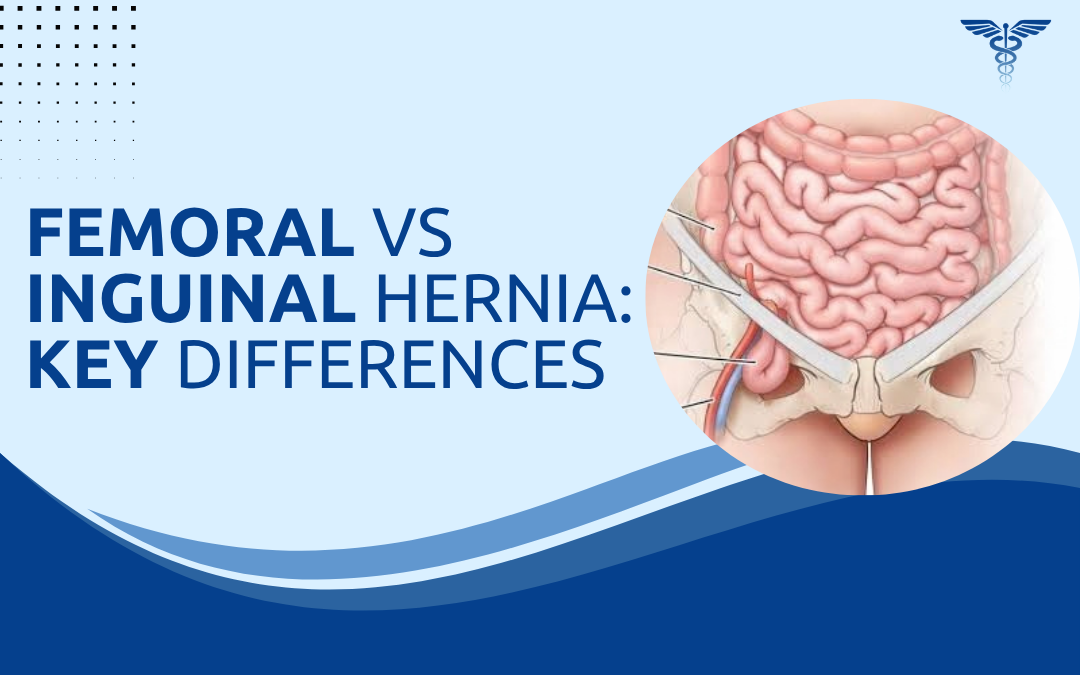
Femoral and inguinal hernias both appear near the groin but aren’t the same condition. Inguinal hernias push through the inguinal canal above the groin crease common, predominantly in men. Femoral hernias push through the femoral canal below the pubic tubercle less common, more frequent in women, and significantly more dangerous due to higher strangulation risk. Both require surgery. Femoral hernias require it more urgently.
According to Dr. Rajeev Premnath, a trusted General and Laparoscopic Surgeon in Bangalore, “The clinical distinction matters because the risk profile is completely different. An inguinal hernia in a young healthy man can often be observed if small and asymptomatic. A femoral hernia should almost never be observed the strangulation risk is high enough that elective repair is recommended as soon as the diagnosis is confirmed. Missing a femoral hernia and calling it an inguinal is a real diagnostic error because the repair approach and urgency are different.”
How Do Femoral and Inguinal Hernias Differ in Presentation and Risk?
Accurate diagnosis determines both urgency and operative approach.
|
Feature |
Inguinal Hernia |
Femoral Hernia |
|
Location |
Above the inguinal ligament groin bulge, may extend into the scrotum |
Below the inguinal ligament small bulge in the upper inner thigh, often mistaken for a lymph node |
|
Who gets it |
Predominantly men wider inguinal canal and persistent processus vaginalis |
More common in women wider femoral ring relative to body size |
|
Strangulation risk |
Approximately 3% over ten years more room for contents to expand |
Up to 40% rigid femoral canal leaves no room, bowel loses blood supply rapidly |
|
Diagnosis |
Identified clinically above the ligament, reducible, cough impulse present |
Smaller, less reducible, frequently confirmed on ultrasound |
For the full range of hernia repair options, visit our hernia surgery section.
How Are Femoral and Inguinal Hernias Treated Differently?
- Repair urgency: Inguinal hernia repair is elective for most asymptomatic patients. Femoral hernia repair is recommended promptly after diagnosis; watchful waiting is inappropriate given the strangulation risk.
- Laparoscopic repair: TAPP or TEP covers both inguinal and femoral defects through the same preperitoneal approach with a single large mesh, making laparoscopic repair particularly advantageous for femoral hernias.
- Open repair: Lichtenstein repair is standard for inguinal hernias. Open femoral repair requires a different incision and approach, making it technically more demanding.
- Emergency repair: A strangulated femoral hernia requires emergency surgery bowel resection if ischaemia has occurred with higher complication rates than elective repair.
Femoral hernias found incidentally should be repaired without delay. Our blog on femoral vs inguinal hernia covers the anatomical and clinical distinctions in further detail.
Why Choose Dr. Rajeev Premnath?
Dr. Rajeev Premnath is a General and Laparoscopic Surgeon with MBBS, MS (Gen Surg.), FRCS (Glasg.), FEBS, FICS, FACS, FIAGES, FMAS, and a Diploma in Laparoscopy from France, with over 20 years of experience in laparoscopic and open inguinal and femoral hernia repair at Ramakrishna Super Speciality Hospital, Jayanagar, Bangalore.
Every groin hernia is assessed individually before repair is planned hernia type, defect size, strangulation risk, and patient fitness all determine whether laparoscopic or open repair is the right approach, and femoral hernias are treated with the urgency their strangulation risk demands.
Groin swelling or pain and unsure whether it’s a hernia and which type?
FAQs
What is the difference between femoral and inguinal hernia?
Inguinal hernias emerge above the groin crease through the inguinal canal. Femoral hernias emerge below it through the femoral canal and carry a much higher strangulation risk.
Which is more dangerous, femoral or inguinal hernia?
Femoral hernia strangulation rates reach up to 40% versus approximately 3% for inguinal hernias over ten years.
Can femoral hernia be watched without surgery?
No the strangulation risk makes elective repair the recommendation as soon as the diagnosis is confirmed, regardless of symptoms.
Is the surgery different for femoral versus inguinal hernia?
Laparoscopic repair covers both with the same mesh open repair requires different incisions and approaches for each type.