

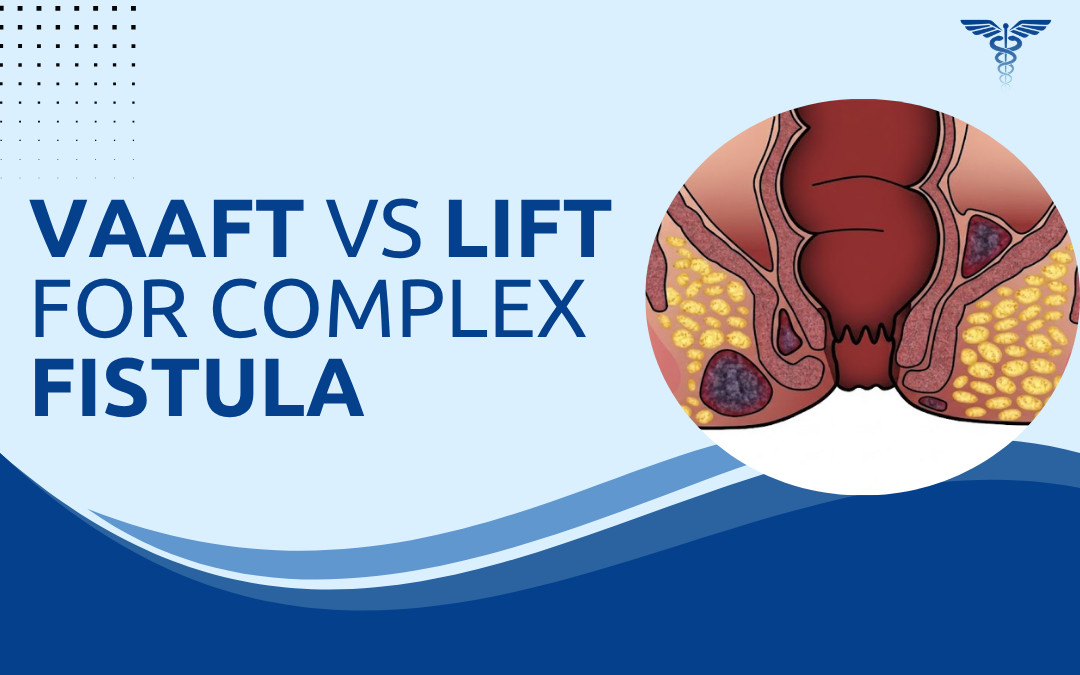
VAAFT and LIFT are both sphincter-sparing techniques for complex anal fistula. Neither is universally better; VAAFT holds a slight edge in failure rates, LIFT in simplicity and cost. Direct comparative studies show no significant differences in continence outcomes, pain scores, or recurrence. The choice comes down to fistula anatomy, abscess presence, and surgeon experience.
According to Dr. Rajeev Premnath, a trusted General and Laparoscopic Surgeon, “Patients often ask me to just tell them which one is better, and the honest answer is that the published data doesn’t support a clear winner. What I look at is the fistula’s specific anatomy, whether there’s an abscess alongside it, how many tracts are involved, whether it’s been operated on before. That’s what actually points toward LIFT or VAAFT for a given patient, more than a general ranking between the two.”
VAAFT vs LIFT: How Do They Compare?
|
Factor |
LIFT |
VAAFT |
|
Approach |
Ties off and divides the tract through the intersphincteric space, between the internal and external sphincter |
Uses a fistuloscope inserted into the tract to visualise it directly and cauterise it from within |
|
Reported failure rate |
28.6% (range 3.8–75% across studies) |
22.3% (range 6.2–65.2% across studies) |
|
Continence disturbance |
1.5% of patients |
No cases reported in the same pooled analysis |
|
Minor complication rate |
4.3% |
7.2% |
|
Typical follow-up in studies |
35 months |
32 months |
|
Best suited for |
Well-defined single transsphincteric tracts without active abscess |
Complex or branching tracts, and cases with an associated abscess needing internal drainage |
|
Equipment and cost |
Simpler instrumentation, generally lower cost |
Requires a dedicated fistuloscope and video equipment, generally higher cost |
Pooled data across dozens of studies shows wide individual variation. A direct single-centre comparison in high transsphincteric fistulas including those with an abscess present found no significant differences between LIFT and VAAFT in continence scores, pain scores, or fistula outcomes over 18 months. On a population level, both techniques land in a similar range. Understanding what makes a fistula complex number of tracts, height, and branching determines which technique fits a specific case.
What Should Actually Influence the Choice Between VAAFT and LIFT?
-
Beyond the headline numbers, several practical factors tend to matter more than the average success rate when choosing between the two.
- Presence of an associated abscess: VAAFT allows direct visualisation and drainage of any abscess cavity connected to the tract during the same procedure, which can make it the more practical choice when infection is active at the time of surgery.
- Tract complexity and branching: VAAFT’s internal camera view can identify secondary tracts or branches that might otherwise be missed, while LIFT is generally best suited to a single, well-defined transsphincteric tract without significant branching.
- Fistula type and recurrence history: Horseshoe fistulas and a history of previous failed fistula surgery have specifically been identified as risk factors for LIFT failure, which may tip the decision toward VAAFT or a different technique in these situations.
- Repeatability if the first attempt fails: VAAFT’s low complication profile means it can reasonably be repeated if the first attempt doesn’t fully close the tract, which is a meaningful practical consideration given that neither technique guarantees success on the first try.
Neither technique should be chosen purely on a general success-rate comparison the anatomy of the individual fistula matters more than the average outcome across a mixed population of patients. Our blog onCan High Anal Fistula Be Treated Without Cutting? covers the broader category of sphincter-sparing options, including where LIFT and VAAFT fit alongside FiLaC and advancement flap.
Why Choose Dr. Rajeev Premnath?
Dr. Rajeev Premnath is a General and Laparoscopic Surgeon with MBBS, MS (Gen Surg.), FRCS (Glasg.), FEBS, FICS, FACS, FIAGES, FMAS, and a Diploma in Laparoscopy from France. He has been managing complex anal fistulas at Ramakrishna Super Speciality Hospital for over 20 years, with hands-on experience in both LIFT and VAAFT, selecting between them based on individual fistula anatomy rather than defaulting to whichever technique is more familiar.
Patients being evaluated for complex fistula here undergo detailed pre-operative assessment of tract anatomy, branching, and any associated abscess, so the recommendation between VAAFT, LIFT, or another sphincter-sparing option is based on their specific case rather than a general preference.
Diagnosed with a complex anal fistula and weighing your options?
FAQs
Is VAAFT better than LIFT for complex anal fistula?
Neither is clearly superior overall. VAAFT shows a slightly lower average failure rate in pooled data, but direct comparative studies show no significant difference in continence or pain outcomes between the two.
Which technique is better when an abscess is present alongside the fistula?
VAAFT allows direct visualisation and drainage of an associated abscess during the same procedure, which often makes it the more practical choice in this specific situation.
Does LIFT or VAAFT carry a higher risk of incontinence?
Both carry a low risk. Pooled data shows a continence disturbance rate of around 1.5% for LIFT, while VAAFT reported no cases of worsening continence in the same analysis, though sample sizes and follow-up vary between studies.
Can VAAFT or LIFT be repeated if the first attempt fails?
Yes. Both techniques have low complication rates, which generally allows a repeat attempt, or a switch to a different sphincter-sparing technique, if the first procedure does not fully close the fistula.
References:
- Failure rates and complications of four sphincter-sparing techniques for the treatment of fistula-in-ano: a systematic review and network meta-analysis. NIH National Library of Medicine, PMC, 2025.
- Lift and VAAFT for high trans-sphincteric anal fistula: a single center retrospective analysis. PubMed, 2020.