

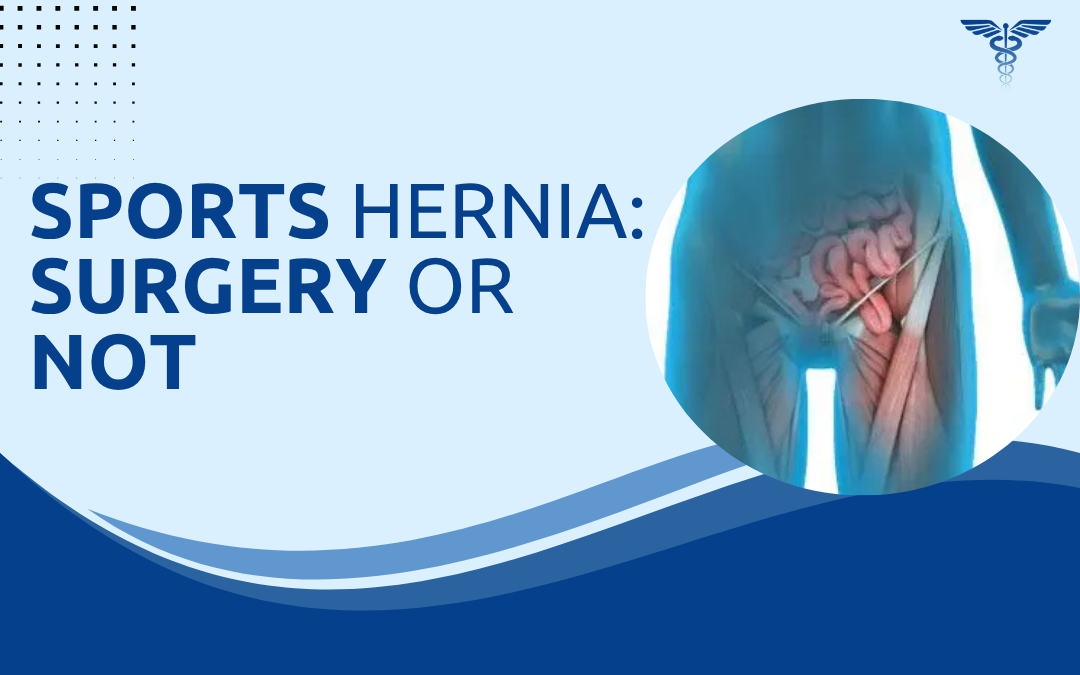
A sports hernia is not a true hernia. No organ protrudes; instead, muscles, tendons, or aponeurotic structures of the lower abdomen and groin tear, most often at the rectus abdominis or adductor longus attachment to the pubic bone. Rest alone does not reknit torn tissue, and returning to high-demand activity without rehabilitation or repair guarantees recurrence. The clinical question is whether six to eight weeks of conservative management restores sufficient function, or whether surgical repair is needed to achieve that outcome.
According to Dr. Rajeev Premnath, a trusted Hernia Specialist in Bangalore, “A sports hernia is a soft tissue failure under load. Rest takes the load away temporarily but does not fix the tissue. Patients who come back to training too soon after just resting find themselves back at square one within weeks. The injury needs active rehabilitation, and when that fails, the repair needs to be done properly so the athlete can actually return to their sport.”
Why Does a Sports Hernia Not Heal With Rest Alone?
The torn aponeurotic and musculotendinous structures in athletic pubalgia are exposed to high shear forces with nearly every movement, making passive healing unreliable without structured rehabilitation or repair.
- Load dependency: The lower abdominal and adductor attachments at the pubic symphysis remain under continuous tension during walking, rising from a chair, and coughing. Even activity restriction does not produce the offloading that allows tendon injuries elsewhere to heal passively.
- Tissue type: Tendons and aponeurotic tissue have poor blood supply compared with muscle belly injuries, slowing the reparative response. This explains why sports hernias that improve with rest reliably recur once sport-specific loading resumes.
- Core instability: The injury reflects an imbalance between hip adductor and lower abdominal forces. Without correcting that imbalance through targeted rehabilitation, the mechanical environment that caused the tear remains unchanged.
- Symptom masking: Anti-inflammatory medications and corticosteroid injections reduce pain effectively enough that athletes mistake reduced symptoms for recovery, reloading tissue that has not regained the structural integrity needed for sport-specific forces.
Conservative management over six to eight weeks with structured core and adductor rehabilitation is the accepted first-line treatment, but surgical repair should be considered when that programme fails. A thorough pre-operative assessment for hernia surgery identifies suitable candidates for operative repair after conservative failure.
When Does a Sports Hernia Require Surgery?
Surgery is indicated when structured conservative management has not restored the athlete to pain-free sport-level activity.
- Conservative failure: Patients who complete six to twelve weeks of targeted rehabilitation without sufficient recovery are appropriate candidates for surgical repair, which addresses the weakened posterior inguinal wall or torn aponeurotic attachment that physiotherapy cannot reconstruct.
- Return to sport rates: Surgical repair produces return-to-sport rates consistently above 90% across elite athletic populations, including professional football, basketball, and soccer players, making it one of the more reliable outcomes in sports medicine.
- Repair type: Both open and laparoscopic approaches are used. Laparoscopic repair offers reduced tissue trauma, earlier mobilisation, and lower wound complication rates, advantages that apply equally here as in conventional day care inguinal hernia surgery.
- Adductor involvement: When adductor longus pathology coexists with posterior wall weakness, an adductor tenotomy performed at the time of repair addresses the tension imbalance directly and reduces recurrent groin pain risk after return to sport.
Surgical repair followed by structured post-operative rehabilitation is the definitive pathway when conservative management fails, and outcomes in properly selected patients are reliably good. Our blog on Mesh vs No Mesh for Hernia Repair covers how mesh reinforcement principles apply to posterior wall weakness in this context.
Why Choose Dr. Rajeev Premnath?
Dr. Rajeev Premnath is a General and Laparoscopic Surgeon with MBBS, MS (Gen Surg.), FRCS (Glasg.), FEBS, FICS, FACS, FIAGES, FMAS, and a Diploma in Laparoscopy from France. He has been managing inguinal and groin pathology including athletic pubalgia at Ramakrishna Super Speciality Hospital for over 20 years, with expertise in both open and laparoscopic posterior wall repair for patients who have failed conservative management and require surgical restoration of groin function.
Patients presenting with sports hernia here are assessed for the specific anatomical injury posterior wall weakness, aponeurotic plate tear, adductor involvement before a treatment pathway is decided. Conservative management is supported where it has a realistic chance of success. Surgery is offered when it does not.
Groin pain that worsens with sport, kicking, or sprinting?
FAQs
Can a sports hernia heal without surgery?
A sports hernia does not heal with rest alone, but structured conservative management over six to eight weeks resolves symptoms sufficiently for return to sport in a proportion of patients. Surgery is indicated when that programme fails.
What is the difference between a sports hernia and a regular hernia?
A sports hernia involves tearing of soft tissue structures at the pubic attachment without an actual protrusion of abdominal contents. A regular hernia involves organs or tissue pushing through a fascial defect and is visible or palpable as a bulge.
How long does sports hernia recovery take without surgery?
Conservative management typically takes six to eight weeks before meaningful functional recovery. Many patients who respond do so within this window; those who do not are candidates for surgical assessment.
Can a sports hernia come back after surgery?
Recurrence is possible, particularly when adductor involvement was not addressed at the time of repair or when the patient returns to sport before the repair has fully healed. The recurrence rate after properly performed repair is low.