

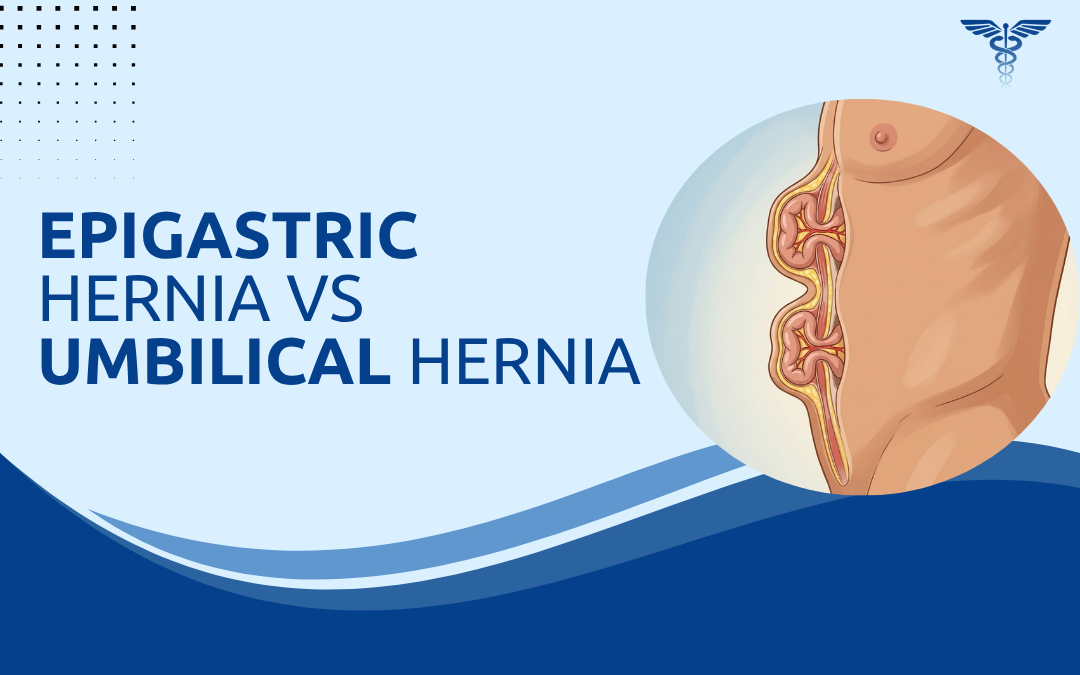
Yes, epigastric hernias are different from umbilical hernias primarily in their location. Epigastric hernias occur in the upper abdomen between the navel and breastbone, whereas umbilical hernias occur directly at the belly button. Both result from abdominal wall weakness but differ in typical location, repair necessity, and developmental origin. And the mesh choice. And the recurrence pattern too.
According to Dr. Rajeev Premnath, hernia surgery in Bangalore, Two midline bulges, two completely different repairs. Mix them up and you’re looking at a redo, which honestly happens more than people think in second opinions.
How Do Epigastric and Umbilical Hernias Differ in Cause and Presentation?
Both sit on the midline, but the underlying anatomy, triggers, and risks tell two very different stories.
| Epigastric Hernia | Umbilical Hernia |
| Location: Between breastbone and navel, anywhere along the upper midline | Location: Fixed at the belly button, doesn’t shift position |
| Cause: Thinned linea alba from years of straining, lifting, or chronic constipation | Cause: Incomplete closure of umbilical ring at birth, or fascia stretched by pregnancy and weight gain |
| Symptoms: Small sore lump, pain on bending, coughing, or after large meals | Symptoms: Larger soft bulge, visible at navel, dragging sensation that persists |
| Content: Mostly preperitoneal fat, rarely anything else | Content: Fat or bowel loops, raising real strangulation risk |
| Strangulation Risk: Low, due to fat-only content | Strangulation Risk: Higher, especially when bowel is involved |
| Typical Patient: Adult lifters, manual workers, chronic strainers | Typical Patient: Infants, post-pregnancy women, obese adults |
Two separate defects, two separate stories. Pinpointing which one you have changes everything before anyone discusseshernia surgery.
Is the surgical treatment for epigastric and umbilical hernias the same?
Not entirely. Closing the defect remains the shared principle. The technique, however, shifts based on size, body habitus, and recurrence risk.
- Open repair: Small epigastric defects under 2 cm are typically closed with a suture or small mesh patch through a single incision. Tiny umbilical hernias in slim patients are managed the same way.
- Laparoscopic repair: Larger defects, recurrent hernias, and complex presentations are addressed through minimally invasive laparoscopic surgery using IPOM or eTEP, with mesh placed behind the muscle for durable reinforcement.
- Mesh choice: A 3D bilayer mesh is well suited for umbilical hernias due to the round, predictable defect. Epigastric hernias often require a flat onlay or sublay mesh sized to the linea alba gap identified intraoperatively.
- Recovery: Both approaches are performed as day care procedures. Patients ambulate the same evening, return to desk work within a week, and resume heavy lifting after four weeks without exception.
The core principle overlaps across techniques. The mesh fixation strategy, however, often determines the difference between a durable repair and a recurrence. For lifestyle measures that reduce recurrence risk, refer to how to prevent hernia.
Why Choose Dr. Rajeev Premnath?
Dr. Rajeev Premnath is a senior general and laparoscopic surgeon with over 20 years of operating experience and international training from IRCAD France and the National University of Health, Singapore. Specialised in 3D and bilayer mesh hernia repair, the kind of technique that genuinely cuts recurrence and shortens recovery. Not just talk. Read more about Dr. Rajeev Premnath and his credentials.
Patients keep saying the same things. Less pain, home the same evening, back at work in a week. No upselling, no over-treatment, just the right surgery for the actual defect on the table.
Got a tender lump above your belly button that flares up when you cough?
FAQs
Can an epigastric hernia turn into an umbilical hernia?
No, they’re separate defects in different parts of the abdominal wall.
Which hernia is more common in adults?
Umbilical hernias are more common in adults, especially after pregnancy or weight gain.
Do small epigastric hernias always need surgery?
Surgery is recommended once symptoms appear or the bulge enlarges.
How long is recovery after laparoscopic hernia repair?
Most patients resume light work within 5 to 7 days.