

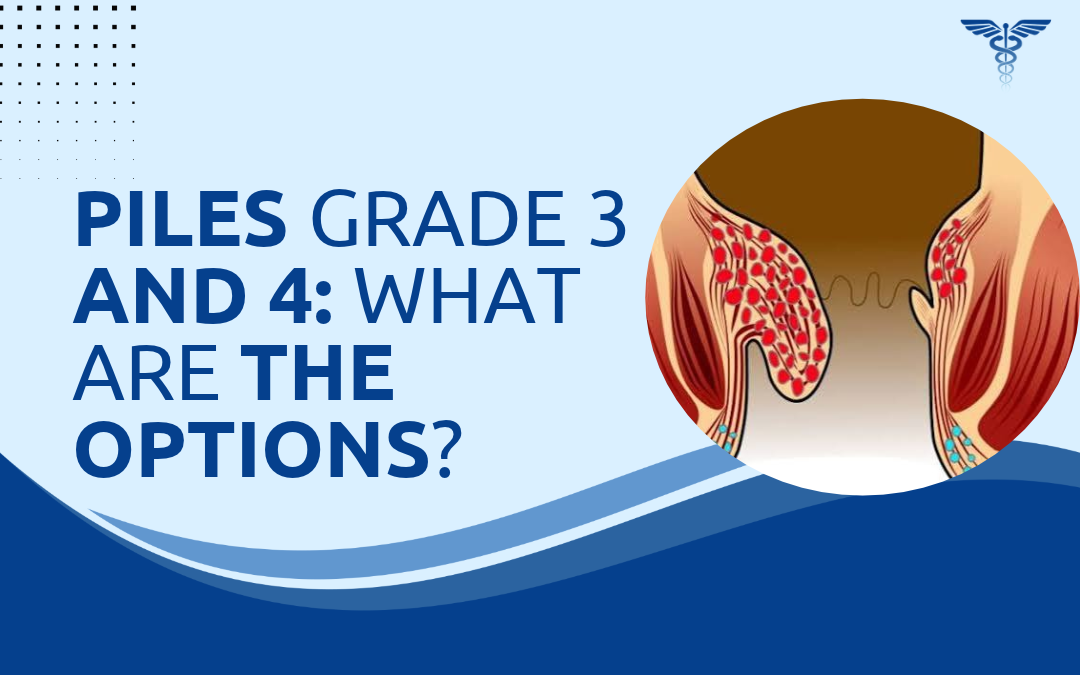
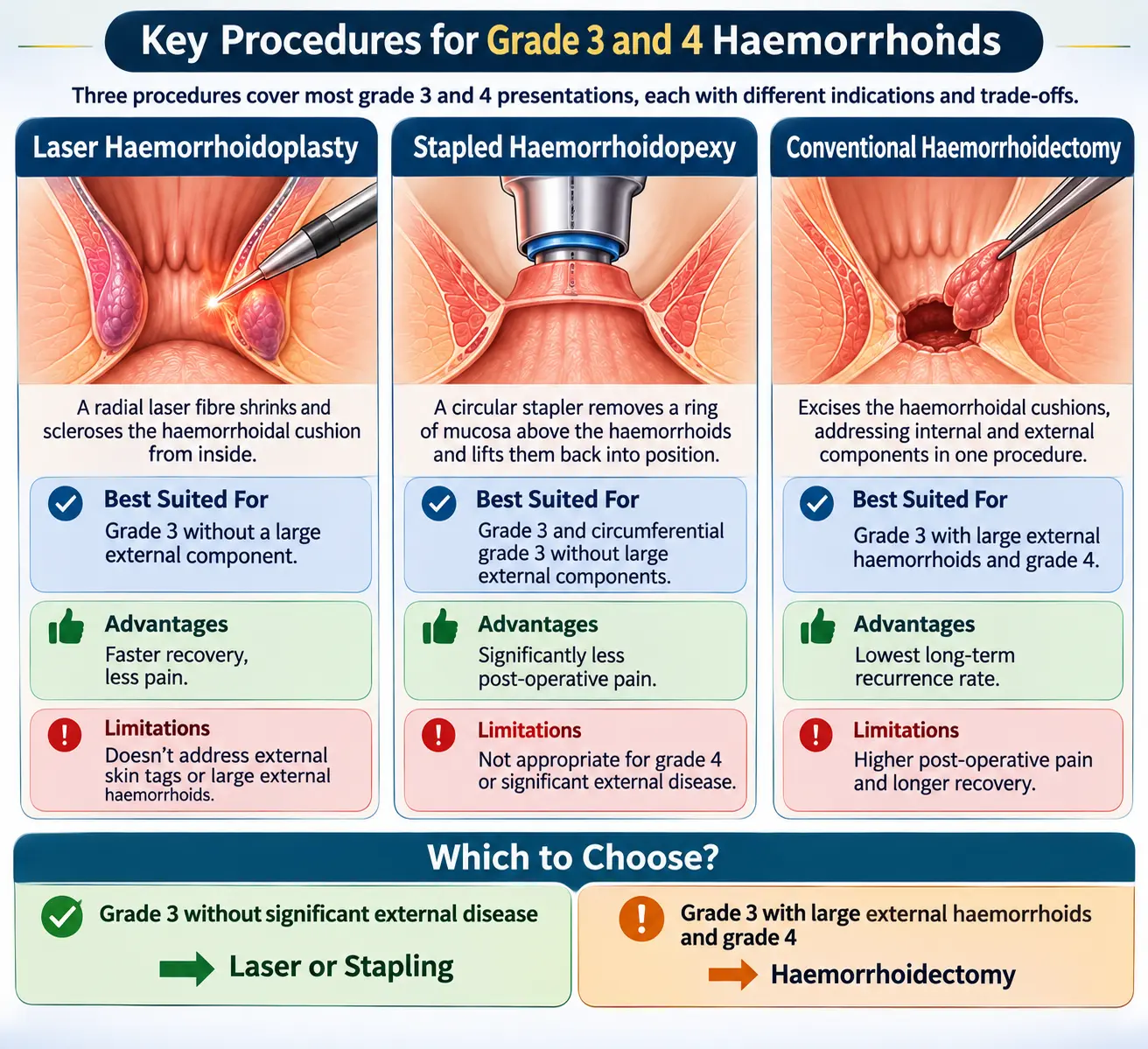
Grade 3 piles prolapse during defecation and need manual reduction. Grade 4 piles are permanently prolapsed and cannot be reduced. Both are beyond the stage where dietary changes, creams, or banding alone produce a lasting result. Treatment options are laser haemorrhoidoplasty, stapled haemorrhoidopexy, and conventional haemorrhoidectomy the right choice depends on size, anatomy, overall health, and what the surgeon finds at examination.
According to Dr. Rajeev Premnath, a General and Laparoscopic Surgeon in Bangalore, “Grade 3 and 4 piles are not a waiting game. Patients sometimes come in having managed a prolapsing pile for two or three years. By then, there’s often a significant external component as well. The question isn’t whether to treat it’s which procedure suits that particular anatomy. A large grade 4 with significant external haemorrhoids needs a haemorrhoidectomy. A grade 3 without a large external component might be well served by laser or stapling.”
What Makes Grade 3 and 4 Piles Different From Lower Grades?
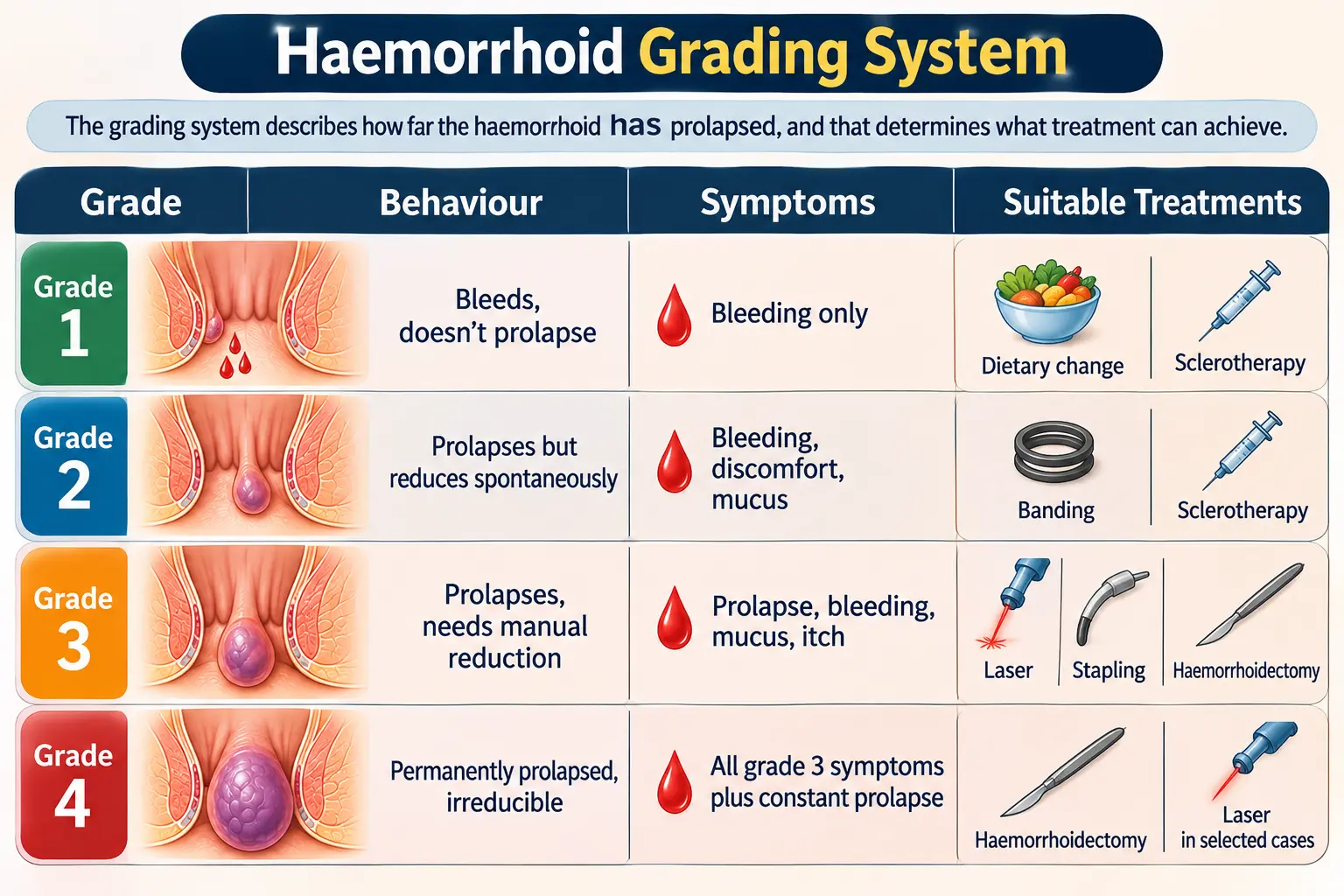
The grading is done by proctoscopy with the patient straining. External components are assessed alongside the internal grade, as both affect the choice of procedure. For a full overview of assessment and treatment, visit our piles treatment section.
What Are the Surgical Options for Grade 3 and 4 Piles?
For a detailed look at who is and isn’t a candidate for the stapled approach, our blog on stapled haemorrhoidopexy suitability covers the indications and contraindications in full.
What Determines the Right Treatment Approach?
Several factors go into the decision alongside the grade itself.
- External component: The most important factor. Laser and stapling leave external haemorrhoids and skin tags in place. If these are significant, haemorrhoidectomy is the right choice regardless of the internal grade.
- Circumferential disease: Haemorrhoids affecting all three quadrants of the anal canal simultaneously are better served by stapling or haemorrhoidectomy than by laser, which treats one cushion at a time.
- Patient fitness: Haemorrhoidectomy is performed under spinal or general anaesthesia. Patients who can’t safely have a longer anaesthetic may be better served by laser, which can be done under sedation or local anaesthetic.
- Previous treatment: A patient who has had banding or sclerotherapy that has failed, or who has had a previous haemorrhoidectomy on one site, needs the anatomy assessed carefully before any further procedure.
- Patient preference and return to work: Laser and stapling offer faster recovery. Haemorrhoidectomy offers the most durable result. The trade-off between recovery time and long-term outcome is part of the conversation before consent.
Prolapsing piles that are getting worse and want to know the options?
FAQs
What is the best treatment for grade 3 piles?
Laser haemorrhoidoplasty, stapled haemorrhoidopexy or haemorrhoidectomy, depending on whether a significant external component is present.
Can grade 4 piles be treated without haemorrhoidectomy?
In selected cases, laser can be used for grade 4, but most grade 4 presentations, especially with external disease, need a haemorrhoidectomy.
Is laser treatment for piles painful?
Post-operative pain after laser is significantly less than after haemorrhoidectomy. Most patients return to work within a few days.
How long does recovery take after haemorrhoidectomy?
Most patients need two to three weeks before returning to desk work, with full comfort taking four to six weeks.