

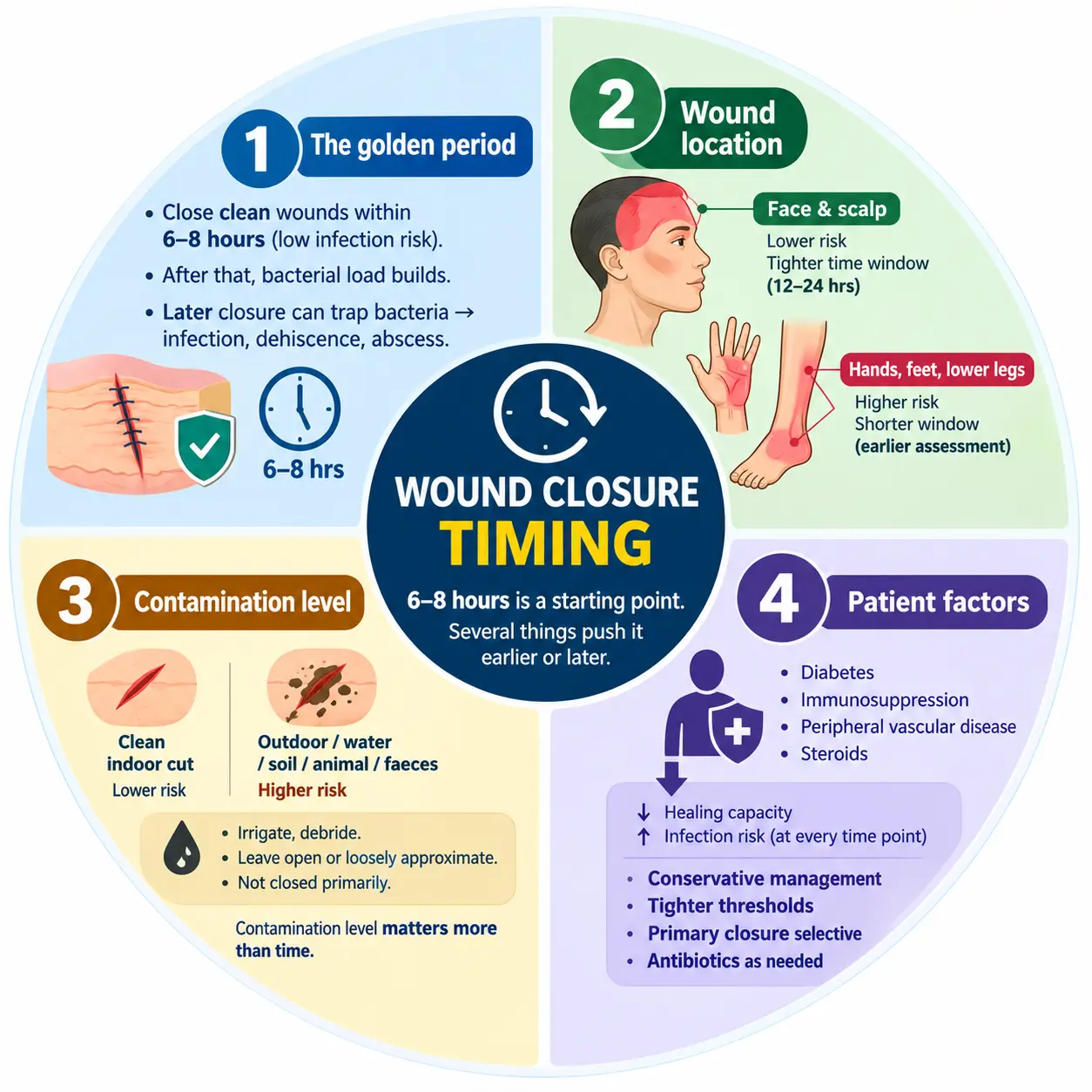
Six to eight hours. That’s the window. After that, bacteria have been in the wound long enough that closing it traps them. Sealed wound. Warm environment. Nutrient-rich tissue fluid. That’s an abscess. The golden period isn’t a hard cutoff; facial wounds run longer because the blood supply is better. Contaminated wounds, bites, and wounds presenting late in high-risk areas get handled differently regardless. Tetanus is a separate question entirely. It applies to every wound. Clean or dirty.
According to Dr. Rajeev Premnath, General and Laparoscopic Surgeon in Banglore, “Patients come in twelve hours after a cut and want it stitched. The honest answer is it depends on the wound, not just the clock. Twelve hours, clean facial laceration, healthy patient very different from eight hours, contaminated leg wound, diabetic. Location, contamination, patient factors all of it goes into the decision. The golden period is a guideline. What we’re actually managing is infection risk. That varies with the wound.”
What Is the Golden Period and What Affects Closure Timing?
Timing is one factor. Not the only one. Wound closure options vary by wound type, depth, and contamination risk see skin glue services for the full picture.
When Is Tetanus Protection Needed After a Cut?
Separate assessment. Runs alongside every wound, regardless of how clean it looks.
- Any break in the skin carries risk. Puncture wounds, crush injuries, soil or animal faeces contamination, burns, devitalised tissue these create anaerobic conditions where Clostridium tetani thrives. Kitchen knife, fully vaccinated: low risk. Garden fork puncture, unknown vaccination history, not low risk.
- Vaccination status is the first question. Fully vaccinated, booster within ten years: no action for a clean wound. Tetanus-prone wound: five years is the threshold. Unknown or incomplete history: booster immediately, immunoglobulin considered.
- Tetanus immunoglobulin passive immunisation. Short-lived but immediate. Given alongside the vaccine when history is incomplete or unknown, and the wound is tetanus-prone. Not instead of the vaccine; the vaccine builds immunity over time, immunoglobulin covers the gap.
- Tetanus-prone wound features: Wound over six hours old before treatment. Significant devitalised tissue. Puncture wound. Soil or manure contamination. Burns. Systemic sepsis at presentation. Any of these: booster plus immunoglobulin assessment, regardless of timing.
Tetanus assessment takes thirty seconds. Our blog on skin glue vs stitches covers which closure method suits which wound once timing and contamination are established.
Hernia Diagnosis in Special Situations: Paediatric, Recurrent, and Emergency Presentations?
Delayed closure and open wound management follow the same principles as primary closure: reduce infection risk, support healing, and reassess as the wound evolves. Is skin glue suitable for children’s wounds? To understand how the closure method is selected once the wound is ready to close.
Key Takeaways
- The golden period is six to eight hours past that; closure traps bacteria, not just the wound.
- Facial wounds run longer; contaminated wounds and bites get assessed on their own terms.
- Tetanus assessment is mandatory for every wound; vaccination status and wound type decide the intervention.
- Delayed primary closure at 48-72 hours is a planned approach for high-risk wounds, not a missed opportunity.
- If pain increases, spreading redness, or discharge occurs after 24 hours, reassess; don’t wait.
Cut that needs closure and unsure how urgent it is?
FAQs
How long after a cut can it still be stitched?
Six to eight hours for most wounds. Facial lacerations run to twelve to twenty-four hours. Contaminated wounds, bites, and punctures get assessed on their own terms regardless of timing.
What is the golden period for wound closure?
Six to eight hours after injury. Bacterial load is low enough that primary closure carries an acceptable infection risk within that window.
Do I need a tetanus injection after a cut?
Depends on vaccination history and wound type. Fully vaccinated, recent booster, clean wound: probably not. Unknown history or contaminated wound: yes.
What makes a wound tetanus-prone?
Puncture wounds, soil or animal contamination, devitalised tissue, wounds more than six hours old before treatment, and burns.