

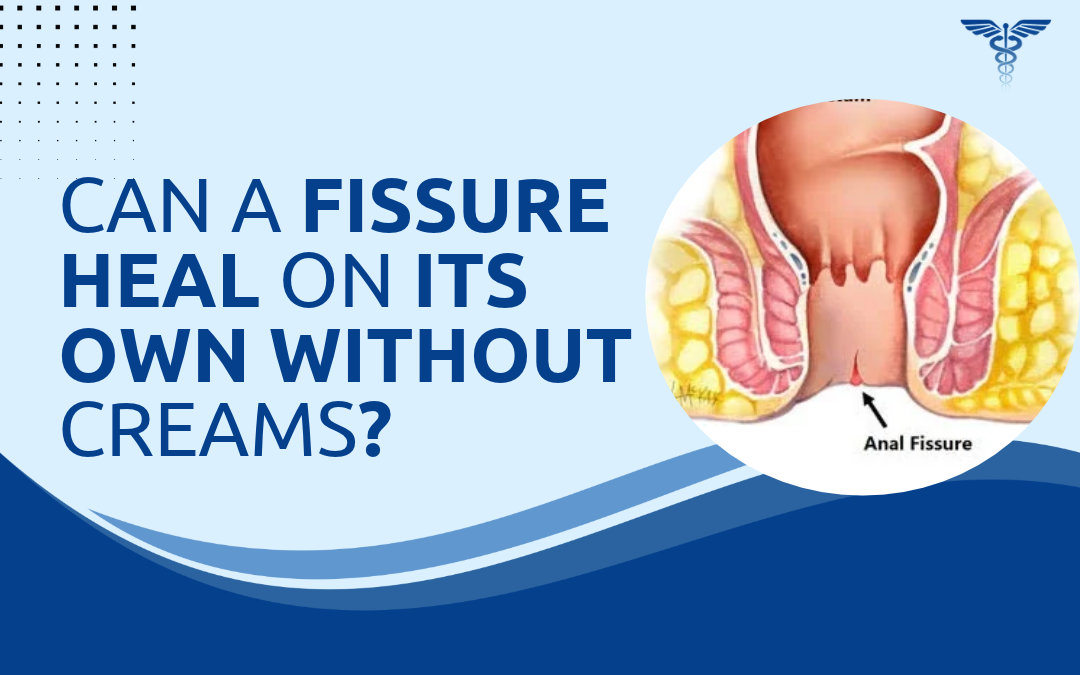
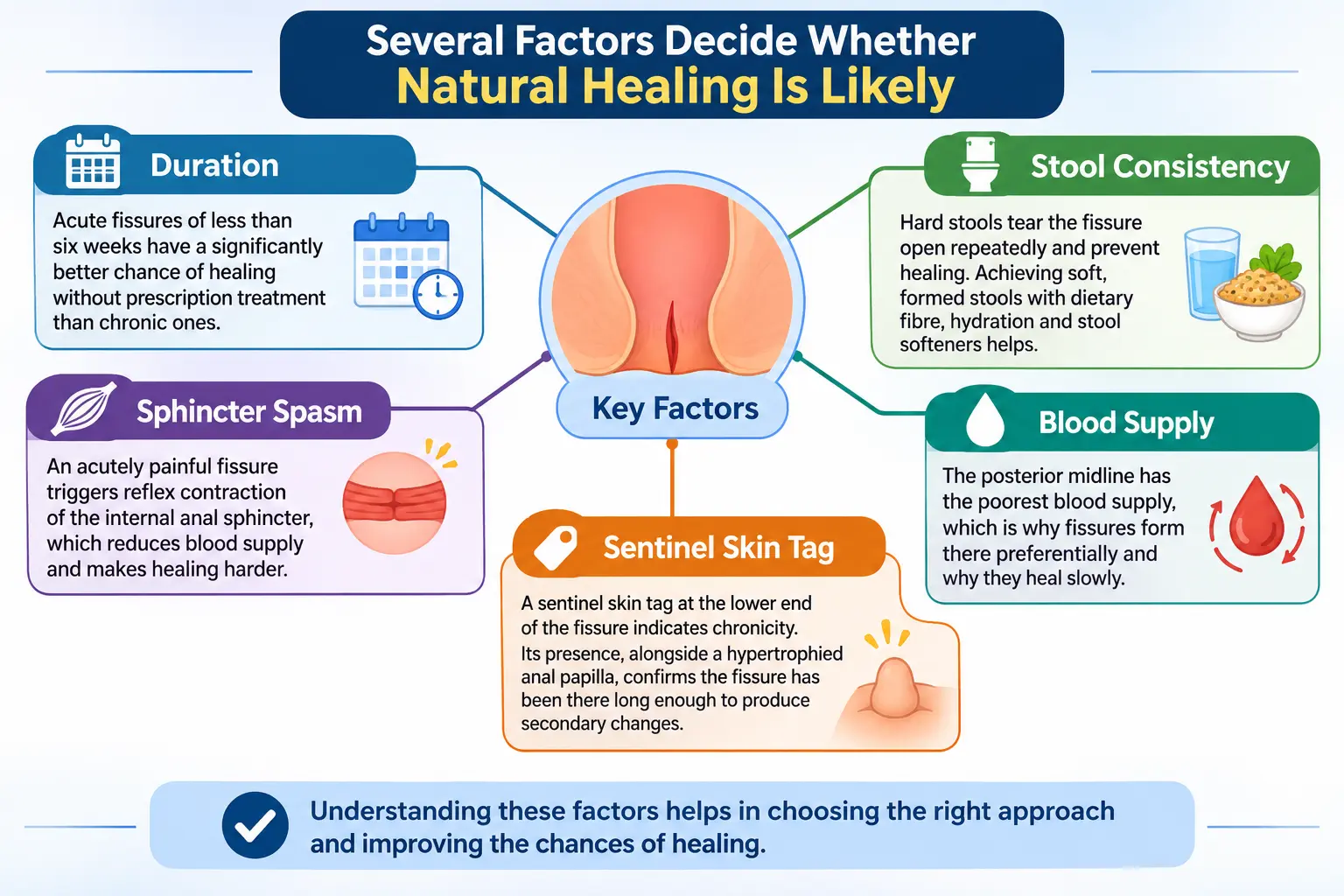
An acute anal fissure present for less than six weeks can heal without prescription treatment in a good proportion of cases. Soft stools, adequate hydration, sitz baths, and avoiding straining remove the mechanical driver and give the tissue a chance to repair. The problem is that many fissures become chronic before the patient seeks help. By that stage, the cycle of spasm, reduced blood supply, and repeated tearing is self-sustaining. A chronic fissure present for more than six weeks, with a sentinel skin tag and exposed internal sphincter fibres, rarely heals without treatment.
As Dr. Rajeev Premnath, General and Laparoscopic Surgeon in Bangalore, puts it: “An acute fissure with a clear dietary trigger often settles with stool softeners and sitz baths alone at six weeks, it’s gone. The ones that don’t heal are the chronic fissures, where the internal sphincter is in spasm, and blood supply to the fissure base is so poor the tissue can’t close even with soft stools. That’s when you need something to relax the muscle: a topical cream, a Botox injection, or, in some cases, an operation.”
What Affects Whether a Fissure Heals Without Treatment?
For a full overview of fissure treatment options when conservative measures aren’t enough, our fissure treatment page covers what a full anorectal assessment involves.
What Can Help a Fissure Heal Without Prescription Creams?
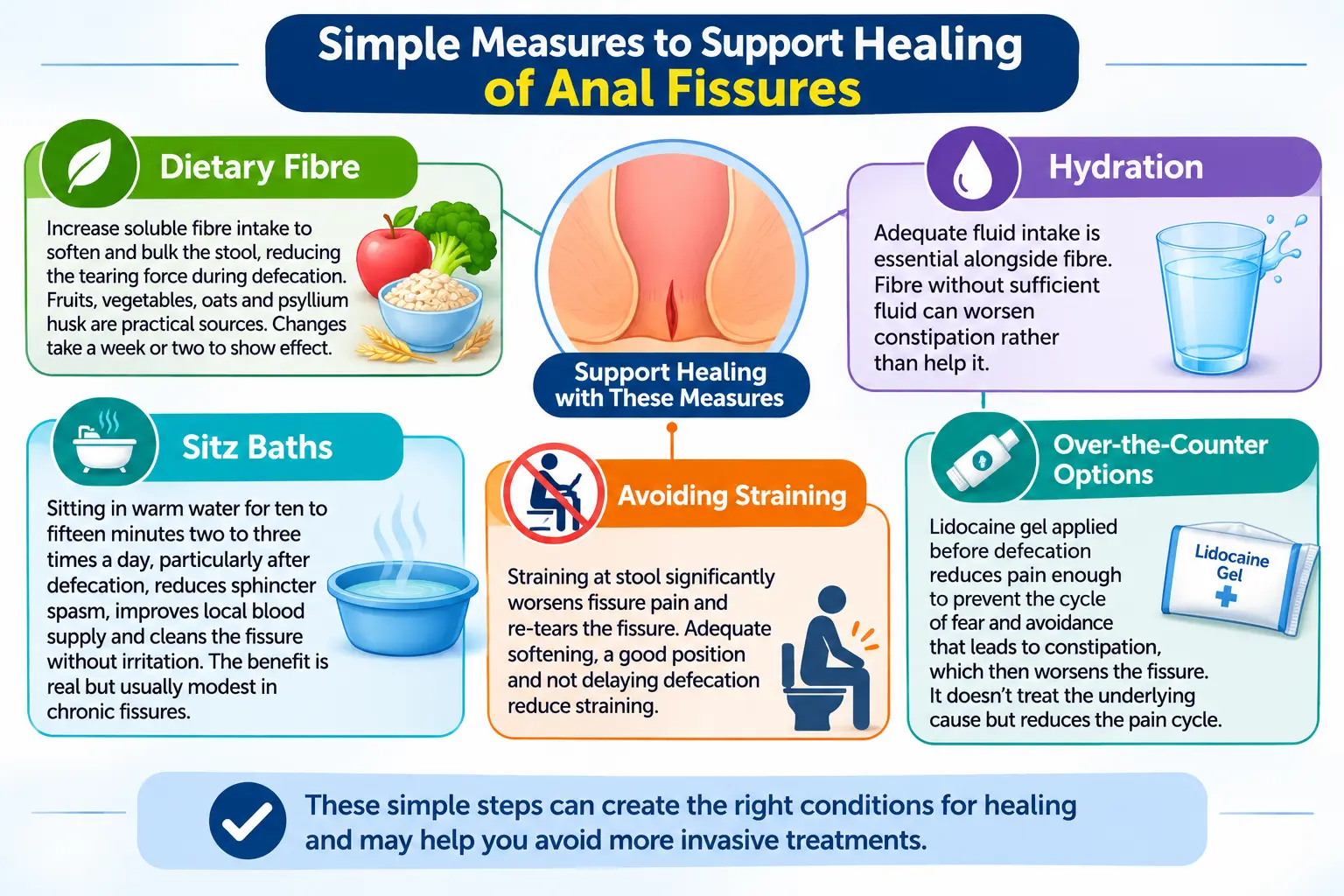
These measures give an acute fissure the best chance of healing without prescription treatment. Our blog on anal fissure surgery vs Botox covers what happens when conservative measures aren’t enough and the choice is between injection and an operation.
What Determines the Right Treatment Approach?
- Acute Fissure Under Six Weeks: Start with dietary modification, hydration, sitz baths, and stool softeners for four to six weeks. If healing occurs, no further treatment is needed. If pain persists or the fissure returns, move to prescription treatment.
- Chronic Fissure Over Six Weeks: Topical GTN or diltiazem for six to eight weeks is standard first-line prescription treatment. Both relax the internal sphincter, improve blood supply, and achieve healing in around fifty to seventy percent of cases.
- Failed Topical Treatment: Botulinum toxin injection into the internal sphincter produces longer-lasting muscle relaxation than topical agents and heals a significant proportion of fissures that haven’t responded to creams.
- Recurrent or Treatment-Resistant Fissure: Lateral internal sphincterotomy carries the highest healing rate, around 95% with the lowest recurrence. Reserved for fissures that haven’t responded to medical treatment due to a small but real risk of minor incontinence.
- Special Circumstances: Pregnancy, Crohn’s disease, and anterior fissures in women with possible sphincter weakness all require a modified approach. Sphincterotomy is avoided in these groups; Botox is preferred. A proctologist experienced in complex fissure cases is best placed to assess which pathway applies.
Fissure pain that hasn’t settled despite softening the stools?
FAQs
Can an anal fissure heal on its own without any treatment?
An acute fissure can, particularly with soft stools and sitz baths. A chronic fissure with a sentinel skin tag rarely heals without treatment targeting the sphincter spasm.
How long does it take for an anal fissure to heal naturally?
An acute fissure that is going to heal without treatment usually shows improvement within four to six weeks of dietary and lifestyle changes.
What is the fastest way to heal an anal fissure?
Soft stools, sitz baths and a topical agent such as GTN or diltiazem together give the fastest healing for most fissures. Botox or surgery is added if these don’t work.
Does a sentinel skin tag mean the fissure won't heal on its own?
Yes, almost always. A sentinel tag indicates the fissure has become chronic, and chronic fissures need treatment beyond dietary changes to heal.