


Rectal prolapse is far less common in men than in women, but men tend to develop it earlier, and the cause is usually different. The rectum slips down and protrudes through the anus, most often after straining. In women, it’s mainly pelvic floor weakness after childbirth and age. In men, there’s rarely one clear reason. Years of straining, constipation, spinal problems or past anorectal surgery sit behind most cases. And because it’s uncommon in men, it often gets called piles for months. Same lump, different problem.
According to Dr. Rajeev Premnath, General and Laparoscopic Surgeon in Banglore, “A man with a lump that won’t stay in needs the cause worked out, not just the prolapse repaired, because untreated straining brings it straight back.”
Why Does Rectal Prolapse Look Different in Men and Women?
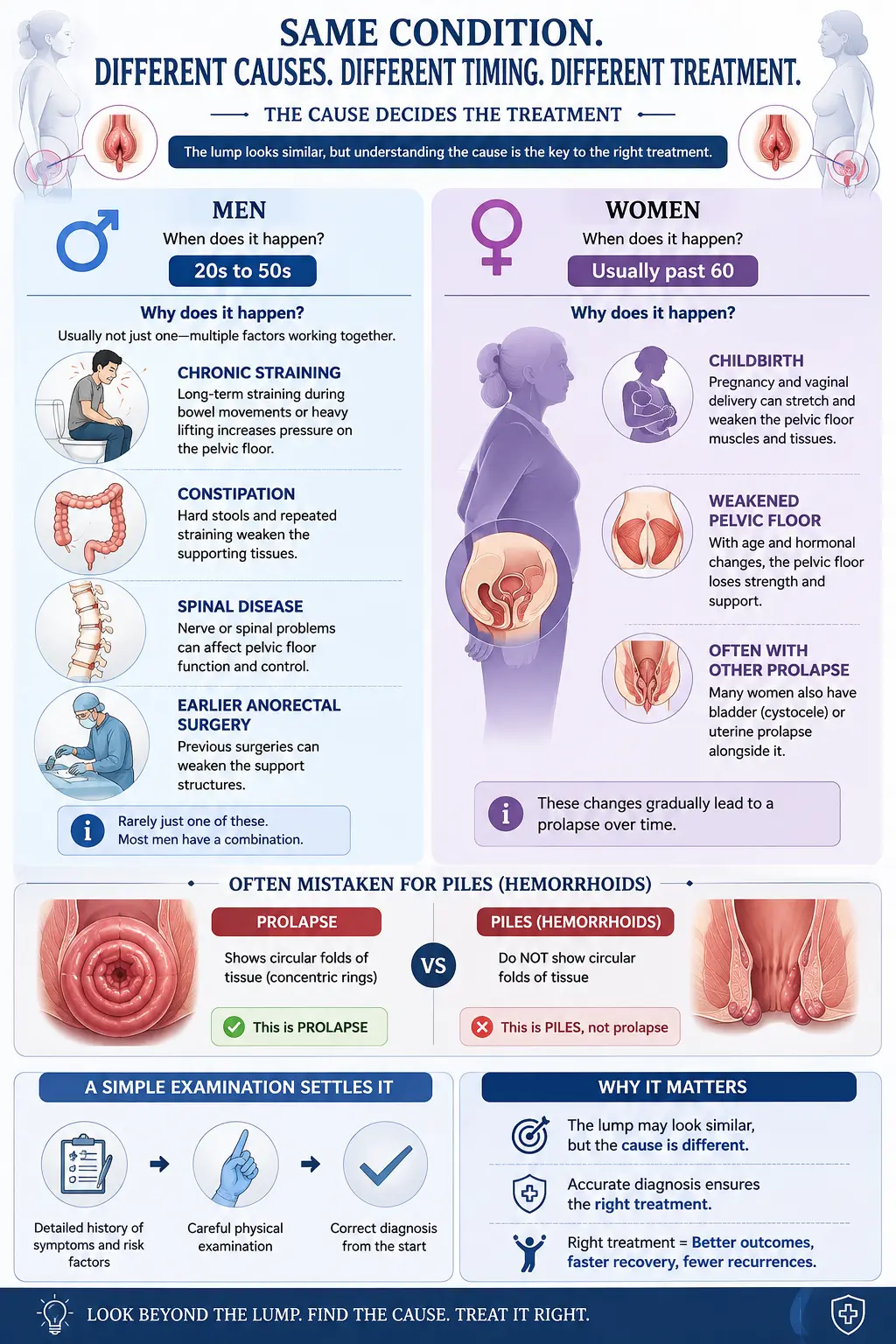
If the assessment confirms haemorrhoids, our dedicated piles treatment section covers the full range of options from conservative management and minimally invasive procedures to surgical intervention based on grade and severity.
How Is Rectal Prolapse Treated in Men?

Surgery lifts the rectum, but it won’t undo years of straining on its own. Still unsure whether it’s piles or prolapse? Read how internal and external haemorrhoids differ.
What Determines the Right Treatment Approach?
The right surgical approach depends on age, fitness, prolapse duration, and what’s driving it.
- Age and fitness: Younger, fitter men are steered toward laparoscopic rectopexy a durable repair with lower recurrence. Older or higher-risk patients are better served by perineal surgery, which avoids abdominal entry entirely.
- Nerve proximity: The dissection lies close to pelvic nerves that control urinary and sexual function. Technique and surgeon experience directly affect whether these are preserved not a minor consideration in younger men.
- Underlying cause: Address chronic straining, constipation, or spinal disease alongside the repair. Surgery corrects the prolapse; it doesn’t correct the pressure that caused it. Left untreated, recurrence follows.
- Prolapse duration: Long-standing prolapse with significant tissue redundancy may require more extensive repair than a recent presentation. How long it’s been coming out changes what the surgeon finds and what needs fixing.
For context on how rectal prolapse presents differently depending on its cause, rectal prolapse after childbirth covers the pelvic floor mechanisms behind the most common presentation in women useful background before any surgical discussion.
Noticed tissue coming out after a bowel movement and unsure if it’s piles?
FAQs
Is rectal prolapse rare in men?
Yes, it’s much less common than in women, but it appears earlier.
Can rectal prolapse be mistaken for piles?
Yes, but prolapse shows circular folds and usually needs surgery.
Does rectal prolapse go away without surgery?
No, surgery is the only lasting fix once the rectum comes out.
Can rectal prolapse surgery affect sexual function in men?
Rarely, because the dissection lies near pelvic nerves, so technique matters.