

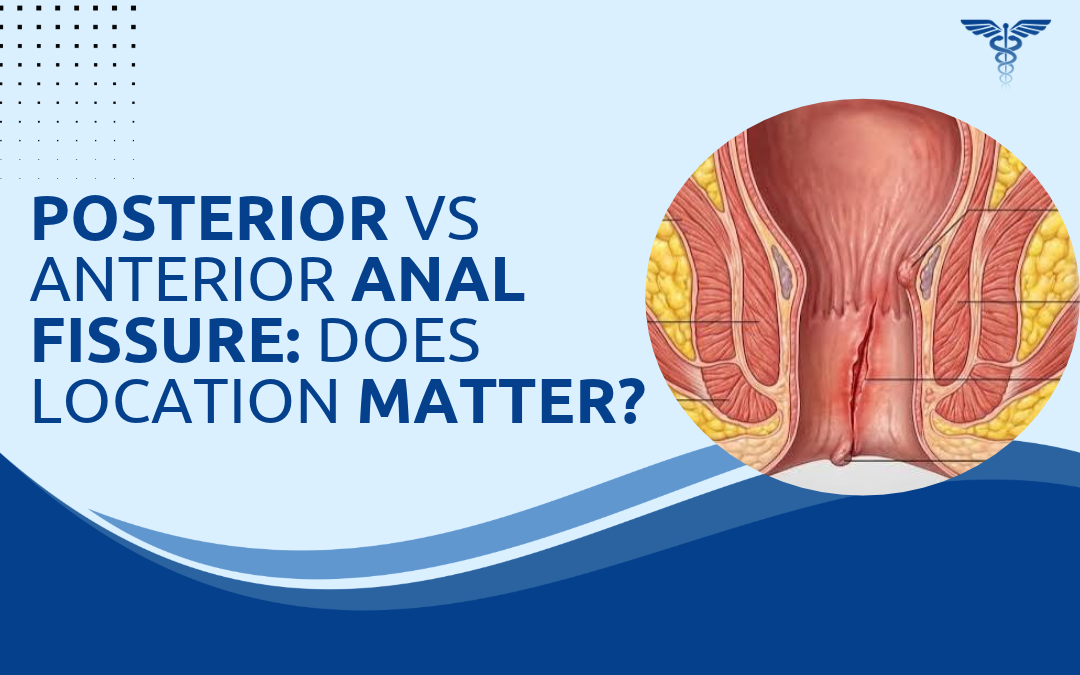
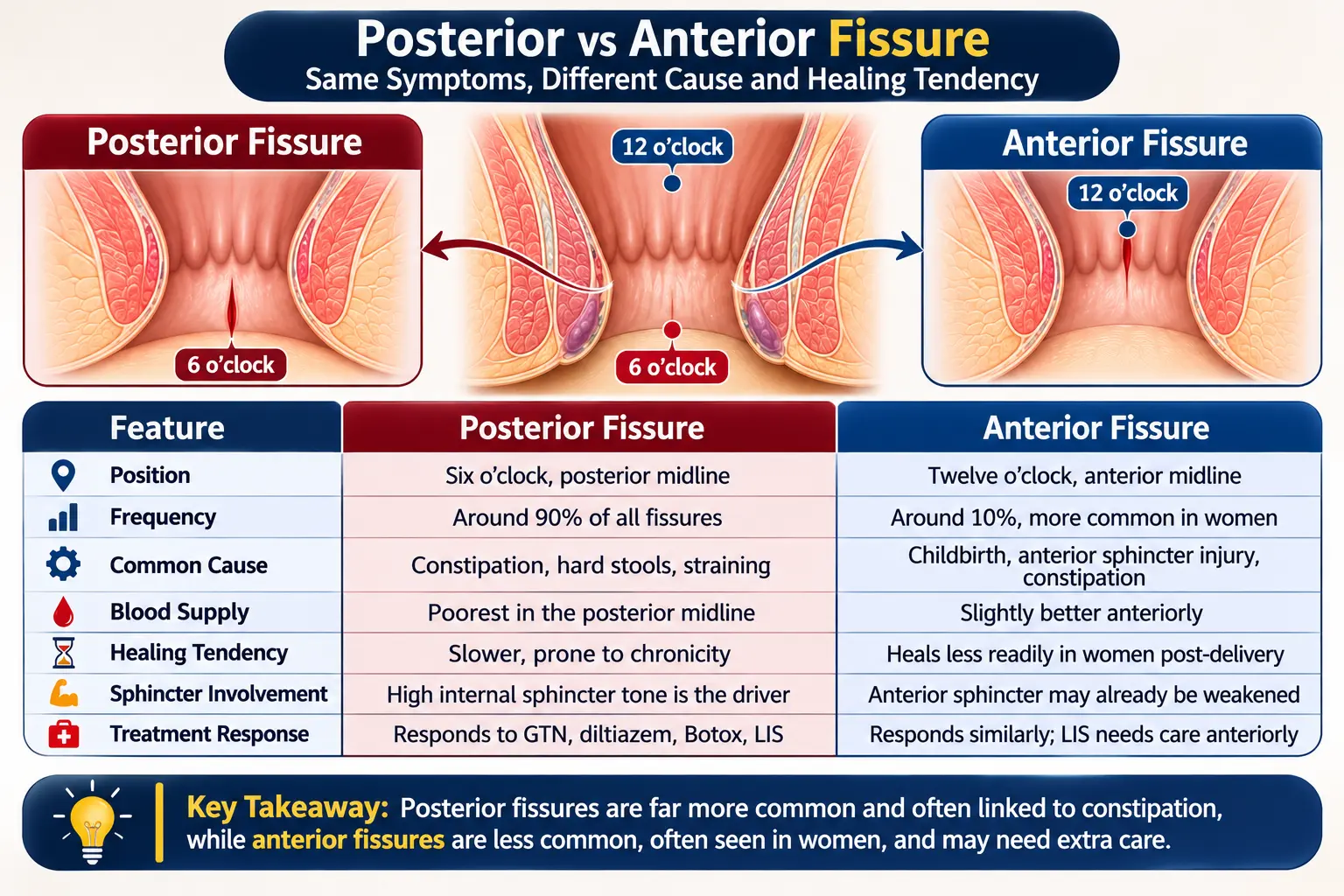
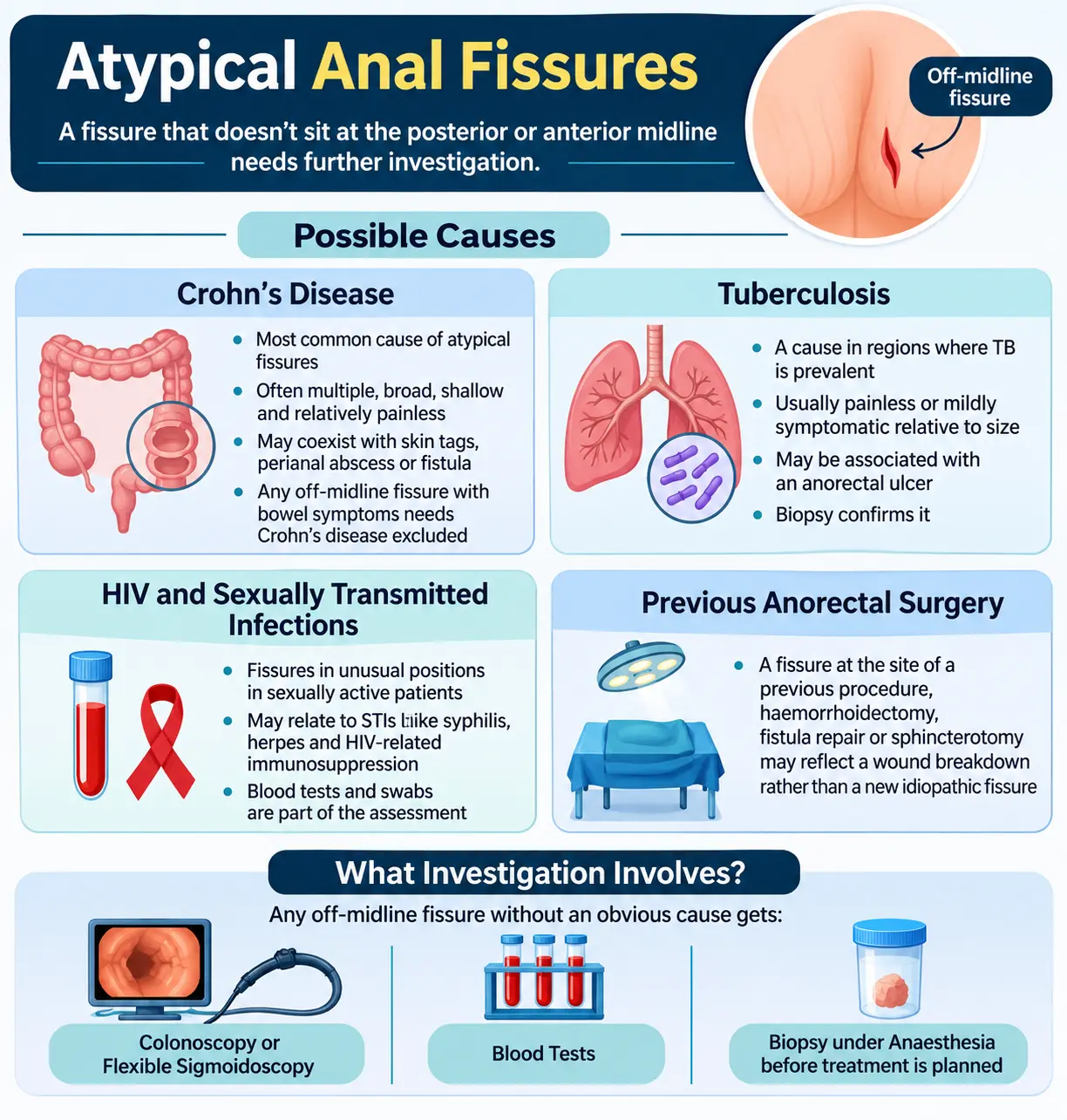
Around 90% of anal fissures occur at the posterior midline, the six o’clock position, because blood supply there is poorest and sphincter pressure during defecation is highest. Anterior fissures at twelve o’clock make up most of the remainder and are more common in women, particularly after childbirth. An off-midline fissure at three or nine o’clock is a different concern and raises the question of an underlying cause: Crohn’s disease, tuberculosis, or a sexually transmitted infection.
According to Dr. Rajeev Premnath, a General and Laparoscopic Surgeon in Bangalore, “The position of a fissure tells me a lot before I’ve even examined the patient. Posterior midline in a young adult with constipation is almost certainly idiopathic. Anterior in a woman who delivered a year ago is likely obstetric. Off-midline in anyone, I’m thinking Crohn’s, TB, HIV, or a previous anorectal procedure. Location changes what I investigate, how I treat, and what I tell the patient about recurrence.”
How Do Posterior and Anterior Fissures Differ?
For a full overview of what assessment and treatment involve, our dedicated fissure treatment section covers everything from diagnosis to recovery.
Why Does an Off-Midline Fissure Raise Concern?
For more information, Read Our blog on can an anal fissure turn into a fistula is relevant for atypical fissures where a fistulous complication is suspected.
What Determines the Right Treatment Approach?
Location, chronicity, sphincter function and any underlying cause all shape the plan.
- Idiopathic posterior fissure: Topical GTN or diltiazem for six to eight weeks first line. Botulinum toxin injection if topical treatment fails. Lateral internal sphincterotomy for chronic fissures that don’t respond to medical treatment, with the lowest recurrence of all options.
- Anterior fissure in women post-delivery: The anterior sphincter may already be weakened from delivery. Lateral internal sphincterotomy on the anterior quadrant carries a higher risk of incontinence in this group. Botulinum toxin is preferred over surgery where possible, and sphincter integrity is assessed before any operative decision.
- Fissure in Crohn’s disease: Standard sphincterotomy is avoided because Crohn’s fissures don’t respond in the same way and wound healing is impaired. Management focuses on treating the Crohn’s disease medically, with surgical intervention limited to drainage of sepsis.
- Atypical fissure with identified cause: Treat the underlying cause first. The fissure often improves once the driving pathology is controlled.
- Recurrent fissure after treatment: Assess whether the original diagnosis was correct, whether there is an underlying cause that was missed, and whether the sphincterotomy was adequate if one was performed.
Anal pain on defecation and not sure where the fissure is?
FAQs
Why do most anal fissures occur at the posterior midline?
Blood supply to the posterior anal canal is poorest and mechanical pressure during defecation is highest there, making it the most vulnerable site for tearing.
Are anterior fissures more difficult to treat?
They can be, particularly in women after childbirth where the anterior sphincter may already be weakened. Sphincterotomy carries a higher incontinence risk in this group.
What does an off-midline fissure mean?
It’s atypical and raises the possibility of Crohn’s disease, tuberculosis, an STI or a complication of previous surgery. Investigation before treatment is needed.
Can a lateral internal sphincterotomy be done for an anterior fissure?
It can, but caution is needed in women with possible anterior sphincter damage from childbirth. Botulinum toxin is usually tried first in this group.