

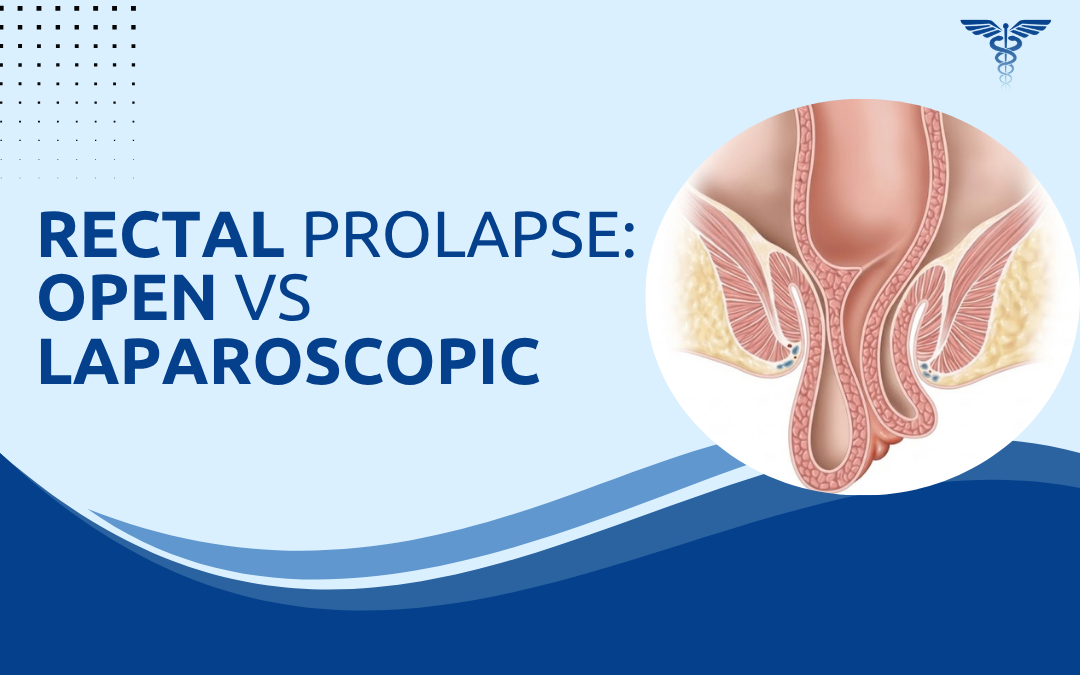
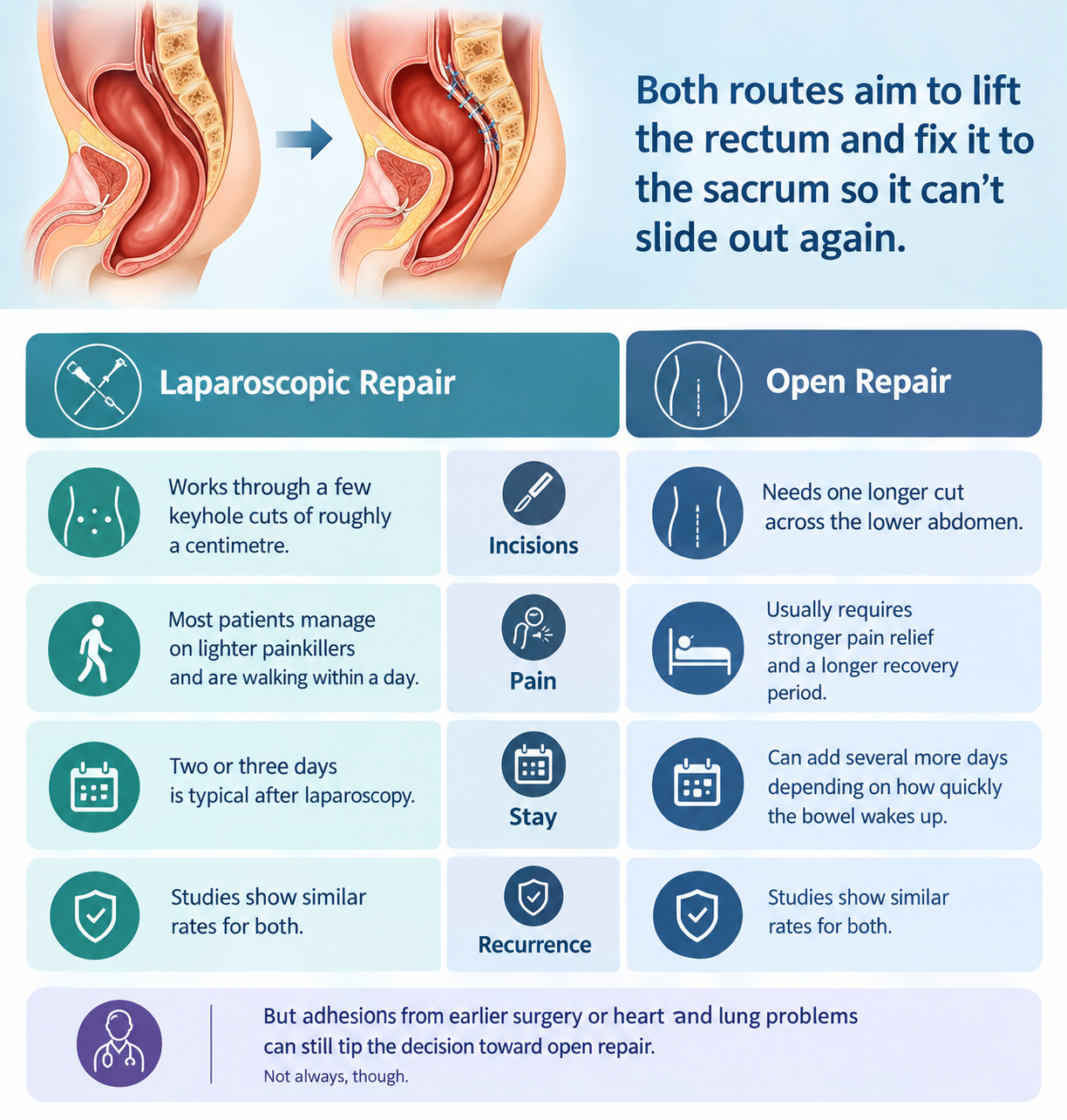
Rectal prolapse is repaired through the abdomen or the perineum, and the abdominal repair, called rectopexy, can be open or laparoscopic. Prolapse itself is the rectum sliding out through the anus, and it rarely improves without surgery. Laparoscopic rectopexy usually means smaller cuts, less pain and a shorter stay. Open repair still has a place in complex or repeat cases. Recurrence rates are broadly similar between the two.
According to Dr. Rajeev Premnath, a trusted General and Laparoscopic Surgeon in Banglore, “Most fit patients do well with a laparoscopic rectopexy, but age, bowel habits and how long the prolapse has been there decide the final call.”
How Does Laparoscopic Rectopexy Compare With Open Surgery?
Constipation and pelvic floor problems are managed alongside it under minimal invasive proctology.
Which Approach Suits Which Prolapse Patient?
Age, fitness and the size of the prolapse matter more than the name of the operation.
- Younger adults: An abdominal rectopexy, usually laparoscopic, gives the most durable hold, and that matters when a repair has to last decades.
- Older patients: Frail people, or anyone carrying higher anaesthesia risk, often do better with a perineal procedure like Altemeier or Delorme, done from below.
- Constipation: Long-standing straining changes the plan, so a sigmoid resection is sometimes added to stop the same problem pulling the rectum out again.
- Repeat prolapse: Often open, though experienced teams manage plenty of these laparoscopically, depending on scarring.
Funny how many people arrive convinced it’s piles, when it’s the rectum itself coming out. Different problem, different fix.
Prolapsing piles are a separate condition, treated with procedures like stapled hemorrhoidopexy.
Why Choose Dr. Rajeev Premnath?
Dr. Rajeev Premnath is a General and Laparoscopic Surgeon with MBBS, MS (General Surgery), FRCS (Glasg.), FACS, FEBS, a Diploma in Laparoscopy from France and over 20 years of experience, including piles treatment and other anorectal surgery at Ramakrishna Super Speciality Hospital.
Every plan is built around bowel habits, fitness and prolapse size, and keyhole repair is offered only when it’s the safer route. Follow-ups are booked, recovery advice is specific, and nothing gets rushed. Prolapse doesn’t settle on its own, so waiting only makes it bigger.
Not sure which repair fits your prolapse?
FAQs
Is laparoscopic rectopexy safer than open surgery?
Both are safe, but laparoscopy usually means less pain and quicker recovery.
Can rectal prolapse heal without surgery?
No, surgery is the definitive fix, though fibre and pelvic floor exercises ease symptoms.
How long is recovery after laparoscopic rectopexy?
Light activity resumes within two to three weeks, while heavy lifting waits longer.
Can rectal prolapse return after surgery?
Yes, occasionally, and rates are similar for open and laparoscopic repair.