

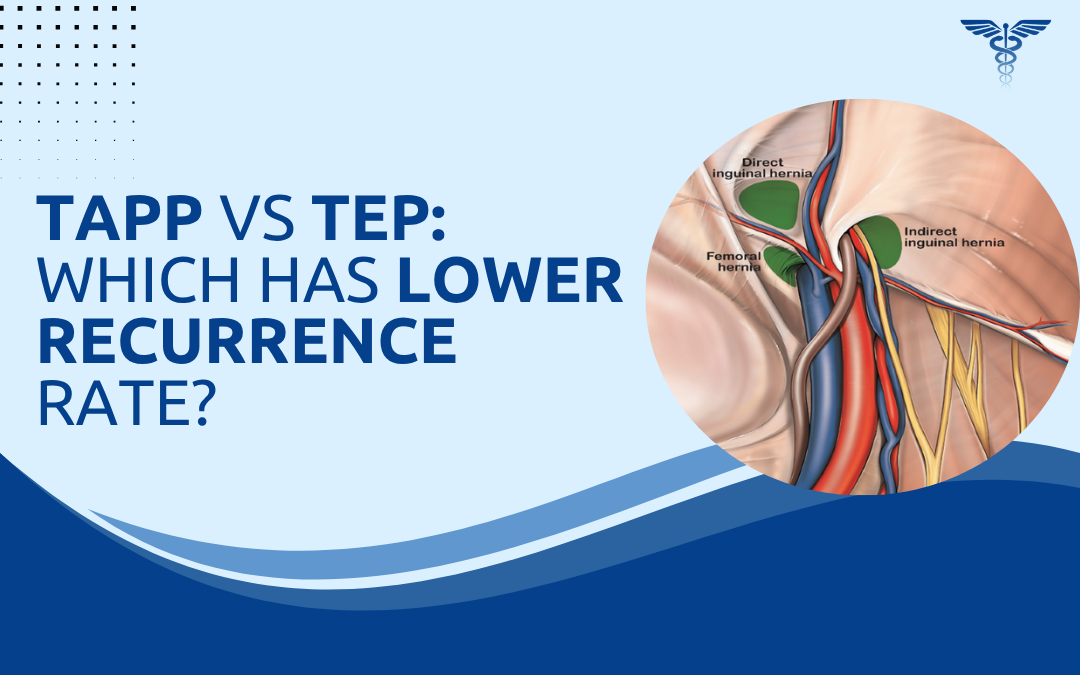
TAPP and TEP have equivalent recurrence rates in the published evidence. Both sit between 1% and 3% in experienced hands no meaningful difference between them when technique and mesh placement are done correctly. The choice between TAPP and TEP isn’t about which one recurs less. It comes down to anatomy, prior surgery, and surgeon experience with each approach.
According to Dr. Rajeev Premnath, a trusted General and Laparoscopic Surgeon, “Patients often come in asking which technique is safer or which one lasts longer. The honest answer is that the data doesn’t separate them on recurrence. What separates outcomes is mesh overlap, port placement, and whether the surgeon has done enough of one technique to do it consistently well. A TAPP done well beats a TEP done poorly, and vice versa.”
How Do TAPP and TEP Differ in Technique and Risk?
| Aspect | TAPP (Transabdominal Preperitoneal) | TEP (Totally Extraperitoneal) |
| Access | Enters the peritoneal cavity first, then creates a flap to reach the preperitoneal space where mesh is placed | Stays entirely outside the peritoneum, using a balloon dissector to create the working space; never enters the abdominal cavity |
| Visceral injury risk | Marginally higher risk of bowel or bladder injury, since the peritoneal cavity is entered | Avoids this risk by working entirely in the preperitoneal plane, though space is more limited and the learning curve is steeper |
| Prior abdominal surgery | Preferred choice after lower abdominal surgery, pelvic radiation, or previous preperitoneal dissection | Becomes significantly harder in these cases — adhesions in the preperitoneal space can make dissection unsafe |
| Bilateral hernia | Slightly easier access for simultaneous bilateral dissection, since the peritoneal cavity offers more working room on both sides | Also handles bilateral repair in a single anaesthetic, but with less working room |
Neither approach is universally superior the risks differ, not the outcomes. For a full overview of hernia repair options, you can visit the hernia surgery page.
What Does the Evidence Say About TAPP vs TEP Outcomes?
Head-to-head data consistently shows comparable results between the two techniques across all major outcome measures.
- Recurrence: Pooled data from randomised trials and meta-analyses puts both techniques in the 1–3% recurrence range at five years no statistically significant difference when performed by experienced surgeons in adequate volume centres.
- Chronic pain: TEP shows a marginal advantage in some series for post-operative chronic groin pain, attributed to less peritoneal handling and fewer tack fixations but the difference is small and not consistent across all studies.
- Operating time: TAPP is generally faster in bilateral cases and in patients with complex anatomy TEP takes longer in difficult dissections where the preperitoneal space is compromised by prior surgery or scarring.
- Conversion rate: TEP has a higher intraoperative conversion rate to open or TAPP when preperitoneal dissection fails TAPP conversions to open are less frequent because the peritoneal access gives more flexibility to manage unexpected findings.
Recurrence in both techniques is more strongly predicted by mesh size, overlap at the medial border, and fixation method than by the choice of approach. Our blog on laparoscopic vs open hernia surgery covers how both laparoscopic techniques compare against open repair on safety and recovery.
Why Choose Dr. Rajeev Premnath?
Dr. Rajeev Premnath is a General and Laparoscopic Surgeon with MBBS, MS (Gen Surg.), FRCS (Glasg.), FEBS, FICS, FACS, FIAGES, FMAS, and a Diploma in Laparoscopy from France, with over 20 years of experience performing both TAPP and TEP across all complexity grades at Ramakrishna Super Speciality Hospital, Jayanagar, Bangalore.
Each patient’s anatomy, surgical history, and hernia classification are assessed before any operative approach is confirmed the technique is chosen for the case, not defaulted to out of habit.
Diagnosed with inguinal hernia and comparing your surgical options?
FAQs
Which is better, TAPP or TEP, for inguinal hernia?
Neither is universally better both have equivalent recurrence rates and outcomes in experienced hands.
Does TAPP have a higher risk of bowel injury than TEP?
Marginally yes, as TAPP enters the peritoneal cavity TEP avoids this by staying in the preperitoneal plane.
Can TEP be done after previous abdominal surgery?
Not always prior lower abdominal surgery or pelvic radiation can make TEP unsafe, making TAPP the preferred option.
What actually determines hernia recurrence after laparoscopic repair?
Mesh size, medial overlap, and fixation method are stronger predictors of recurrence than the choice between TAPP and TEP.