

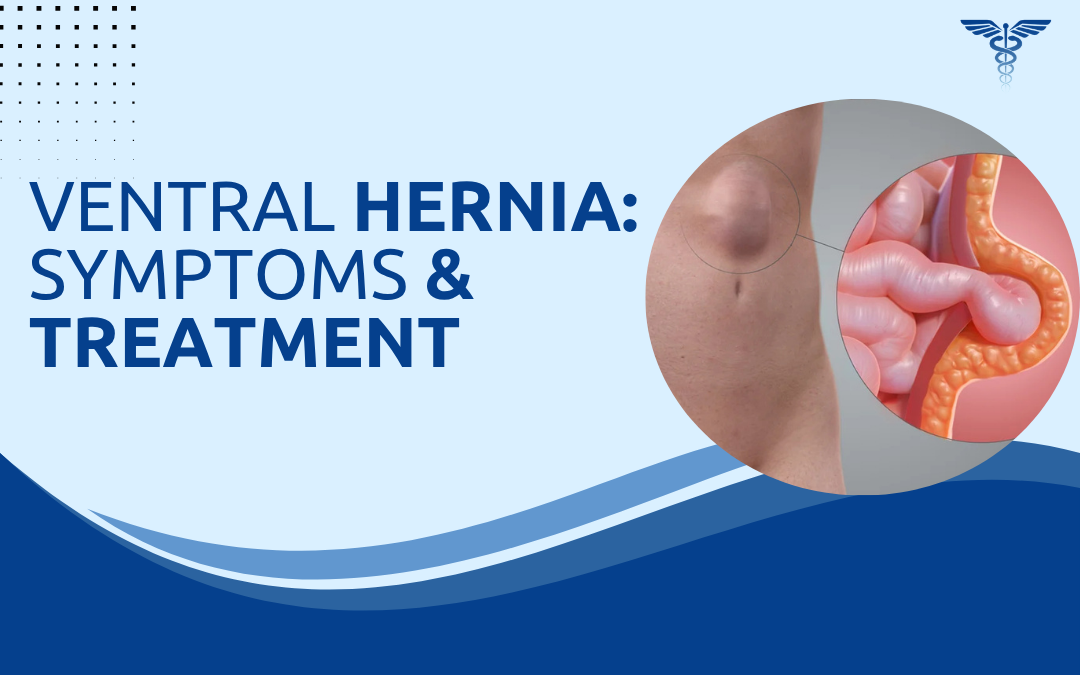
A ventral hernia is a protrusion of abdominal contents through a weakness in the front wall of the abdomen. It does not resolve on its own. The fascial defect does not close spontaneously it enlarges over time, and the risk of serious complications increases the longer repair is deferred. Surgery is the only definitive treatment. Laparoscopic mesh repair is the standard approach for most patients and is performed as a day care procedure in eligible cases.
According to Dr. Rajeev Premnath, a trusted General and Laparoscopic Surgeon, “Most patients with a ventral hernia delay coming in because the bulge isn’t painful yet. By the time they do, the hernia is larger and the repair is more complex. A small hernia fixed early means a simpler procedure, faster recovery, and lower recurrence. Waiting doesn’t improve the situation.”
What Are the Types, Causes, and Symptoms of a Ventral Hernia?
Types
- Umbilical hernia: Occurs at the navel. Weakens from chronic raised abdominal pressure obesity, multiple pregnancies, or ascites. The most common ventral hernia in adults.
- Epigastric hernia: Appears in the midline above the umbilicus through a gap in the linea alba. Often small but causes pain disproportionate to its size.
- Incisional hernia: Develops at the site of a previous abdominal surgical scar. The fascial closure breaks down and bowel or fat pushes through. The most complex type to repair.
- Visible bulge: Enlarges when standing, coughing, or straining. Flattens when lying down.
- Dragging discomfort: Localised aching after prolonged standing or activity. Improves with rest in uncomplicated hernias.
- Loss of reducibility: Hernia no longer flattens when lying down indicates incarceration.
- Sudden severe pain with nausea and vomiting: Indicates strangulation. Surgical emergency requiring immediate admission.
Any hernia that has recently become painful, firm, or irreducible requires same-day surgical assessment. Depending on the diagnosis, different hernia surgery procedures may be recommended.
How Is a Ventral Hernia Diagnosed and Treated?
- Diagnosis: involves clinical examination with the patient standing and straining, supported by ultrasound to assess defect size and contents, and CT abdomen for complex or large incisional hernias to map dimensions and check bowel involvement.
- Surgery is the only definitive treatment: with high-risk patients requiring additional pre-operative assessment before proceeding. Patients with additional risk factors may require high-risk inguinal hernia surgery assessment before proceeding.
- Laparoscopic repair: uses 3 to 4 small port incisions, reduces hernial contents under camera view, and secures synthetic mesh intraperitoneally. Most patients go home the same day or the morning after.
- Open repair: involves a direct incision over the hernia with mesh placed in the appropriate plane (onlay, sublay, or inlay), and is preferred for very large hernias, bowel resection cases, or failed laparoscopic repairs.
- Mesh is standard: in all ventral hernia repairs. Primary suture closure alone carries up to 50% recurrence for larger defects, while mesh reinforcement reduces this to 3 to 10% depending on type and technique. The mesh type, whether polypropylene, composite, or biological, is selected based on the repair plane and contamination risk.
- Post-operative recovery: ranges from 1 to 2 weeks for laparoscopic repair to 6 to 8 weeks for open repair, with light activity encouraged early and return to desk work by weeks 2 to 4. For a related condition, read our detailed guide on umbilical hernia in adults and when it needs surgery. No long-term mesh surveillance is needed unless symptoms recur.
Why Choose Dr. Rajeev Premnath?
Dr. Rajeev Premnath is a General and Laparoscopic Surgeon with MBBS, MS (Gen Surg.), FRCS (Glasg.), FEBS, FICS, FACS, FIAGES, FMAS, and a Diploma in Laparoscopy from France. He has been performing laparoscopic hernia repair across all complexity grades from primary umbilical hernias to recurrent incisional hernias requiring component separation at Ramakrishna Super Speciality Hospital, Jayanagar, Bangalore for over 20 years.
Each patient receives an individual assessment: hernia type, defect dimensions, mesh selection, and operative approach are determined before any procedure is scheduled. Day care repair is the standard for eligible patients.
Abdominal bulge noticed or diagnosed with a ventral hernia?
FAQs
What is a ventral hernia?
A ventral hernia is a protrusion of abdominal contents through a defect in the front abdominal wall. Types include umbilical, epigastric, and incisional hernias. It does not resolve without surgery.
Can a ventral hernia heal on its own?
No. The fascial defect does not close spontaneously. Without repair, hernias enlarge and carry increasing risk of incarceration or strangulation.
What is the best treatment for a ventral hernia?
Laparoscopic mesh repair is the gold standard for most patients smaller incisions, lower recurrence, and faster recovery than open repair.
How long is recovery after ventral hernia surgery?
Laparoscopic repair: light activity in one to two weeks, full activity by four to six weeks. Open repair for large hernias may take six to eight weeks.