

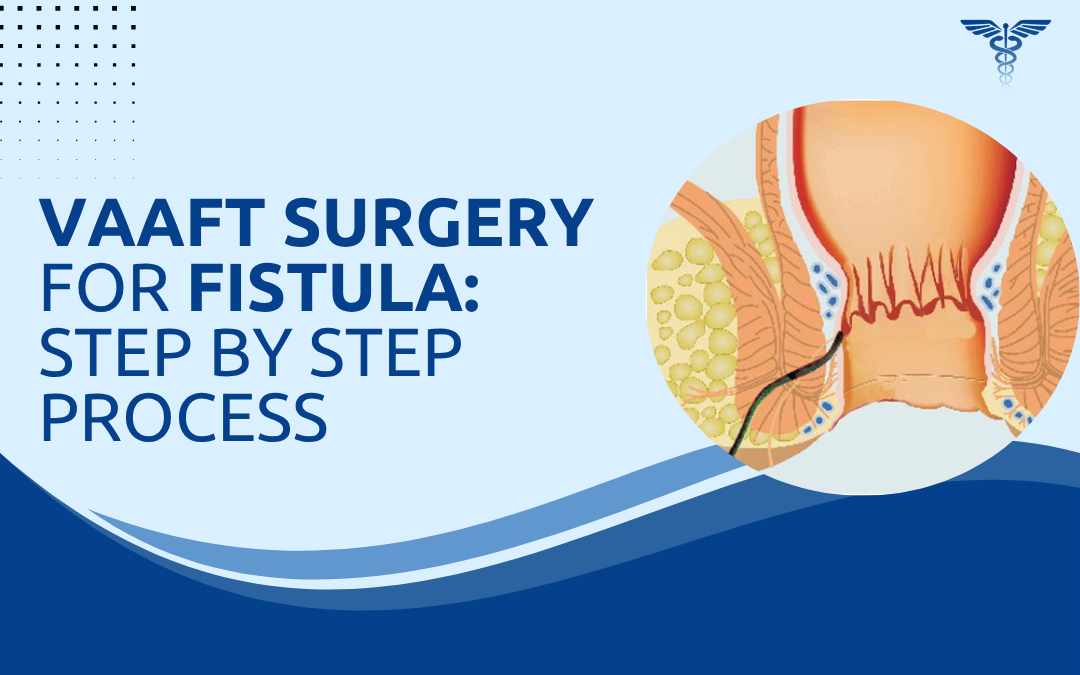
Video-Assisted Anal Fistula Treatment (VAAFT) is a minimally invasive, sphincter-saving procedure used to treat complex anal fistulas. It’s done under spinal or general anaesthesia and uses a fistuloscope for direct 360-degree visualisation of the tract. The procedure splits into two phases: diagnostic and operative. The diagnostic phase maps the tract, branches and internal opening under direct vision. Then comes the operative phase, which fulgurates the lining, washes out debris and closes the internal opening with sutures, staples or a sealing agent.
According to Dr. Rajeev Premnath, an experienced piles specialist in Bangalore, VAAFT shows you the tract from the inside, so the internal opening isn’t a guess anymore. That’s what changes recurrence rates.
How is VAAFT Surgery Performed Step by Step?
Roughly 30 to 60 minutes, anaesthesia on board, and the surgeon’s watching everything on a screen.
Scope insertion. A fine fistuloscope goes in through the external opening, and irrigation fluid distends the tract so every branch and the internal opening become visible.
Tract mapping; Secondary tracts, abscess pockets, the exact internal opening, all of it gets identified under direct vision. Something traditional probing simply can’t do.
Fulguration and cleaning: A monopolar electrode is then passed through the scope and used to burn the inner lining of the tract, while granulation tissue and debris are flushed out as the surgeon watches.
Closure: Sutures or a stapler shut the internal opening. And then synthetic glue or a sealing agent may go in to help the tract collapse from the inside.
So that’s the core sequence. Nothing left to guesswork because the camera does the talking. For complex or recurrent cases, laparoscopic surgery follows the same image-guided philosophy.
What Happens After VAAFT Surgery?
No external wound to dress, no daily packing routine. That’s the big difference.
Discharge: Same day or within 24 hours for most people, and routine desk work usually resumes in 3 to 5 days. Heavy lifting waits longer.
Pain: Mild. Oral painkillers handle it. You won’t be lying flat for weeks like with classical fistulotomy, which is honestly the part patients dread the most.
Hygiene: Warm sitz baths twice a day, stool softeners to stop straining, and gentle perianal care in the first two weeks. This guide on anal fistula symptoms and care covers the basics.
Follow-up: Wound checks at 2 weeks. Then again at 6 weeks. By then the tract should be collapsing and the internal opening sealed.
Published series report success rates around 70 to 85 percent for primary cases. Continence stays preserved in nearly all patients because no sphincter muscle is cut. And if recurrence does happen, the same scope can go back in and redo the job.
Why Choose Dr. Rajeev Premnath?
Dr. Rajeev Premnath is a General and Laparoscopic Surgeon and Proctologist with over 20 years of clinical experience. His qualifications include MBBS, MS (Gen Surg), FRCS (Glasgow), FEBS, FACS, and a Diploma in Laparoscopy from France. He was the first surgeon in Karnataka to perform VAAFT for anal fistula, and he continues to manage simple, complex, and recurrent cases at Ramakrishna Super Speciality Hospital.
Patient outcomes remain the priority here sphincter preserved, recurrence kept low, and same-day or next-day discharge for most. No oversold promises, just what the scope reveals and what the closure holds.
Worried about cuts near the sphincter or losing continence after surgery?
FAQs
Is VAAFT painful after surgery?
Pain stays mild and oral painkillers handle it for 3 to 5 days.
How long does VAAFT surgery take?
Around 30 to 60 minutes under anaesthesia.
Can VAAFT treat complex fistulas?
Yes, branched tracts and recurrent fistulas respond well thanks to direct visualisation.
Does VAAFT cause incontinence?
No, the sphincter stays intact because no muscle gets cut.