

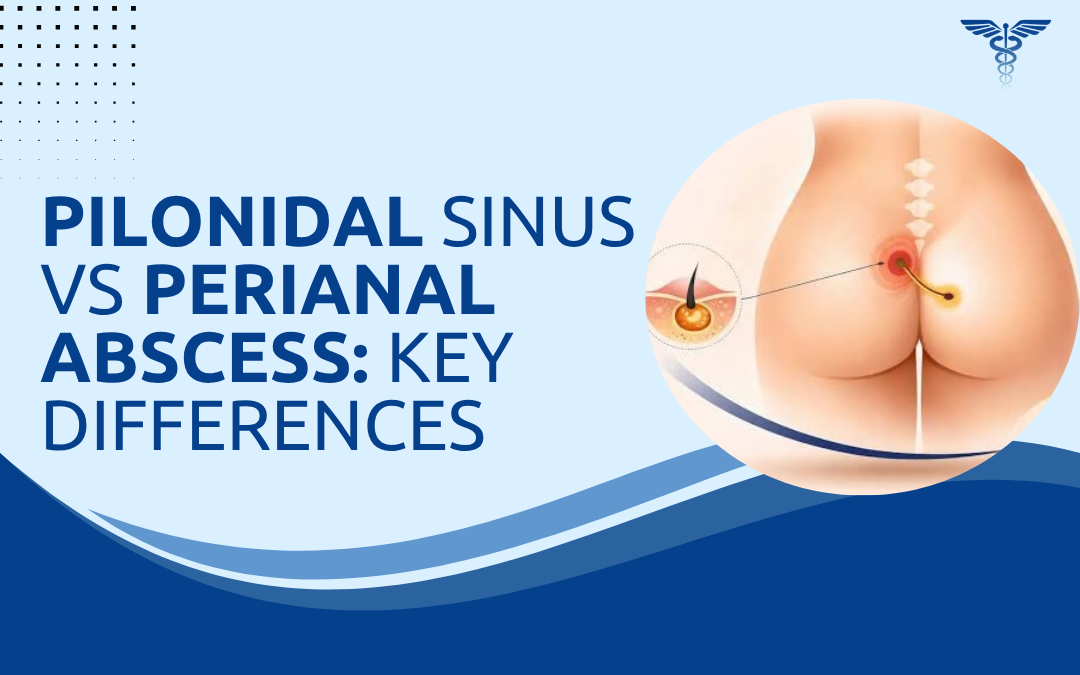
Stapled haemorrhoidopexy (PPH) treats Grade 3 and 4 internal haemorrhoids by lifting prolapsed tissue back into place with a circular stapler placed above the pain-sensitive dentate line. That usually means less pain and faster recovery than conventional haemorrhoidectomy. Stapled haemorrhoidopexy works well but only for the right presentation. Grade 1 and 2 piles, significant external haemorrhoids, and fibrotic tissue that can’t be repositioned are not suitable for this approach.
According to Dr. Rajeev Premnath, piles specialist in Bangalore, “Stapled haemorrhoidopexy gives excellent results in the right Grade 3 and 4 patient but offering it to someone with predominantly external disease or fibrotic piles is a setup for a poor outcome and a frustrated patient.”
How Do Pilonidal Sinus and Perianal Abscess Differ?
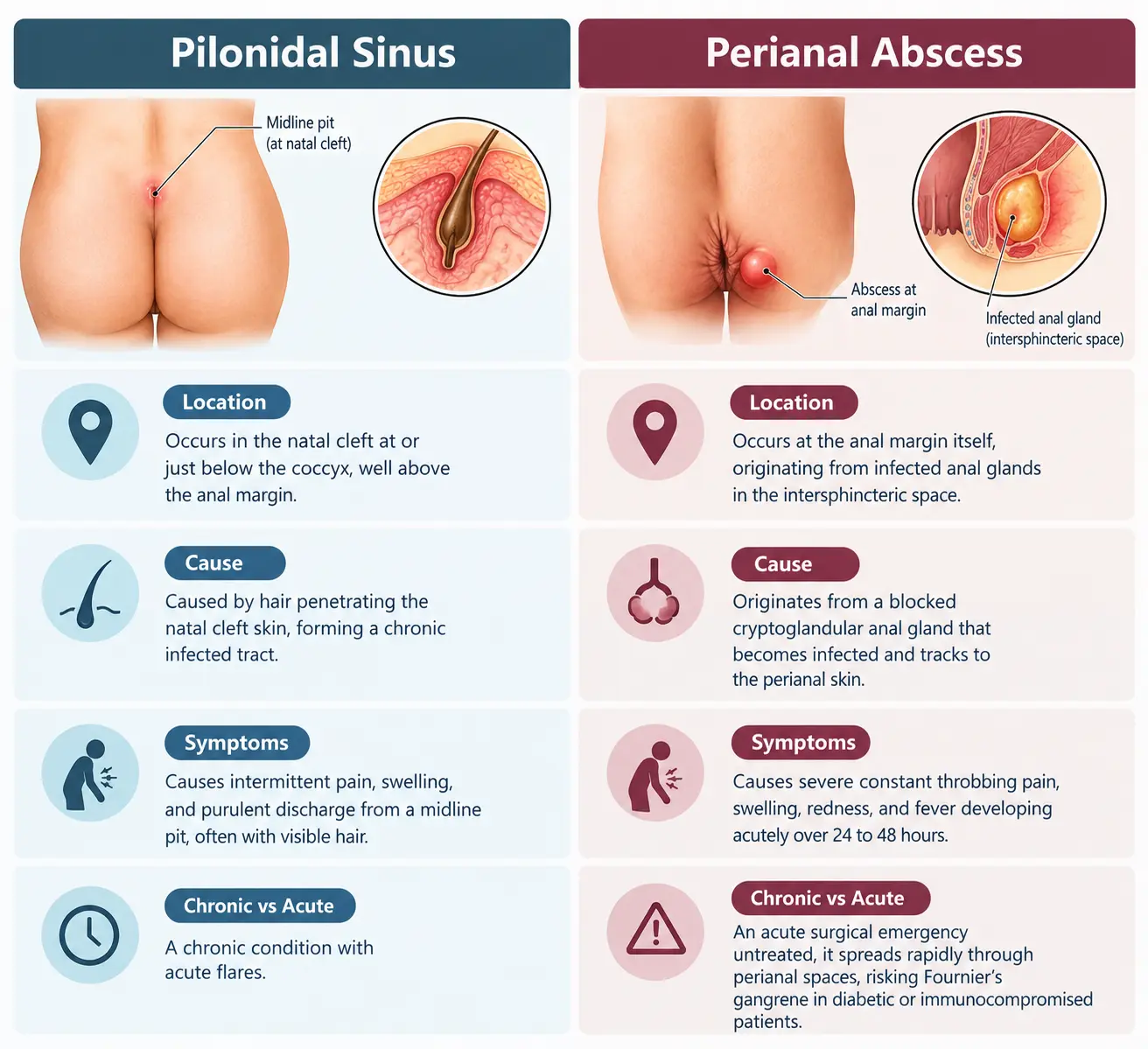
Accurate diagnosis determines both urgency and operative approach. When a persistent tract develops after drainage, it often requires the same evaluation pathway used for fistula treatment.
How Are Pilonidal Sinus and Perianal Abscess Treated?
Both require surgical intervention but the procedures, timing, and post-operative course are completely different.
- Perianal abscess: Incision and drainage under anaesthesia the abscess is opened, pus drained, and the cavity left open to heal. Antibiotics alone don’t drain an abscess. Around 30 to 50% develop a fistula-in-ano after drainage, requiring a separate fistula procedure weeks later.
- Pilonidal sinus acute phase: A pilonidal abscess is drained acutely to relieve infection. Definitive sinus excision is planned as a separate elective procedure once inflammation settles, typically six to eight weeks later.
- Pilonidal sinus definitive treatment: Options include wide local excision, Karydakis flap, or EPSiT endoscopic treatment for suitable tracts. Choice depends on sinus complexity, number of tracts, and prior treatment history.
- Recurrence: Pilonidal sinus recurs in 5 to 30% of cases depending on technique, BMI, hair density, and natal cleft depth. Perianal abscess recurs as a fistula in a significant proportion and requires fistula surgery if a persistent tract develops.
Both conditions are manageable with the right surgical approach and timing. Our blog on pilonidal sinus covers who is most at risk and what treatment involves.
Why Choose Dr. Rajeev Premnath?
Dr. Rajeev Premnath is a General and Laparoscopic Surgeon with MBBS, MS (Gen Surg.), FRCS (Glasg.), FEBS, FICS, FACS, FIAGES, FMAS, and a Diploma in Laparoscopy from France, with over 20 years of experience in proctological surgery including pilonidal sinus excision, EPSiT, and perianal abscess drainage at Ramakrishna Super Speciality Hospital, Jayanagar, Bangalore.
Every patient presenting with perianal pain and swelling is examined before any diagnosis is attributed. Location, chronicity, and clinical features are assessed together so the right procedure is planned for the right condition from the outset.
Painful swelling near the anal area and unsure what it is?
FAQs
What is the difference between pilonidal sinus and perianal abscess?
Pilonidal sinus is a chronic hair-containing tract in the natal cleft. Perianal abscess is an acute infection of anal glands at the anal margin.
Is a perianal abscess a surgical emergency?
Yes. It requires incision and drainage without delay. Antibiotics alone don’t treat an abscess and delay allows the infection to spread.
Can a perianal abscess turn into a fistula?
Yes. Around 30% to 50% of perianal abscesses develop a fistula-in-ano after drainage, requiring separate fistula surgery.
Is pilonidal sinus treated the same way as a perianal abscess?
No. Pilonidal abscess is drained acutely, then definitive sinus excision or EPSiT is planned electively six to eight weeks later.