

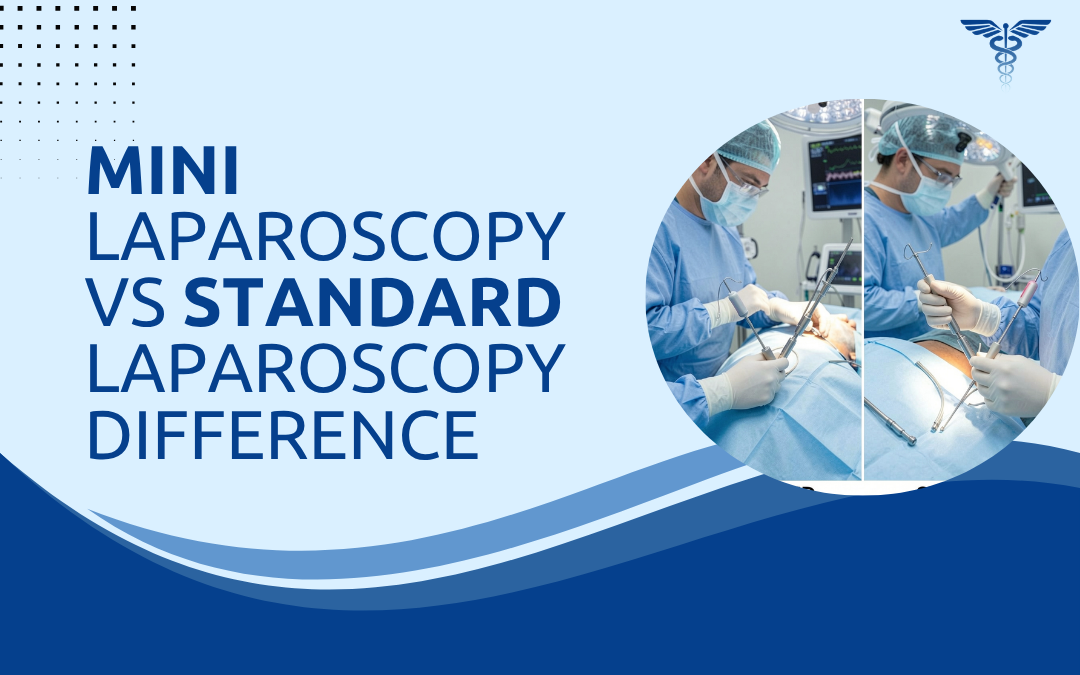
Mini laparoscopy and standard laparoscopy are both minimally invasive, but they differ mainly in instrument size and, as a result, pain levels and cosmetic outcomes. Mini laparoscopy uses needlescopic instruments under 3mm, leaving scars that are often invisible, with significantly less postoperative pain and no suture requirement. Standard laparoscopy uses 5mm to 10mm incisions that need formal closure and produce slightly more discomfort during recovery.
According to Dr. Rajeev Premnath, General Surgeon in Bangalore, “The biggest gain with mini laparoscopy isn’t just smaller scars. It’s the drop in wound-related pain, which lets patients walk out the same day.”
How does mini laparoscopy actually differ from standard laparoscopy?
The differences begin with instrument diameter and extend into incisions, closure, pain perception and final cosmetic appearance.
|
Parameter |
Mini Laparoscopy |
Standard Laparoscopy |
|
Instrument Size |
Sub-3mm needlescopic graspers |
5mm to 10mm trocars |
|
Incisions |
Needle prick punctures |
Formal port incisions |
|
Closure |
No formal suturing needed |
Sutures or skin glue |
|
Pain Levels |
Noticeably less discomfort |
Moderate postoperative pain |
|
Cosmetic Result |
Fades within weeks |
Faintly visible for months |
Both are minimally invasive. Choice depends on the pathology, not preference. For straightforward cases like uncomplicated appendicitis or simple gallstones, mini laparoscopy is the more refined option.
Which one offers faster recovery and better outcomes?
Recovery timelines and patient comfort diverge meaningfully, especially during the first postoperative week.
- Hospital stay: Most mini laparoscopy patients are discharged the same day, while standard laparoscopy may need an overnight observation
- Suture care: Needlescopic wounds heal without suture removal visits, unlike standard incisions that often need follow-up wound checks
- Specimen retrieval: Standard laparoscopy holds an edge here. Larger or inflamed tissues need wider ports, and that’s where gallbladder stone removal sometimes calls for the standard approach
- Return to routine: Office workers typically resume duties in three to five days after mini laparoscopy, versus seven to ten days post-standard
That said, complex pathology can change everything. A perforated appendix or thick-walled gallbladder may need standard ports for safety. So faster recovery isn’t automatic, it depends on matching technique to disease. For more on choosing the right approach, see proctologist services and related surgical options.
Why Choose Dr. Rajeev Premnath?
Dr. Rajeev Premnath brings over two decades of experience in general and laparoscopic surgery, with international training from IRCAD France and the National University of Health, Singapore. As Head of Day Care Surgery at Ramakrishna Specialty Hospital, he performs both mini and standard laparoscopic procedures with documented same-day discharge outcomes.
Patients consistently highlight his clarity, precision and honest case-by-case selection. He doesn’t push one technique over another. He picks what fits the disease, which is exactly what good surgery should look like.
Worried about visible scars after surgery?
FAQs
Is mini laparoscopy safe for everyone?
Not always. It suits uncomplicated cases best and isn’t ideal for severe inflammation or large specimens.
Does mini laparoscopy require sutures?
No, the needle-thin incisions usually heal without sutures, often closed with skin glue or strips.
Can mini laparoscopy be converted mid-surgery?
Yes, surgeons can switch to larger ports if anatomy or pathology demands it for safety.
Are mini laparoscopy scars permanent?
Scars are tiny and usually fade significantly within weeks, often becoming nearly invisible.