

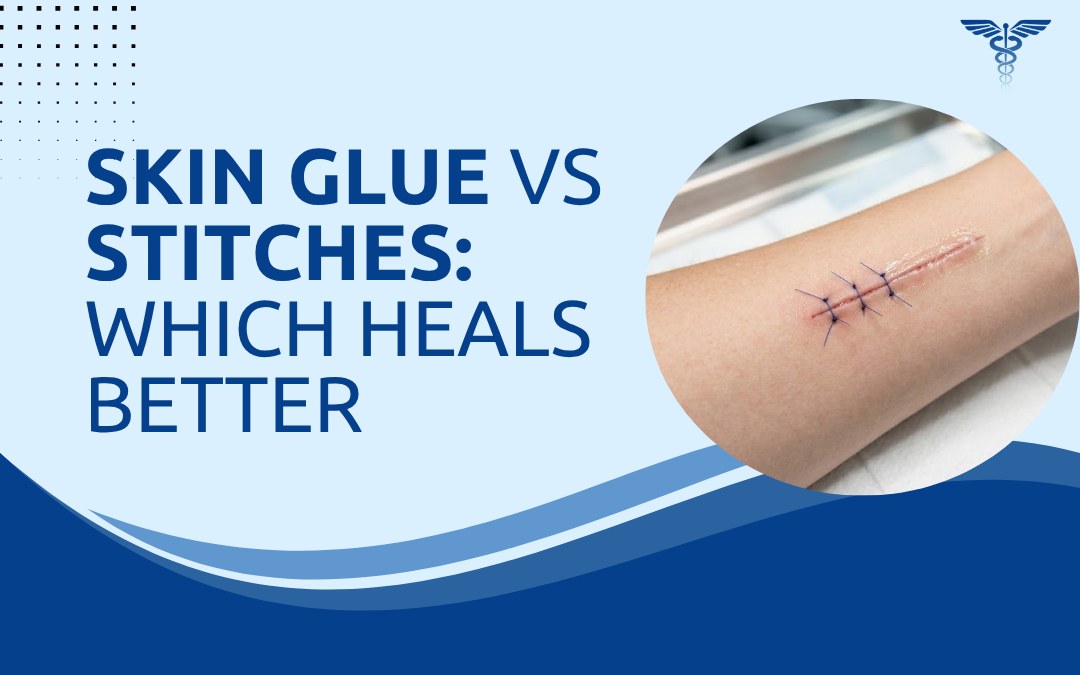
Skin glue gives better cosmetic results, less pain, and lower infection rates on minor, clean, low-tension cuts. Stitches win on deep, jagged, or high-tension wounds that need real structural hold. Glue’s faster, waterproof, and you don’t come back to get it removed. Sutures pull tissue layers together from the inside out, which matters when the wound’s doing more than sitting flat on the skin.
According to Dr. Rajeev Premnath, General Surgeon in Bangalore, Wound closure isn’t a one-size choice. Depth, location, tension, all of it decides what bonds the skin best, and that call shapes how the scar looks six months later.
When does skin glue work better than stitches?
Glue’s the right pick when the cut’s shallow, the edges line up clean, and the skin around it isn’t pulling in three directions. Quick, no needle, done in under a minute.
- Shallow cuts: works on superficial wounds under 5 cm, the kind where edges already want to meet without anyone forcing them
- Facial wounds: kids especially, but adults too. Nobody wants a needle near their face if they can help it, and the scar tends to fade softer
- Low-movement zones: forehead, cheek, shin. Skin doesn’t flex enough there to pop the seal open mid-healing
- Clean edges: sharp, even borders bond fast. Crushed or jagged tissue? Glue won’t grip it properly
Glue isn’t a fix for everything though. Wet skin, oily areas, anywhere the wound keeps stretching, it just peels off. For those situations, hernia and surgical wound closure techniques take a different route altogether.
| Closure Method | Ideal Application | Healing Duration | Scar Outcome |
| Tissue Adhesive | Superficial facial wounds | 5 to 7 days | Minimal cosmetic impact |
| Sutures | Deep or high-tension wounds | 7 to 14 days | Visible, technique dependent |
| Surgical Staples | Scalp and limb lacerations | 7 to 10 days | Moderate linear marks |
| Adhesive Strips | Shallow low-tension cuts | 5 to 10 days | Faint, often unnoticeable |
Are stitches still the safer choice for deep wounds?
Yes. And honestly, no surgeon’s reaching for glue once the cut goes past skin level. Sutures let you control depth, layer alignment, tension. All the things glue can’t touch.
- Deep lacerations: anything into fat or muscle needs real stitching because glue has zero grip below the dermis
- High-tension areas: joints, palms, soles, the back, they’re moving constantly, and only proper laparoscopic and open suturing holds up under that pull
- Jagged or contaminated cuts: bite wounds, irregular edges, anything dirty, you need to clean it and pull it tight. Glue would just trap the debris inside
- Bleeding wounds: active oozing kills the bond before it sets, sutures close vessels mechanically
So glue feels modern and fuss-free, sure. But stitches still close most of what walks into a surgery room. Want to know how surgeons pick between absorbable and non-absorbable thread? Read more on wound healing and surgical recovery.
Why Choose Dr. Rajeev Premnath?
Dr. Rajeev Premnath is a senior General and Laparoscopic Surgeon. Twenty-plus years on the table. Everything from minor wound closures to complex abdominal work. He picks closure methods on what’ll heal best long-term, not what’s quickest to get through.
Patients come back because the scars stay minimal and recovery’s not a circus. No overselling, no shortcuts. Just careful work that holds up.
Worried about which option suits your wound?
FAQs
Does skin glue hurt less than stitches?
Glue application is painless, no needle prick or anesthesia for small cuts.
How long does skin glue last on a wound?
About 5 to 10 days, then it peels off on its own.
Can skin glue be used on stitches together?
Surgeons sometimes layer glue over deep sutures for extra surface protection.
Will stitches always leave a bigger scar than glue?
Not always. Skilled suturing on clean wounds matches glue’s cosmetic outcome.