

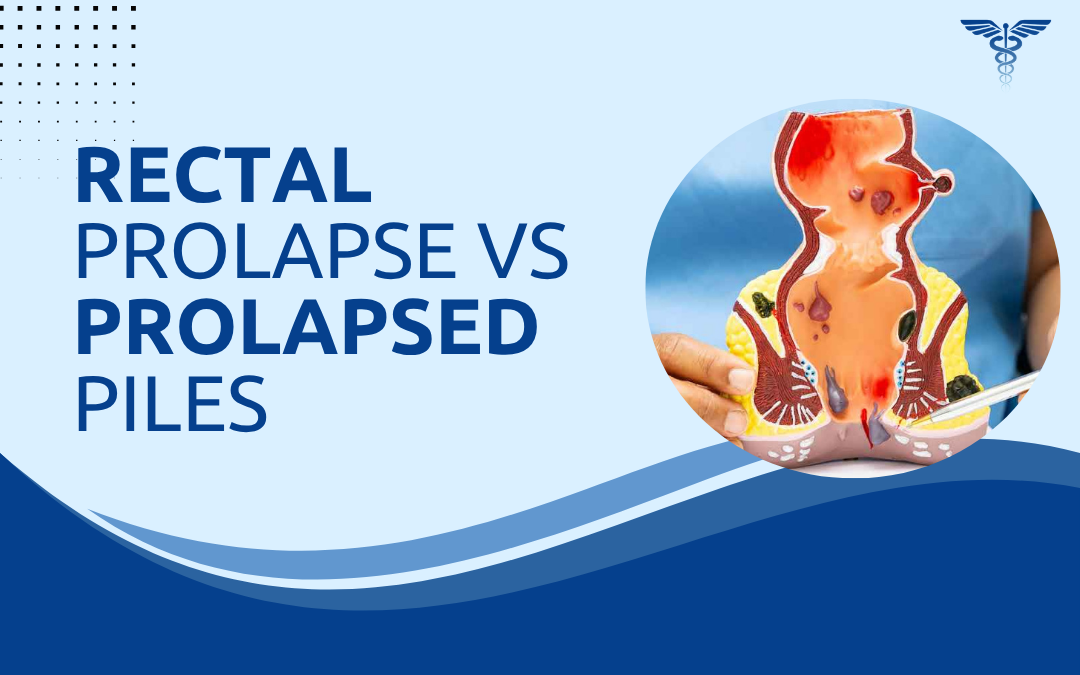
Rectal prolapse is when the actual rectum slides out through the anus, and the protruding tissue shows concentric circular rings on its surface. Prolapsed piles are swollen veins, and they slip out as separate, flesh-coloured lumps that radiate around the anal opening. Rectal prolapse runs bigger and rarely tucks back on its own. Piles are smaller in most cases, and they often retract without any help.
According to Dr. Rajeev Premnath, piles specialist in Bangalore, Patients keep mixing these two up because both push tissue out of the anus, but the structure underneath and the surgery they need are nothing alike.
How do you tell rectal prolapse and prolapsed piles apart by appearance?
Look closely. The tissue itself tells you almost everything, and the table below breaks it down fast.
| Feature | Rectal Prolapse | Prolapsed Piles |
| Tissue type | Full bowel wall | Swollen veins |
| Surface pattern | Concentric rings | No rings |
| Shape | Continuous tube | Separate lumps |
| Colour | Reddish-pink, moist | Flesh to purple |
| Length | 2–5 cm or more | Usually smaller |
| Retraction | Rarely on its own | Often retracts |
When the bulge keeps showing up after every bowel movement and feels like a long sleeve of tissue hanging out, that’s almost certainly a rectal prolapse needing surgical evaluation.
What causes each condition and who is more at risk?
Different roots, different patient profiles. The overlap is smaller than people think.
- Pelvic floor weakness: Years of straining and chronic constipation slowly stretch the muscles that hold the rectum in place, and that’s exactly why so many patients walking in for piles treatment in Bangalore actually turn out to have a rectal prolapse instead
- Age and gender: Women crossing 50 lead the rectal prolapse charts, and a tough childbirth history shows up in their files often, whereas piles don’t really care about gender
- Pressure factors: Heavy lifting, a cough that won’t go away, and pregnancy keep loading pressure onto the abdomen, and that pressure has to escape somewhere downward
- Lifestyle: Skipping fibre, sitting on the toilet too long with the phone, and holding stool in for hours quietly set the stage for both
So the daily habits feeding both conditions are nearly identical, even though the diseases themselves aren’t. Curious about another similar mix-up? Read the difference between piles and fissure.
Why Choose Dr. Rajeev Premnath?
Dr. Rajeev Premnath has been operating for over twenty years and is one of the senior General and Laparoscopic Surgeons in Jayanagar. He’s the surgeon who performed Karnataka’s first VAAFT, and his training stretches across France and Singapore in minimal access surgery.
People walk in confused. They walk out with a clear answer and a plan that fits their case. No rushed consults. No guesswork.
Spotted something coming out and unsure what it is?
FAQs
What does prolapsed piles feel like compared to rectal prolapse?
Piles itch and sting, but rectal prolapse feels like something heavy dragging downward.
Can rectal prolapse be mistaken for piles initially?
Yes, early rectal prolapse gets labelled as grade 4 piles surprisingly often.
Is surgery always needed for rectal prolapse?
For adults, almost always, because weak pelvic muscles don’t fix themselves with diet alone.
Do prolapsed piles always need surgery?
No, grades 1 and 2 usually settle with fibre, water, and small in-clinic procedures.