

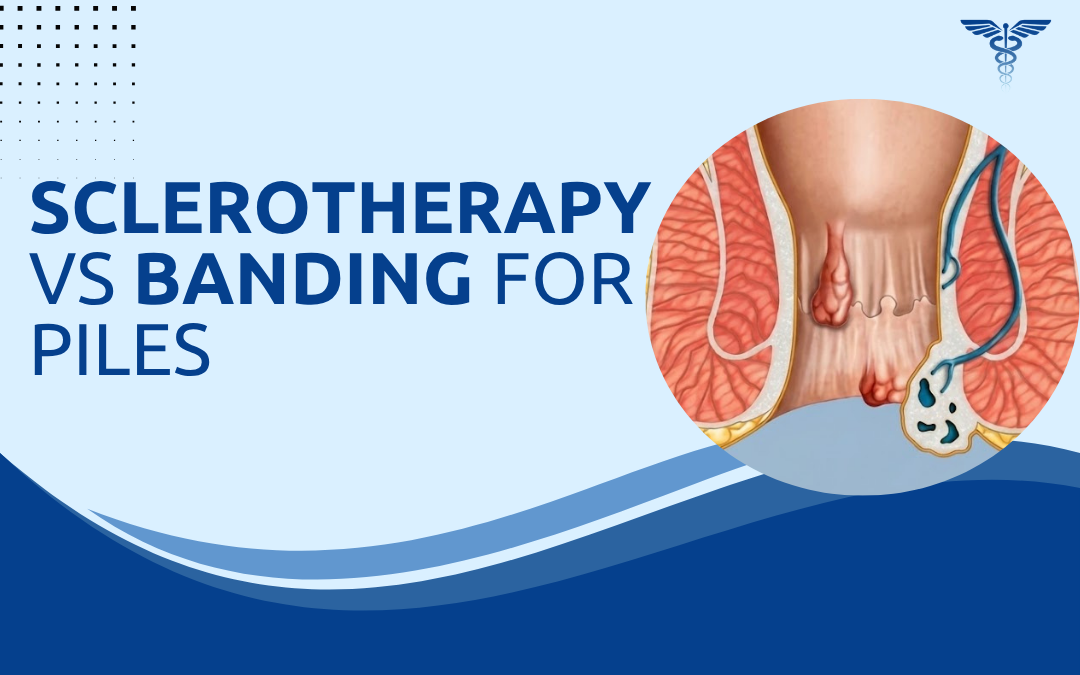
Sclerotherapy and rubber band ligation are both office procedures for Grade 1 and Grade 2 internal piles, performed without anaesthesia or hospital admission. Sclerotherapy injects a chemical solution to shrink haemorrhoidal tissue. Banding places an elastic band at the pile base, cutting off blood supply until the tissue detaches within five to ten days. Neither requires surgery. The right choice depends on pile grade, bleeding pattern, and the clinical picture on proctoscopy.
According to Dr. Rajeev Premnath, a trusted piles specialist in Bangalore, Sclerotherapy and banding are both useful but they’re not interchangeable. Grade 1 bleeding piles respond well to sclerotherapy. Grade 2 prolapsing piles do better with banding. Getting the grading right before choosing the procedure is what determines whether it works.
How Do Sclerotherapy and Rubber Band Ligation Compare?
Sclerotherapy and banding are not interchangeable. Mechanism, grade suitability, and complication profile all differ, and selecting the wrong one for the clinical picture produces a predictable failure.
- Mechanism: Sclerotherapy injects sclerosant into the submucosal layer, triggering fibrosis and shrinkage. Banding strangulates the pile at its base. Both reduce tissue but through completely different pathways.
- Grade suitability: Sclerotherapy suits Grade 1 bleeding piles without prolapse. Banding suits Grade 2 piles that prolapse and reduce spontaneously. Neither reliably resolves Grade 3 or 4 disease.
- Pain profile: Sclerotherapy is virtually painless when injected correctly above the dentate line. Banding causes dull pressure for one to two days. Significant pain usually means the band was placed too low.
- Anticoagulant patients: Banding carries delayed haemorrhage risk when the band falls off at seven to ten days. Sclerotherapy is safer in this group as it doesn’t create an open wound.
|
Feature |
Sclerotherapy |
Rubber Band Ligation |
|
Best grade |
Grade 1 |
Grade 2 |
|
Mechanism |
Chemical fibrosis |
Blood supply strangulation |
|
Pain |
Minimal |
Mild pressure 1-2 days |
|
Anticoagulants |
Safe |
Higher bleeding risk |
The grade determines the procedure, not patient preference or convenience. A clinical assessment for piles treatment confirms which option is appropriate before any sitting is booked.
What Determines Which Procedure Is the Right Choice?
Procedure selection here is driven by grade and clinical findings, not by what the patient read online or came in requesting.
- Pile grade: Grade 1 bleeds without prolapsing. Grade 2 prolapses and reduces spontaneously. Sclerotherapy suits Grade 1, banding suits Grade 2. Applying banding to non-prolapsing Grade 1 piles is excessive.
- Recurrence rates: Banding recurrence runs eleven to eighteen percent at five years. Sclerotherapy runs higher at twenty to thirty percent for Grade 2, which is why it isn’t the first choice for prolapsing disease.
- When both fail: If Grade 3 disease has developed or both procedures have failed, laser haemorrhoidoplasty, stapled haemorrhoidopexy, or conventional haemorrhoidectomy are the appropriate next steps.
- Multiple sittings: Banding is done one pile at a time to avoid simultaneous haemorrhage risk. Sclerotherapy can treat multiple sites in one sitting but often needs two to three sessions for complete response.
Repeated non-surgical attempts when office procedures aren’t working delays definitive treatment. Our previous blog on rubber band ligation vs laser covers when to escalate beyond office procedures.
Why Choose Dr. Rajeev Premnath?
Dr. Rajeev Premnath is a General and Laparoscopic Surgeon with MBBS, MS (Gen Surg.), FRCS (Glasg.), FEBS, FICS, FACS, FIAGES, FMAS, and a Diploma in Laparoscopy from France. Over 20 years at Ramakrishna Super Speciality Hospital managing piles from Grade 1 to Grade 4, with sclerotherapy, banding, laser, and stapled haemorrhoidopexy all performed in-house and selected based on what the proctoscope shows, not patient preference or assumption.
Proctoscopic grading precedes every procedure decision at this practice. No patient goes to a sitting without a confirmed grade driving the choice.
Bleeding or prolapse from piles and considering a non-surgical procedure?
FAQs
What is the difference between sclerotherapy and rubber band ligation for piles?
Sclerotherapy injects a chemical to shrink tissue. Banding cuts off blood supply with a rubber band. Both are office procedures for Grade 1 and 2 piles.
Which works better for piles, sclerotherapy or rubber band ligation?
Banding has higher cure rates for Grade 2 prolapsing piles. Sclerotherapy suits Grade 1 bleeding piles and patients on anticoagulants.
Is rubber band ligation painful?
Mild pressure or fullness for one to two days is normal. Significant pain means the band was placed too close to the dentate line.
Can sclerotherapy or rubber band ligation treat Grade 3 piles?
No. Neither is reliable for Grade 3. Laser or stapled procedures produce better outcomes at that stage.
Disclaimer:
This blog is for educational and informational purposes only and should not be considered professional advice.