

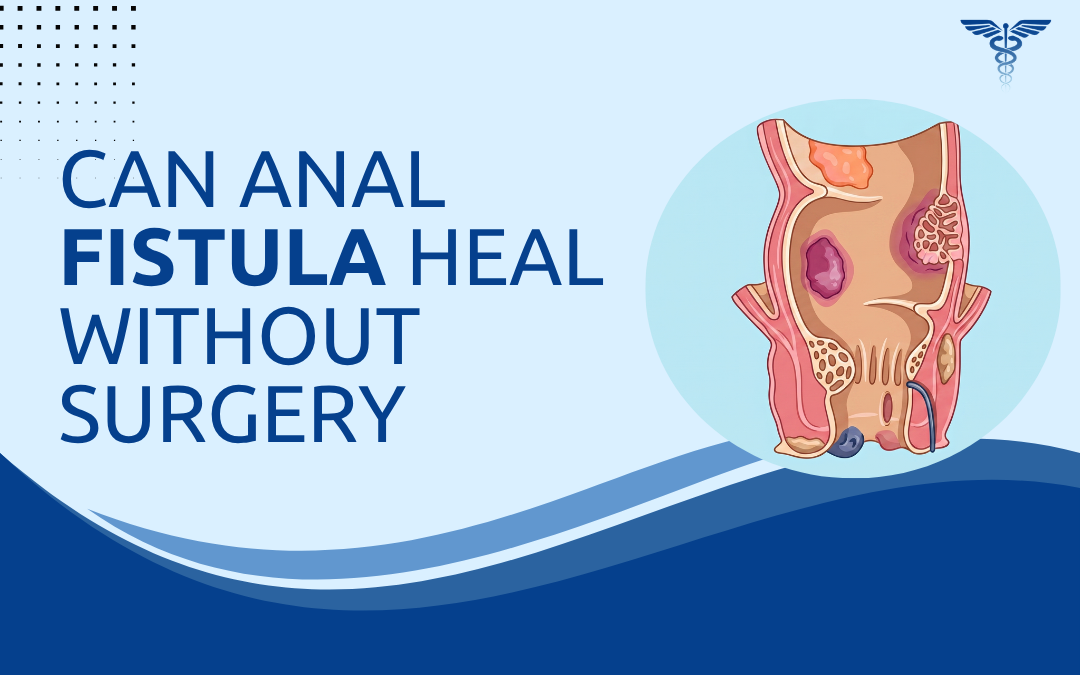
Anal fistulas rarely heal without surgery because the tract develops its own lining that prevents natural closure. A small superficial fistula might drain less temporarily with antibiotics and sitz baths, but the channel almost always persists. Untreated fistulas lead to chronic discharge, recurring abscesses and complex branching.
According to Dr. Rajeev Premnath, Proctologist in Bangalore, Most patients I see with fistula have already tried months of antibiotics and home remedies before accepting that the tract won’t seal without addressing the internal opening surgically.
Why doesn't an anal fistula close on its own?
The anatomy of a fistula tract actively works against any attempt at natural healing.
- Tract lining: Once the channel matures it develops epithelial tissue along its walls, and that lining physically blocks the two sides from fusing shut the way a normal wound would.
- Infected gland: The anal gland that caused the original abscess stays chronically infected underneath, continuously feeding bacteria into the tract month after month.
- Sphincter motion: Tracts running through sphincter muscles face constant mechanical disruption during every bowel movement, which tears apart any early healing before it gets anywhere.
- Branching: Left alone long enough some fistulas develop secondary side tracts that create a network the body simply can’t resolve on its own.
Temporary symptom relief from warm soaks or antibiotics doesn’t equal actual tract closure.
A proper evaluation determines which fistula treatment approach matches your specific tract anatomy.
What surgical procedures actually cure anal fistula?
Surgery remains the only treatment with proven long-term closure rates for established fistula tracts.
- Fistulotomy: The tract gets laid open completely so it heals from the base upward, and for simple superficial fistulas this carries cure rates consistently above 90% with minimal recurrence.
- VAAFT: Video-assisted treatment uses a tiny camera to visualize the tract from inside, preserving sphincter function the same way modern piles treatment techniques protect anal cushions during anorectal procedures.
- Seton: A thread drawn through the tract allows controlled drainage and staged healing over several weeks, and it’s particularly suited for high trans-sphincteric tracts where cutting directly would risk continence.
- LIFT: Ties off the fistula between the internal and external sphincter from an intersphincteric plane, keeping continence fully intact while eliminating the connection.
Antibiotics alone won’t fix this. And delaying makes the whole situation worse quietly.
Delayed cases often face fistula recurrence that makes eventual surgery significantly harder than the original would have been.
Why Choose Dr. Rajeev Premnath?
Dr. Rajeev Premnath performed Karnataka’s first VAAFT surgery for anal fistula. With over 20 years of surgical experience, international fellowship training from IRCAD France and SILS certification from NUH Singapore, he combines advanced minimally invasive technique with high-volume proctological expertise that most general surgeons simply don’t have.
Patients with complex or recurrent fistulas report better outcomes because the tract gets mapped completely with MRI before any cut is made. That difference shows up directly in the recurrence numbers.
Dealing with persistent anal discharge or a recurring abscess near the anus?
FAQs
Can a simple fistula heal without surgery?
Most simple fistulas don’t heal permanently without surgical intervention.
How long does fistula surgery recovery take?
Recovery typically takes two to four weeks depending on procedure type.
Does delaying fistula treatment make it worse?
Delayed treatment often leads to branching tracts and higher complexity
How long does recovery take after high fistula surgery?
Recovery takes six to twelve weeks depending on technique and tract complexity.