

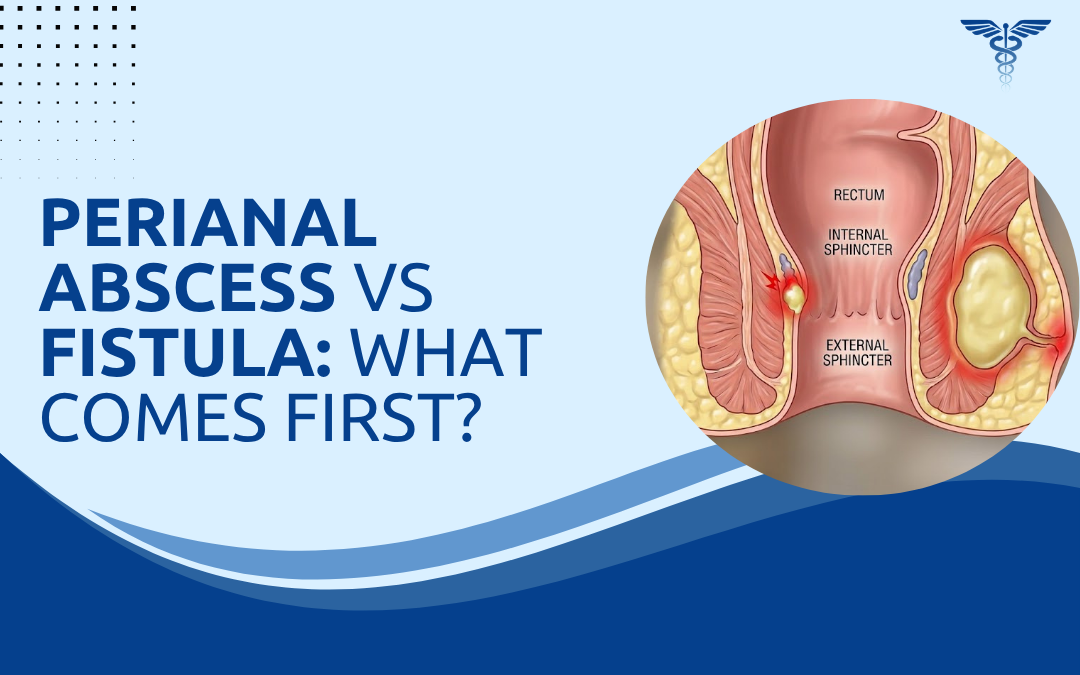
A perianal abscess almost always develops first. It’s an acute, painful, pus-filled infection in the tissue near the anus, caused by a blocked or infected anal gland. When the abscess bursts on its own or gets surgically drained, a small abnormal tunnel often remains, connecting the infected gland to the skin. That leftover tract is the anal fistula. So one’s the acute infection. The other’s what gets left behind. Around 30 to 50 percent of abscess cases end up forming a fistula later.
According to Dr. Rajeev Premnath, a senior consultant for fistula treatment in Bangalore, An untreated or poorly drained perianal abscess is the single biggest reason patients walk in with a fistula months later, and recognising the abscess early changes the entire outcome.
What Causes a Perianal Abscess to Turn Into a Fistula?
Most fistulas trace back to one blocked gland nobody drained on time. Here’s the sequence.
Gland blockage: Small glands inside the anal canal get clogged. Bacteria piles up, pus collects under the skin, and that tender lump throbs when you sit or pass stool.
Abscess rupture: And then the abscess bursts. Either on its own or with a small cut. Pus drains out but the infected gland keeps leaking through the same path.
Track formation: That drainage path doesn’t just close. It hardens. The tunnel epithelialises and turns into a fixed track that won’t heal without surgery.
Recurrence trigger: Diabetes makes it worse. So does Crohn’s, smoking, and anything that weakens immunity, because the body just can’t seal the track when those factors are in play.
Treated at the abscess stage, one drainage procedure is often enough. Wait six months and the conversation changes. For tougher cases that keep coming back, proctology care under someone who actually deals with this daily makes the real difference.
How Are Perianal Abscess and Fistula Treated Differently?
Treatment depends on which stage the patient walks in at. Abscess needs urgent drainage. Fistula needs planned surgery. Two separate problems, two separate fixes.
Abscess drainage: A small incision under local or general anaesthesia lets the pus out, and relief is usually instant, but antibiotics on their own won’t cut it because pills can’t drain a pocket of infection.
Seton placement: For tricky fistulas crossing the sphincter muscle, a thread is looped through the track to let it drain slowly while keeping continence safe, and this often goes hand in hand with minimally invasive fistula surgery in a staged plan.
Fistulotomy or VAAFT: Simple shallow tracks get laid open. Deeper ones get mapped with a tiny camera through VAAFT, sealing the track without slicing through muscle.
Aftercare: Recurrence is best prevented through consistent conservative measures: regular sitz baths, adequate dietary fibre, and follow-up imaging when indicated. Adherence to these measures is key to preventing recurrence of the fistula.
Skip either stage and patients are back in six months with worse anatomy than they started with. For anyone trying to understand the condition itself first, our guide on what is an anal fistula covers the basics.
Why Choose Dr. Rajeev Premnath?
Dr. Rajeev Premnath is a General and Laparoscopic Surgeon with over 20 years of experience. His credentials include MBBS, MS (General Surgery), FRCS (Glasgow), FEBS, FACS, FIAGES, FMAS, and a Diploma in Laparoscopy from France. He was the first surgeon in Karnataka to perform VAAFT for anal fistula, with international training at IRCAD France and the National University of Health, Singapore.
Patients with recurring abscesses and stubborn fistulas come here because sphincter preservation genuinely matters in the treatment plan—prioritising real outcomes and honest answers at every step.
Noticing recurrent swelling or discharge near the anus?
FAQs
Can a perianal abscess heal without becoming a fistula?
Yes, if drained early and properly, around half of abscesses heal without forming a fistula.
How long after an abscess does a fistula appear?
Fistulas usually develop within weeks to a few months after an unresolved or recurrent abscess.
Is antibiotic treatment enough for a perianal abscess?
No, antibiotics alone don’t drain pus, surgical drainage is the definitive treatment.
Does a fistula always need surgery?
Yes, anal fistulas don’t close on their own and require surgical correction for permanent resolution.