

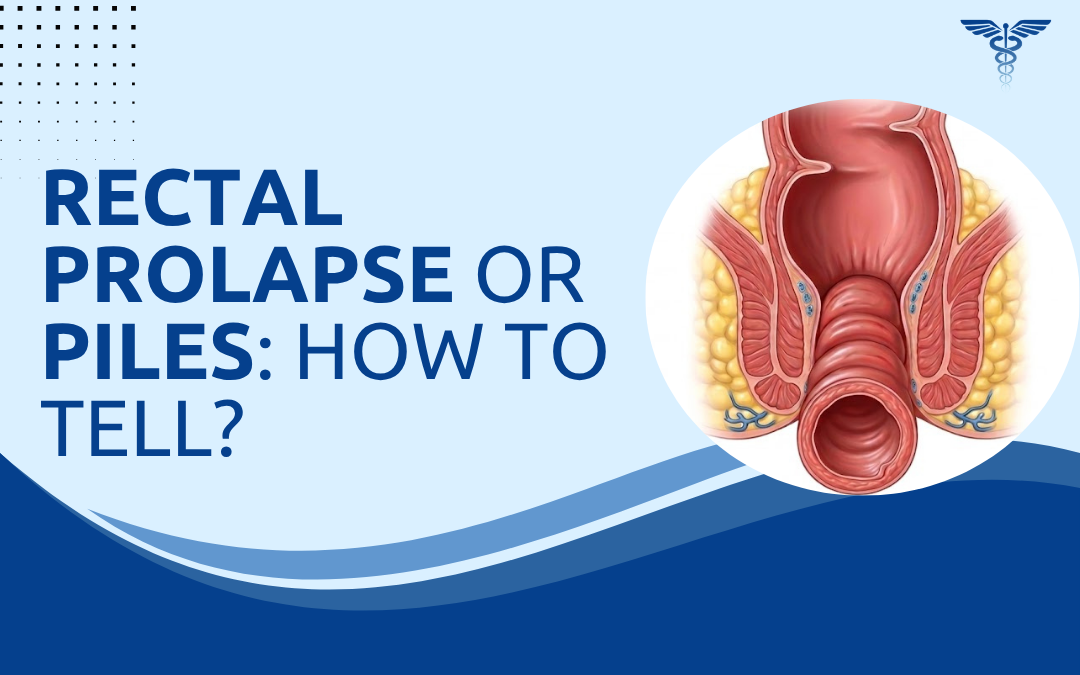
Rectal prolapse and piles are not the same condition. Piles are swollen veins in the anal canal that prolapse outward in higher grades. Rectal prolapse is the full thickness of the rectal wall sliding through the anus, a structural failure of the pelvic floor rather than a vascular problem. Both cause something to appear at the anus and both cause bleeding and discomfort, which is why one gets mistaken for the other constantly. The treatment is completely different for each.
According to Dr. Rajeev Premnath, one of the best proctologist in Bangalore, Rectal prolapse gets misdiagnosed as Grade IV piles regularly. The appearance overlaps enough to confuse patients and sometimes clinicians who don’t see high volumes of anorectal disease. Treating prolapse as piles does nothing for the patient. You have to examine properly and know what you’re looking at.
What Exactly Is Rectal Prolapse and How Does It Differ?
What protrudes, why it protrudes, and how it gets fixed are all different between these two conditions. Treating one like the other produces no useful outcome.
- Full thickness protrusion: In rectal prolapse, all layers of the rectal wall slide through the anal opening. It’s not a vascular problem. The pelvic floor muscles and ligaments that normally keep the rectum in position have weakened enough to let it descend completely through the sphincter.
- Who gets it: Elderly women with weakened pelvic floor musculature are the most common presentation. Chronic straining, previous vaginal deliveries, and connective tissue laxity all contribute. It also occurs in children under five, where it’s usually self-limiting and managed conservatively.
- How it looks: Rectal prolapse produces a larger circular red mass with visible concentric mucosal folds. Prolapsed piles produce distinct separate cushions at the anal margin. That difference in appearance is the key visual distinguishing feature on examination.
- Symptoms overlap: Both cause bleeding, mucus discharge, and a feeling of something coming down. Rectal prolapse additionally causes faecal incontinence because the prolapsing rectal wall stretches and damages the internal sphincter over time. Piles don’t cause incontinence.
| Feature | Rectal Prolapse | Piles |
| What protrudes | Full rectal wall | Swollen anal veins |
| Appearance | Circular mass, concentric rings | Distinct lumps or cushions |
| Cause | Pelvic floor weakness | Increased venous pressure |
| Treatment | Surgical rectopexy | Ligation, laser, haemorrhoidectomy |
Getting the diagnosis right before any treatment is attempted matters. Misidentifying prolapse as piles leads to repeated failed piles treatment while the actual problem progresses untreated.
How Is Rectal Prolapse Treated Compared to Piles?
The surgical approach for rectal prolapse and piles shares nothing. Different anatomical problems, different operative targets, different outcome expectations.
- Rectopexy: The standard surgical treatment is laparoscopic abdominal rectopexy, where the rectum is mobilised and fixed to the sacrum with mesh or sutures. It restores normal rectal position, addresses the pelvic floor defect, and has low recurrence rates in experienced hands.
- Perineal approaches: In elderly or high-risk patients who can’t tolerate abdominal surgery, perineal procedures like Altemeier’s or Delorme’s operation are performed under regional anaesthesia. More accessible but higher recurrence rates than abdominal rectopexy.
- Piles are treated at the venous level, not the structural level. Rubber band ligation, laser haemorrhoidoplasty, and stapled haemorrhoidopexy address the swollen vascular cushions. None of these fixes a rectal prolapse because they don’t address the pelvic floor defect driving it.
- Recurrence prevention: After rectopexy, bowel habit correction is essential. Straining at stool recreates the pressure that caused the prolapse. Dietary fibre, hydration, and avoiding prolonged straining are as important post-operatively as the surgery itself.
Prolapse that goes unrepaired progresses. The sphincter damage from repeated prolapse episodes is cumulative and not always reversible after surgical repair. Our previous blog on piles bleeding covers when rectal bleeding needs investigation beyond a straightforward piles diagnosis.
Why Choose Dr. Rajeev Premnath?
Dr. Rajeev Premnath is a General and Laparoscopic Surgeon with MBBS, MS (Gen Surg.), FRCS (Glasg.), FEBS, FICS, FACS, FIAGES, FMAS, and a Diploma in Laparoscopy from France. He’s been managing both piles and rectal prolapse at Ramakrishna Super Speciality Hospital for over 20 years, with laparoscopic rectopexy and the full range of piles interventions performed regularly across all grades and presentations.
Patients presenting with prolapse here don’t get treated for piles until a proper proctological examination confirms which condition is actually present.
Tissue at the anus that doesn’t reduce or feels different from previous piles episodes?
FAQs
What is the difference between rectal prolapse and piles?
Piles are swollen anal veins. Rectal prolapse is the full rectal wall sliding through the anus. Different conditions, different treatment.
How can I tell if I have rectal prolapse or piles?
Prolapse produces a large circular mass with concentric rings. Piles produce distinct separate lumps. Clinical examination confirms it.
Can rectal prolapse be mistaken for piles?
Yes. Both cause protrusion and bleeding. Prolapse is frequently misdiagnosed as Grade IV piles without proper examination.
Does rectal prolapse require surgery?
Yes. It doesn’t resolve on its own. Laparoscopic rectopexy or perineal repair is needed depending on patient fitness.
Disclaimer:
This blog is for educational and informational purposes only and should not be considered professional advice.