

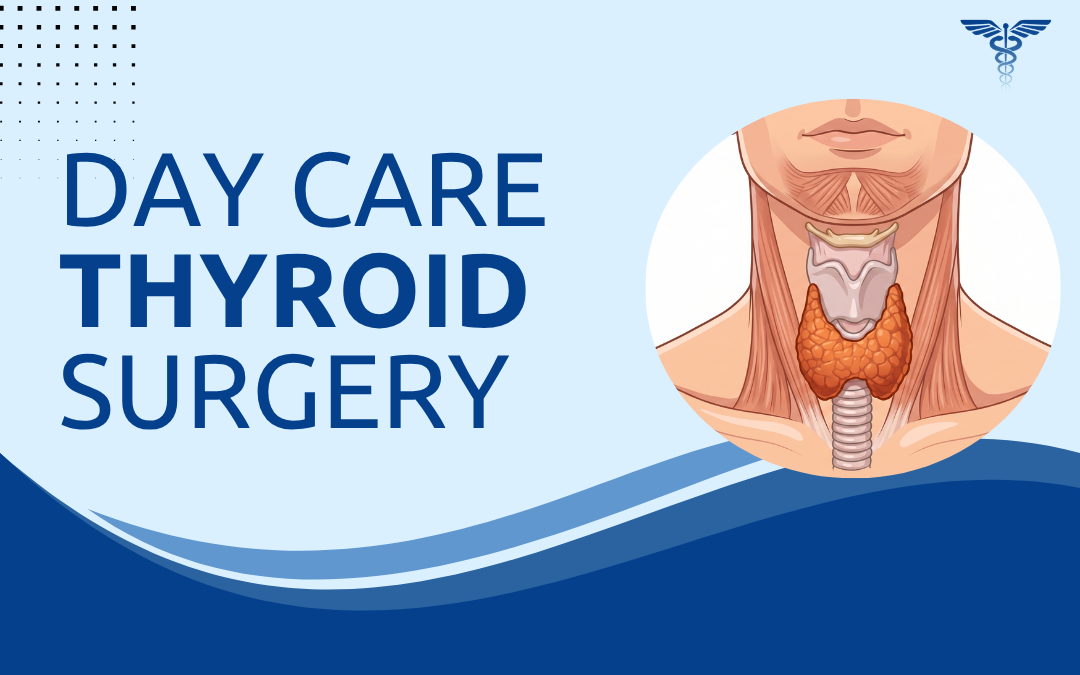
Day care thyroid surgery, where patients go home on the same day as their procedure, is now a safe and widely practiced option for both partial and total thyroidectomy. Better anaesthesia, smaller instruments, and improved bleeding control have changed what’s possible, and most patients are out the door within 4 to 6 hours of surgery. If you’ve been putting this off because you assumed a week in hospital, that assumption’s worth revisiting. Symptoms that push patients toward surgery include a fast-growing neck lump, trouble swallowing, a hoarse voice that doesn’t clear, or a hard nodule that doesn’t move.
According to Dr. Rajeev Premnath, an experienced general and laparoscopic surgeon in Bangalore, Nerve preservation and calcium monitoring are what determine when a thyroid patient goes home, not the surgery itself, and for most patients that’s a matter of hours.
What Happens on the Day of Thyroid Surgery?
The process is more predictable than most patients expect, and nothing about it is rushed.
- Pre-op Assessment: All the groundwork, blood work, thyroid scans, ultrasound, and an anaesthesia check, is done before the surgery date so there’s no scrambling on the day itself and the surgical plan is already decided.
- Surgery Time: The procedure runs one to two hours depending on whether one lobe or the whole gland comes out, and the instruments used are fine enough to work around nerves and parathyroid tissue without disturbing them.
- Recovery Room: This is where voice and calcium are checked, because a dip in either means the patient stays longer. Most don’t have an issue. But it’s non-negotiable when they do.
- Going Home: Stable wound, normal breathing, calcium in range, and the patient leaves with written instructions, a prescription, and a follow-up date already booked before they walk out.
If your thyroid condition has been on the fence, a proper day care thyroid surgery evaluation is the fastest way to know whether you qualify.
Does Everyone Qualify for Same-Day Discharge?
Not automatically. But more patients qualify than they think, and the checklist is clinical, not complicated.
- What’s being removed: Single-lobe disease, benign nodules, and early cancers confined to one area are the cleanest cases because the surgical scope is tight and the risk of post-op complications drops significantly when the other lobe stays intact.
- Other health conditions: Heart disease, poorly controlled diabetes, or any airway problem puts day care off the table, because these aren’t about the thyroid, they’re about how safely anaesthesia can be managed and how fast monitoring can wrap up after.
- Calcium stability: Anyone having a total thyroidectomy needs their parathyroid function assessed beforehand. Low calcium post-surgery is the single most common reason a patient doesn’t go home the same day.
- Someone at home: And this one catches people off guard. You need a responsible adult with you for the first 24 hours, not because complications are likely, but because fatigue, neck stiffness, and some wound soreness are normal and shouldn’t be managed alone.
Our blog on day care surgery explains how the overall approach works and why same-day discharge is safer than it sounds.
Why Choose Dr. Rajeev Premnath?
Dr. Rajeev Premnath has 20 years in general and laparoscopic surgery, credentials including FRCS (Glasgow), FACS, FEBS, and a Diploma in Laparoscopy from France, and runs the Day Care Surgery department at Ramakrishna Group of Hospitals, where the same-day thyroid discharge protocol was built from the ground up.
What patients consistently mention is that they understood the plan before they went into theatre, not after. Dr. Premnath’s pre-surgical explanation covers what’s being done, why, what to expect in recovery, and what warrants a call. That’s not standard everywhere.
Neck lump or swallowing difficulty that’s been there a while?
FAQs
What is day care thyroid surgery?
It’s thyroid removal with same-day discharge, typically within 4 to 6 hours, once nerve and calcium checks clear.
Who is a good candidate for same-day thyroid surgery?
Patients with benign nodules, single-lobe disease, or early cancer and no major comorbidities typically qualify.
Will there be a visible scar after thyroid surgery?
Small incisions closed with skin glue heal cleanly; most scars fade significantly within three to six months.
Is lifelong medication needed after thyroid surgery?
Total thyroidectomy requires daily hormone replacement; partial removal often preserves enough function without medication.