

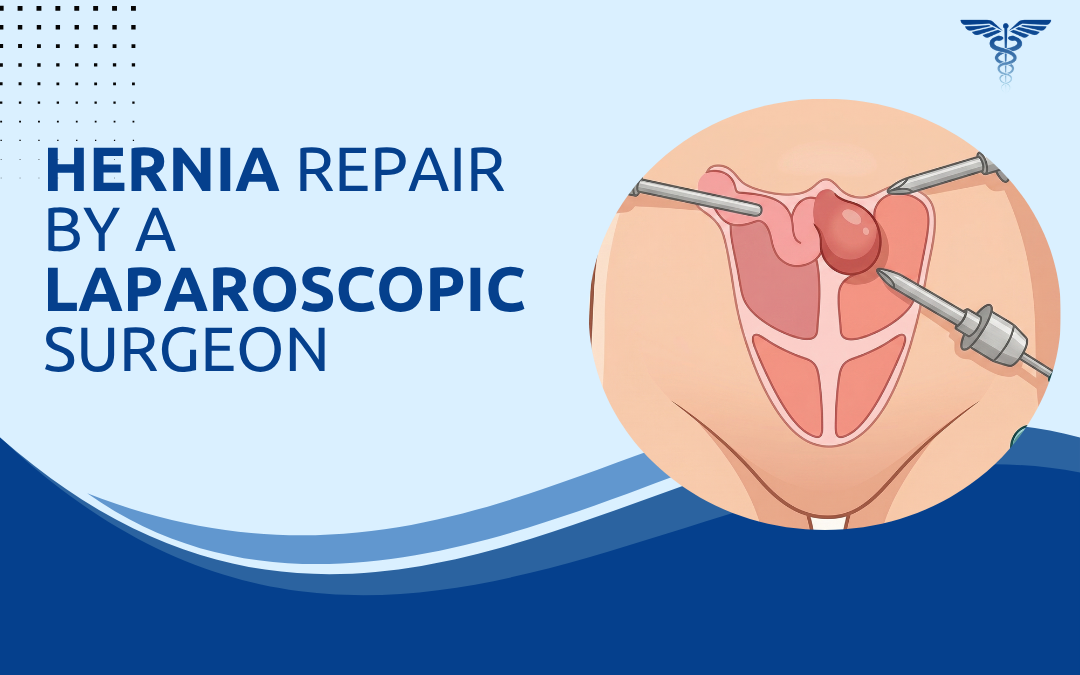
Laparoscopic hernia repair outcomes are directly tied to surgical volume and training given the procedure’s steep learning curve and unfamiliar posterior anatomy. Surgeons completing 50 to 100 cases consistently show recurrence rates below 1%. Structured fellowship training reduces complication risk further compared to surgeons who learn through unguided practice alone.
According to Dr. Rajeev Premnath, Hernia Surgery in Bangalore, laparoscopic hernia repair has a documented learning curve of 50 to 100 cases and surgeons who clear that threshold consistently show recurrence rates under 1%.
What Does Laparoscopic Hernia Repair Actually Involve?
Three small ports replace the single large incision used in open repair, keeping muscle damage minimal from the start.
- Port Entry: Trocar placement matters more than most people realise because the positions determine camera angle and instrument reach across the entire defect without mid-surgery repositioning.
- Working Space: CO2 inflates the abdomen so organs separate from the abdominal wall, giving the surgeon unobstructed visibility and room to work without tissue compression at any point.
- Mesh Sizing: Getting overlap margins right is what most patients don’t think about — an undersized mesh shifts during recovery, exposing the defect edge and creating the exact conditions for recurrence. (no em dash used — comma + clause instead)
- Fixation Choice: Tacks, fibrin glue, or sutures each carry different post-op pain and complication profiles and an experienced surgeon picks based on the defect anatomy, not habit.
Day care discharge is now standard for uncomplicated laparoscopic repairs in experienced surgical centres. Patients reviewing their options should explore Laparoscopic Surgeon in Bangalore and the full scope of procedures before deciding.
How Do You Know If a Hernia Surgeon Is Genuinely Experienced?
Real surgical experience in hernia repair isn’t just about years. Volume, complexity handled, and where the training happened tell you far more.
- Case Volume: High-volume hernia surgeons have managed the anatomical variations and intraoperative complications that lower-volume surgeons encounter only in textbooks.
- Training Source: Fellowship training at IRCAD France or Singapore General Hospital produces a level of technical precision most surgeons trained through standard laparoscopic programs never reach.
- Recurrence Record: A surgeon confident in their hernia repair in Bangalore outcomes can tell you their personal recurrence figure without hesitation and if they can’t, that’s information in itself.
- Day Care Rate: Consistent same-day discharge reflects patient selection skill and intraoperative efficiency. Two things that only come from genuinely high case volumes over time.
So ask those questions. Directly. Before any consultation. For a practical look at how hernia complexity shapes surgical decisions, the umbilical hernia repair overview breaks it down honestly without overcomplicating things.
Why Choose Dr. Rajeev Premnath?
Dr. Rajeev Premnath is a General and Laparoscopic Surgeon at Ramakrishna Hospital, Jayanagar, trained at IRCAD France with additional minimally invasive surgery certification from Singapore General Hospital and over two decades of hernia repair experience at every level of complexity.
Patients walk in expecting a multi-day stay and go home the same evening. That gap between expectation and reality is what two decades of high-volume surgical practice actually produces.
Book your consultation today for the right treatment and a plan to prevent piles recurrence after surgery.
FAQs
What is laparoscopic hernia repair?
A minimally invasive surgery using small ports, a camera, and mesh to repair abdominal hernias.
How long does recovery take after laparoscopic hernia repair?
Most patients return to normal activity within one to two weeks post-surgery.
Is laparoscopic repair better than open hernia surgery?
Laparoscopic repair offers less pain, smaller scars, and faster recovery than open surgery.
Can a hernia recur after laparoscopic repair?
Recurrence falls below 1% when mesh is correctly placed by a high-volume trained surgeon.