

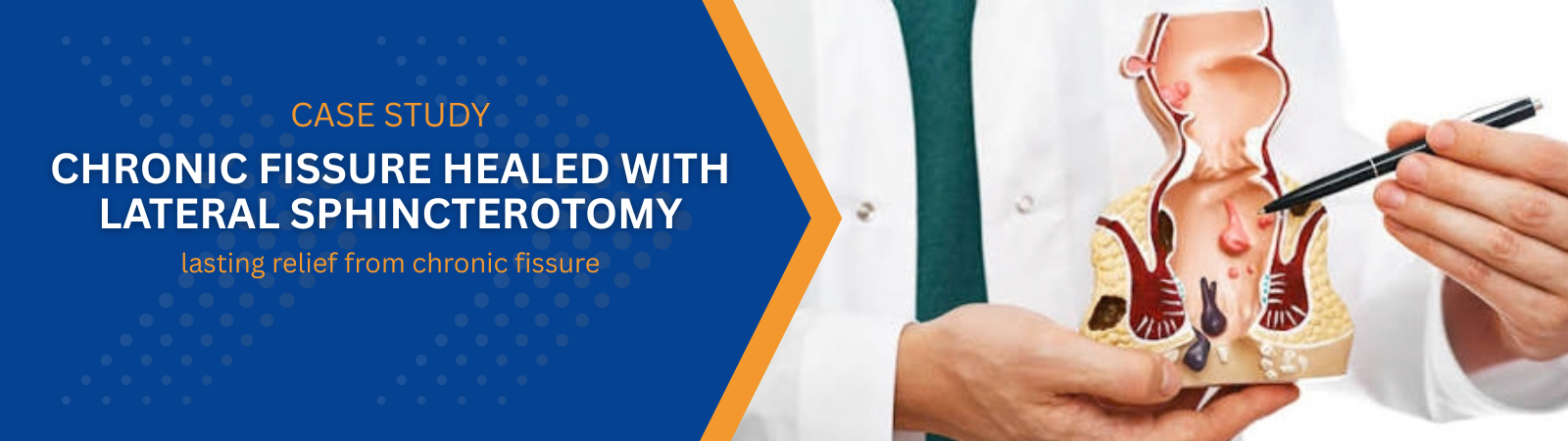
Chronic Fissure-in-Ano Not Responding to MedicationResolved with Lateral Internal Sphincterotomy, Day Care
Patient Information
Age
34-year-old
Gender
Male
Symptom Duration
8 months
Procedure
Lateral Internal Sphincterotomy (LIS)
Duration of Surgery
25 minutes
Outcome
Complete healing by 6 weeks
Diagnosis
Chronic Fissure-in-Ano (posterior midline)
Prior treatment
Topical GTN, Diltiazem, stool softeners
Anaesthesia
Spinal (SAB)
Admission Type
Day Care (same-day discharge)
Follow-Up
3 months no recurrence
Patient identity withheld in accordance with confidentiality guidelines.
Introduction
Anal fissure is one of the most common anorectal conditions managed by a General and Laparoscopic Surgeon in Jayanagar, Bangalore characterised by severe tearing pain during and after defaecation, often with bright red rectal bleeding. Acute fissures usually heal with conservative management, but a significant proportion persist beyond 6–8 weeks, developing into chronic fissures with indurated edges and an exposed internal sphincter signs that further medical therapy is unlikely to work.
Chronic anal fissure is fundamentally driven by internal anal sphincter hypertonia: elevated resting pressure → sphincter spasm → reduced perfusion at the posterior midline → impaired healing. A vicious cycle that topical medication alone cannot reliably break.
Lateral Internal Sphincterotomy (LIS) directly addresses this. By partially dividing the lower fibres of the internal anal sphincter, it reduces resting anal pressure, abolishes spasm, restores blood supply, and creates the conditions required for fissure healing performed as a day-care procedure with minimal disruption to daily life.
This case study documents the assessment, surgical decision-making, operative technique, and recovery of a 34-year-old patient whose 8-month chronic posterior fissure-in-ano, unresponsive to multiple lines of medical therapy, was definitively resolved with a day-care LIS.
Patient Presentation & History
A 34-year-old software professional presented with an 8-month history of severe, knife-like anal pain during and for up to 2 hours after every bowel movement, associated with streaks of bright red blood on toilet paper. He reported actively avoiding defaecation due to the severity of pain — a behaviour that worsened his constipation and further perpetuated the cycle of re-tearing.
Symptoms at Presentation
- Severe spasmodic anal pain during and after defaecation (pain score 8–9/10)
- Bright red per-rectal bleeding streaks on paper and occasional drips in the pan
- Significant fear of defaecation leading to voluntary constipation
- Intermittent anal pruritus and mucoid discharge
- No history of inflammatory bowel disease, sexually transmitted infections, or previous anorectal surgery
Treatment History Prior to Referral
| Treatment | Duration | Response |
| Topical GTN 0.2% ointment | 8 weeks | Partial — headaches limiting use; no healing |
| Topical Diltiazem 2% cream | 8 weeks | Minimal symptom relief; fissure persisted |
| Oral stool softeners + high-fibre diet | 6 months ongoing | Improved stool consistency; pain and fissure persisted |
| Sitz baths twice daily | 4 months ongoing | Mild symptomatic relief only |
| Botulinum toxin injection (offered) | Declined by patient | — |
Clinical Examination & Investigation
On examination, the patient was visibly apprehensive. Inspection of the perianal region revealed a well-defined posterior midline chronic anal fissure with indurated edges, a prominent sentinel skin tag at the anal verge, and a visible hypertrophied anal papilla proximally the classic triad of a chronic fissure.
A gentle digital rectal examination (DRE) confirmed markedly elevated resting anal sphincter tone, consistent with internal sphincter hypertonia. Proctoscopy was deferred given the degree of pain and spasm; the clinical diagnosis was unambiguous.
KEY CLINICAL FINDING: The presence of indurated edges, a sentinel skin tag, a hypertrophied anal papilla, and elevated resting sphincter tone on DRE — in the context of 8 months of treatment-refractory symptoms confirmed a true chronic anal fissure with internal sphincter hypertonia as the driving pathophysiology. Conservative and pharmacological management had been exhausted.
Investigations
- Pre-operative blood work (CBC, LFT, RFT, coagulation profile) within normal limits
- ECG and anaesthesia fitness assessment cleared for spinal anaesthesia
- Fasting blood sugar normal
- No imaging required; clinical diagnosis of chronic fissure-in-ano was confirmed
Surgical Decision-Making
Given the duration (8 months), clinical chronicity (indurated edges, sentinel tag, papilla hypertrophy), failed pharmacological therapy, elevated resting anal pressure, and the patient’s quality of life impact, the decision to proceed with Lateral Internal Sphincterotomy was straightforward and in keeping with current evidence-based guidelines for chronic fissure-in-ano management.
LIS was chosen over botulinum toxin injection because the patient had already endured 8 months of symptom burden, the fissure exhibited all features of established chronicity, and LIS offers a significantly higher and more durable cure rate (~90–95%) compared to Botox (~60–80%) in this clinical setting.
The procedure was planned as a day-care operation a decision aligned with the patient’s professional schedule, the short operative time, the minimal physiological insult of the procedure, and the well-established safety profile of outpatient LIS in appropriately selected patients. Patients with concurrent anorectal conditions such as piles treatment in Bangalore are evaluated separately to determine whether staged or combined intervention is appropriate.
Pre-Operative Preparation
- Thorough counselling regarding the procedure, expected outcomes, and the very low (~1–2%) risk of transient flatus incontinence
- Written informed consent obtained
- Nil by mouth for 6 hours prior to procedure
- Pre-operative glycerine enema administered on the morning of surgery
- IV access established; prophylactic IV antibiotics given (Cefazolin 1g + Metronidazole 500mg)
- Patient positioned in the lithotomy position under spinal anaesthesia
Operative Technique Lateral Internal Sphincterotomy
Under subarachnoid block (spinal anaesthesia), the patient was placed in the lithotomy position. The perianal area was cleaned and draped in the standard fashion. A bivalve anal retractor was gently introduced to provide adequate visualisation of the anal canal.
- The intersphincteric groove was palpated at the left lateral position (3 o’clock), defining the plane between the internal and external anal sphincters.
- A 1.5 cm radial incision was made at the 3 o’clock position in the intersphincteric plane — the open technique was employed for direct visualisation and precision.
- The lower one-third of the internal anal sphincter was carefully identified, isolated on a right-angle clamp, and divided under direct vision with diathermy.
- Haemostasis was achieved. The wound was irrigated with normal saline.
- The skin incision was closed with a single 2-0 Vicryl absorbable suture.
- The existing sentinel skin tag at the posterior fissure margin was excised for pathological confirmation and to promote fissure wound edge healing.
- Total operative time: 25 minutes.
INTRA-OPERATIVE FINDING: The internal anal sphincter was visibly hypertrophied with pale, ischaemic-appearing fibres consistent with chronic high-tone sphincter spasm and confirming the appropriateness of sphincterotomy.
Post-Operative Recovery & Follow-Up
| Milestone | Time Point | Clinical Notes |
| ✅ Day 0 | Day of Surgery | Monitored 4 hrs post-op. Vitals stable. Passed urine. Discharged with oral analgesics, Metronidazole 400mg TDS × 5 days, and stool softener. |
| 📞 Day 2 | Telephone Review | Patient reported first post-op bowel movement was “the least painful in 8 months.” Mild wound discomfort controlled with oral analgesics. |
| 🩺 Week 1 | 1-Week Follow-Up | Wound healing well. Sentinel tag excision site clean. 90% reduction in defaecatory pain. No incontinence of any form noted. |
| 🔬 Week 4 | 4-Week Follow-Up | Fissure completely re-epithelialised. Sphincterotomy wound fully healed. Patient entirely pain-free on defaecation. Normal continence confirmed. |
| ✔️ Month 3 | 3-Month Clinic Review | Complete clinical resolution confirmed. No recurrence. Normal anal sphincter tone. Full return to professional and social activity. |
Discussion
Chronic anal fissure remains one of the most debilitating benign anorectal conditions, with a profound impact on quality of life disproportionate to its apparent simplicity. The internal sphincter hypertonia → ischaemia → impaired healing loop is well-established, and Lateral Internal Sphincterotomy remains the gold standard surgical treatment with cure rates consistently reported at 85–95% in published literature — an approach Dr. Rajeev Premnath applies consistently to deliver definitive outcomes for patients with chronic fissure unresponsive to medical therapy.
The open technique, as employed in this case, allows direct visualisation of the internal sphincter fibres and enables precise, calibrated division minimising the risk of over-sphincterotomy (and consequent incontinence) while ensuring adequate pressure reduction.
The day-care setting for LIS is both safe and patient-friendly. The procedure involves no visceral dissection, carries a very low haemorrhage risk, and requires only basic post-operative analgesia. In this case, the patient was discharged within 4 hours and was functionally independent within 48 hours a stark contrast to the 8-month disability caused by the untreated chronic fissure.
The excision of the sentinel skin tag serves a dual purpose: it removes a nidus for perianal hygiene difficulty and sends the excised tissue for histopathological examination to exclude rare pathologies mimicking a fissure (Crohn’s disease, malignancy, TB). In this case, histology confirmed benign fibrotic tissue consistent with a sentinel pile.
Key Surgical Takeaways
- A fissure with indurated edges, sentinel tag, hypertrophied papilla, and elevated resting sphincter tone is a chronic fissure medical therapy rarely succeeds beyond this stage.
- LIS directly targets the aetiological mechanism (sphincter hypertonia) rather than the fissure wound itself.
- The open technique allows visual confirmation of sphincter division depth, reducing the risk of both under-treatment and over-treatment.
- Day-care LIS under spinal anaesthesia is safe, reproducible, and cost-effective in appropriately selected patients.
- Post-operative stool softeners and dietary advice are mandatory the best surgery is undone by unaddressed constipation.
Frequently Asked Questions
Q1: What is a chronic fissure-in-ano and when is surgery recommended?
A chronic anal fissure is a persistent tear in the lining of the anal canal lasting more than 6–8 weeks, often with indurated (hardened) edges, a sentinel skin tag, and an exposed internal sphincter at its base. Surgery is recommended when the fissure fails to heal despite adequate conservative treatment with stool softeners, dietary changes, topical nitrates, calcium channel blockers, or botulinum toxin injections for at least 6–8 weeks.
Q2: What is lateral internal sphincterotomy and how does it work?
LIS is a short surgical procedure where the surgeon makes a small incision at the side (lateral position) of the anal canal and carefully divides a portion of the internal anal sphincter. This reduces the resting pressure and spasm of the sphincter, allowing improved blood flow to the fissure site and enabling natural healing. The procedure is highly effective with a success rate of 85–95%.
Q3: Is LIS done as a day-care procedure?
Yes. LIS is routinely performed as a day-care outpatient procedure under spinal or local anaesthesia, typically takes 20–30 minutes, and patients are discharged the same day. Most patients resume normal activities within a few days.
Q4: Will I lose bowel control after LIS?
The risk of incontinence with a correctly performed LIS is very low — typically less than 1–2% for flatus and even lower for solid stool. Precise, tailored sphincter division under direct vision minimises this risk.
Q5: How long does it take to recover from LIS?
Most patients experience immediate relief from severe spasmodic pain within 24–48 hours. Complete wound healing typically occurs within 4–8 weeks. Sitz baths twice daily, a high-fibre diet, adequate fluid intake, and stool softeners are advised during recovery.
Q6: Can a chronic anal fissure recur after surgery?
Recurrence after a properly performed LIS is uncommon, occurring in fewer than 5% of patients. Long-term maintenance of a high-fibre diet, adequate hydration, and avoidance of chronic constipation or straining significantly reduces recurrence.