

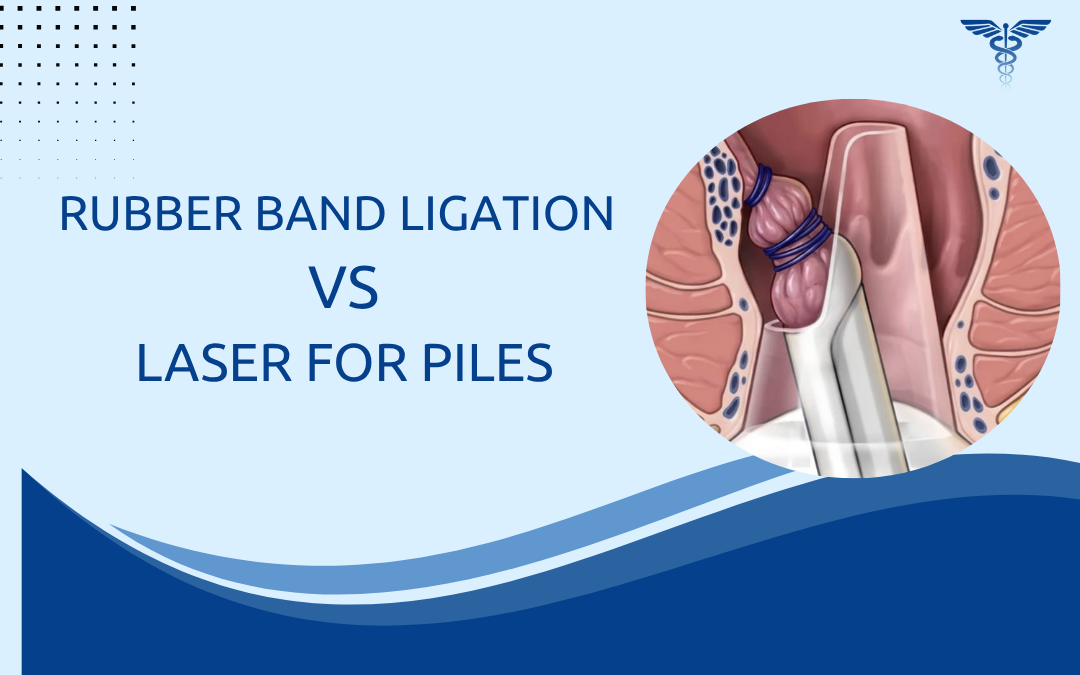
Laser haemorrhoidoplasty is generally considered the better option over rubber band ligation for piles treatment. It causes significantly less post-operative pain, fewer complications and faster recovery. Both work for grade 2 hemorrhoids but laser handles grade 3 and selected grade 4 cases more effectively with lower recurrence. Rubber band ligation often needs repeat sessions and is limited to early grade internal piles only.
According to Dr. Rajeev Premnath, piles treatment in Bangalore, Laser gives us better tissue precision and sphincter safety but banding still has a role in early grade piles where a quick office procedure is all that’s needed.
How does rubber band ligation work and where does it fall short?
A small elastic band is placed at the base of the internal hemorrhoid using a suction ligator and the strangled tissue dies and detaches within five to ten days.
- Blood cutoff: The band strangles the hemorrhoid’s feeding vessels and the shrivelled tissue passes during a normal bowel movement on its own without the patient noticing most times
- Office procedure: Done in under ten minutes without anaesthesia which is why it stays the most commonly performed outpatient intervention for grade 1 and grade 2 internal piles globally
- Repeat sittings: Larger hemorrhoids or multiple sites need two to three sessions spaced weeks apart because banding more than one at a time raises secondary bleeding risk considerably
- Grade ceiling: Grade 3 with significant prolapse and all grade 4 hemorrhoids don’t respond to banding at all, and that’s where patient selection matters more than technique
Post-banding discomfort is usually a dull pressure lasting a day or two. But recurrence rates sit between 11% and 18% over five years. Proper grade confirmation through a proctology evaluation before choosing any approach makes all the difference.
Why is laser considered the better option for most patients?
A thin diode laser fibre goes directly into the hemorrhoid tissue and controlled energy shrinks the pile mass from inside without cutting or removing anything.
- Precision shrinkage: The laser seals off submucosal arteries feeding the hemorrhoid and the tissue gradually fibroses and contracts over three to four weeks with recurrence rates dropping to 5% to 9% in most studies
- Pain advantage: Post-operative pain scores with laser are consistently 40% to 60% lower than both banding and conventional surgery because there’s no open wound and no tissue excision involved
- Sphincter preservation: Zero cutting and zero stitching means the sphincter complex stays completely untouched, the same precision that matters in fissure treatment where muscle integrity decides long-term continence outcomes
- Single session: Grade 2, grade 3 and selected grade 4 hemorrhoids get handled in one sitting under short anaesthesia and most patients go home the same day walking normally
Recovery takes three to five days. The trade-off is cost. Laser runs significantly higher than banding but when you factor in fewer repeat visits and lower recurrence the gap narrows over time. Understanding piles recurrence after surgery helps set realistic expectations before.
Why Choose Dr. Rajeev Premnath?
Dr. Rajeev Premnath is a general and laparoscopic surgeon with over 20 years of clinical experience, FRCS (Glasgow), FEBS, FACS credentials and international training in minimal access surgery from IRCAD France. He performed Karnataka’s first VAAFT surgery for anal fistula and handles the full spectrum of proctology cases including laser haemorrhoidoplasty at Ramakrishna Specialty Hospital in Jayanagar.
Patients here don’t get defaulted into one procedure. They get matched to the technique that fits their hemorrhoid grade, tissue bulk and recovery reality. That consistency is what drives referrals instead of second opinions.
Book your consultation today for the right treatment and a plan to prevent piles recurrence after surgery.
FAQs
Is rubber band ligation painful?
Most patients feel mild pressure or dull ache for one to two days.
Can laser treat grade 4 piles?
Yes selectively. Large permanently prolapsed grade 4 cases still need excisional surgery.
How long does laser hemorrhoid treatment take?
The procedure takes 20 to 30 minutes under short anaesthesia.
Does rubber band ligation need hospital admission?
No. It is an outpatient clinic procedure done without any anaesthesia.