

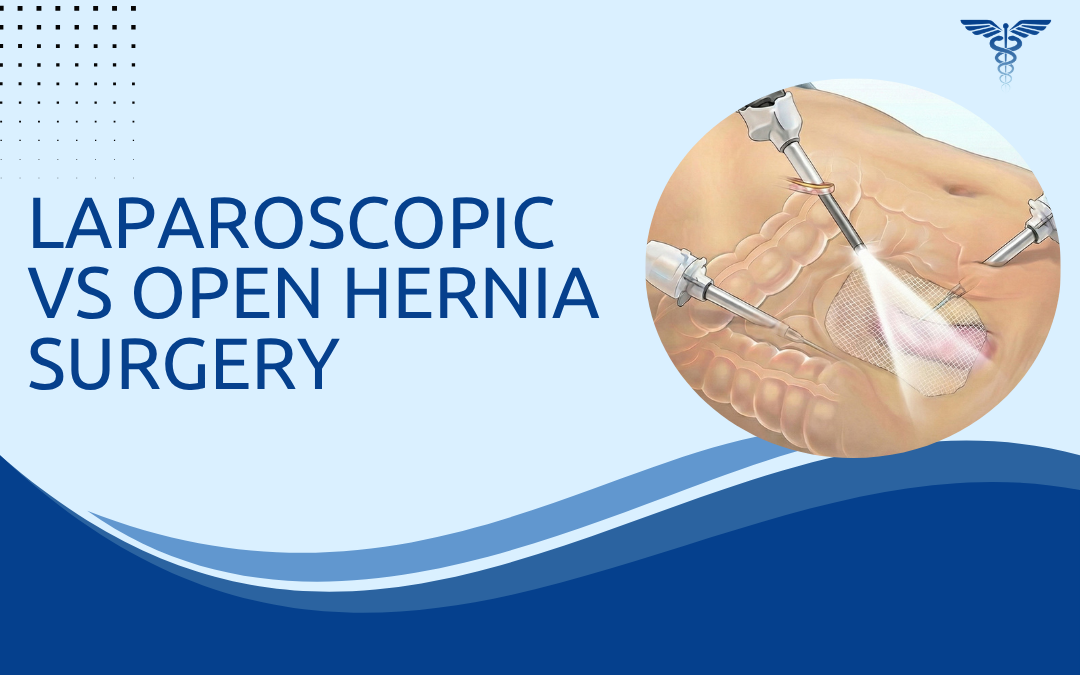
Three small ports instead of one long incision. That single difference changes infection risk, pain levels, and how fast a patient gets back to normal life after hernia repair. Most patients are doing light work again within five to seven days.
“ For bilateral and recurrent hernias, laparoscopic repair cuts complication rates and gets patients home faster than open surgery does in those exact same cases. “ — Dr. Rajeev Premnath, General and Laparoscopic Surgeon in Bangalore
What Makes Laparoscopic Hernia Repair Safer for Most Patients?
Less muscle damage. Everything else follows from that.
Infection rates — Wound infection after open hernia repair sits between 15% and 45%. The number depends on hernia type and patient health. Laparoscopic ports leave almost no wound surface exposed, so contamination drops sharply.
Post-op pain — Open repair means cutting through muscle layers. That is where first-day and second-day pain comes from. Laparoscopic patients end up needing far less medication because the muscle stays mostly intact.
Recovery — Light activity in five to seven days with laparoscopic. A patient with the same hernia going open? Still restricted weeks later.
Bilateral repair — Three ports, both sides fixed, one session. Open surgery would need a significantly larger cut and longer hospital time to achieve the same result.
Most patients do not realise the size of that gap until they sit down for a consultation. Asking about laparoscopic hernia repair options before you decide? Book Appointment
When Does Open Hernia Surgery Make More Clinical Sense?
Open repair is a deliberate clinical decision in the right situation. Not a second choice.
Strangulation — Blood supply to the bowel is gone. Surgeon needs full direct access immediately. No scope can replace that in an emergency.
Prior abdominal surgery — Adhesions from old procedures turn laparoscopic access into a risk. Going open for inguinal hernia repair in these patients is the correct plan, full stop.
Anaesthetic risk — General anaesthesia is off the table for some cardiac and respiratory patients. Spinal or regional block with open repair keeps them safe.
Complex defects — Big abdominal wall gaps with actual tissue loss. Mesh has to be placed by hand. A camera cannot give the surgeon that kind of control.
The right approach depends on what is in front of the surgeon on that day. Nothing else. This guide on umbilical hernia surgery walks through recovery across different hernia types
Why Choose Dr. Rajeev Premnath
Dr. Rajeev Premnath runs Day Care Surgery at Ramakrishna Hospital, Jayanagar, with over 20 years of hernia repair experience and more than 15,000 patients treated. Trained in 3D mesh repair at Day Hospital, Italy, and advanced laparoscopy at University Hospital Essen, Germany.
Bilateral cases, recurrent defects, high-risk presentations. Patients in those categories routinely leave the same day and recover faster than they expected going in. That track record comes from surgical volume, not from telling patients what they want to hear.
Book your consultation today for the right treatment and a plan to prevent piles recurrence after surgery.
FAQs
Is laparoscopic hernia surgery safer than open repair?
Lower infection rates and faster recovery in most patients, yes.
Can all hernia types be treated laparoscopically?
No. Strangulated hernias and complex abdominal wall defects still need open access.
How soon can I return to activity after laparoscopic hernia surgery?
Light activity within five to seven days for most patients.
Do bilateral hernias require two separate surgeries?
No. Both sides get repaired in one laparoscopic session.