

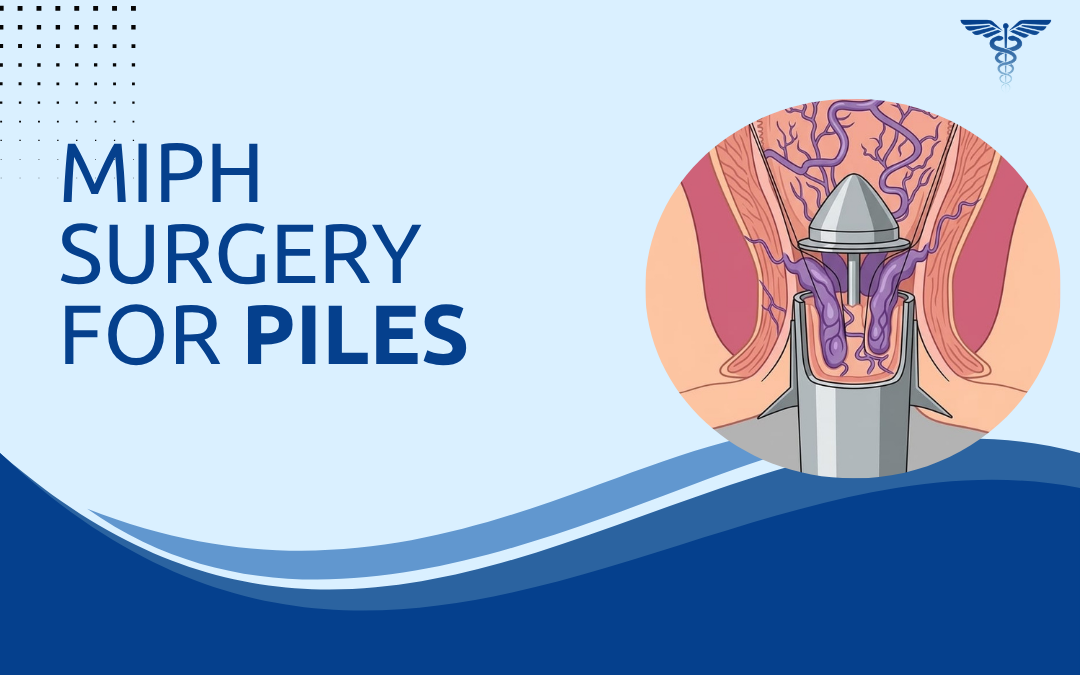
MIPH, short for Minimally Invasive Procedure for Hemorrhoids, is a stapled technique used on grade 3 and grade 4 piles. A circular stapler cuts out a ring of stretched tissue and pulls prolapsed hemorrhoids back inside the anal canal. Less pain than open surgery. Hardly any bleeding. And patients get back on their feet faster than they’d expect.
According to Dr. Rajeev Premnath, piles treatment in Bangalore, “MIPH works best when prolapse is the main complaint, not external skin tags or thrombosed components.”
How Does MIPH Surgery Work Step by Step?
The whole procedure stays above the dentate line. That’s the part of the anal canal where nerve endings are thin, so pain drops right off.
- Purse-string: A circumferential stitch goes in above the dentate line, bunching up redundant rectal mucosa into the barrel of the circular stapling device
- Firing: The PPH gun fires. It cuts out a doughnut-shaped ring of stretched mucosa and lays down two rows of titanium staples that seal everything shut in one motion
- Tissue lift: With that mucosal band gone, prolapsed hemorrhoidal cushions get dragged back to where they belong inside the rectum. Nobody touches the cushions directly
- Vascular effect: The staple line also chokes off a chunk of the superior hemorrhoidal arteries feeding those swollen cushions. Over weeks, they gradually shrink on their own
Twenty to thirty minutes under spinal or general anaesthesia and it’s done. Most patients walk out the same day. Explore proctology care options for anorectal conditions.
What Makes MIPH Different from Conventional Piles Surgery?
Conventional hemorrhoidectomy slices tissue from the sensitive anoderm below the dentate line. Pain receptors live there in abundance. That’s the whole reason recovery after open surgery feels brutal.
- Pain: MIPH stays above the dentate line where receptors are sparse. Postoperative discomfort is noticeably lower. Not zero, but nothing close to what open excision puts patients through
- Recovery: Most people get back to routine within 3 to 5 days. No raw wound sitting on perianal skin. No weeks of dressing changes and wincing every time you sit down
- Scope: MIPH only deals with internal hemorrhoidal prolapse. Something like anal fistula needs an entirely separate approach, like fistula treatment
- Cushion preservation: The hemorrhoidal cushions aren’t cut out. They’re repositioned. That keeps the natural continence mechanism of the anal canal intact, which matters more than most patients realise
But picking between MIPH and conventional surgery depends on hemorrhoid grade, prolapse extent, and whether external components are involved. Read about piles recurrence after surgery for long-term outcomes.
Why Choose Dr. Rajeev Premnath?
Dr. Rajeev Premnath holds FRCS (Glasgow), FEBS, FACS and a Diploma in Laparoscopy from IRCAD France with over 20 years in general and laparoscopic surgery. He performed Karnataka’s first VAAFT surgery and routinely does stapled hemorrhoidopexy and laser hemorrhoidoplasty.
Patients who come in for minimally invasive procedures at his practice keep saying the same thing. Less pain, quicker return to work. That kind of consistency over two decades isn’t accidental.
Book your consultation today for the right treatment and a plan to prevent piles recurrence after surgery.
FAQs
Is MIPH surgery painful?
Minimal pain because it operates above the dentate line.
How long does MIPH surgery take?
Usually 20 to 30 minutes under anaesthesia.
Can MIPH treat grade 4 piles?
Works best for grade 3 and early grade 4 prolapse.
What is recovery time after MIPH?
Most patients resume normal activities within five to seven days.