

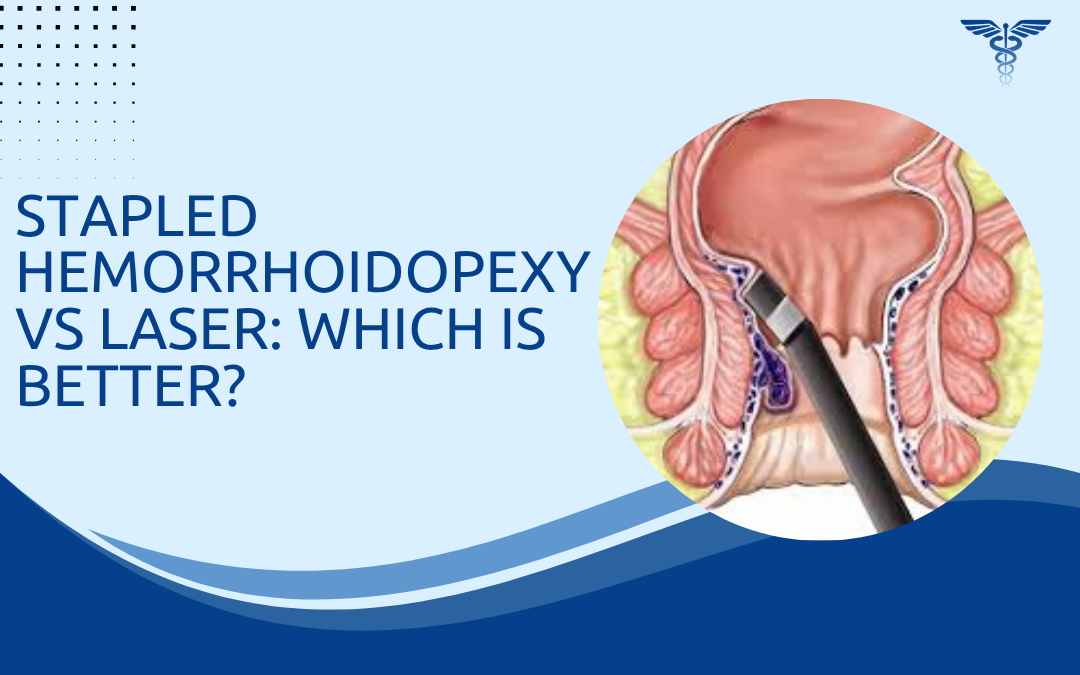
Stapled hemorrhoidopexy works best for prolapsed internal piles that have moved outside the anal canal. Laser works best for smaller internal hemorrhoids, where minimal tissue removal with fast healing is the priority. The right choice depends entirely on the grade, size and location of the hemorrhoids and a surgeon who tells you one is always better than the other without examining the patient first isn’t giving a complete answer.
“The choice between stapled hemorrhoidopexy and laser treatment depends on the grade and type of hemorrhoids present and what the individual patient needs from their procedure,” says Dr. Rajeev Premnath, General and Laparoscopic Surgeon.
Grade matters. Type matters. And getting that assessment right before deciding on a procedure is what determines whether someone gets a good outcome or ends up back in clinic months later.
How Do Stapled Hemorrhoidopexy and Laser Treatment Actually Work?
Two completely different mechanisms. Two different target grades. Both done as day care procedures in most cases. Piles treatment today covers a range that didn’t exist ten years ago and understanding what each approach actually does makes the choice far less confusing.
- Stapled hemorrhoidopexy mechanism. A circular stapler removes a ring of tissue above the hemorrhoids and simultaneously pulls prolapsed tissue back up into the anal canal. The hemorrhoids lose their blood supply and shrink while the prolapse gets corrected in one step.
- Laser treatment mechanism. Laser energy is delivered directly into the hemorrhoidal tissue through a thin probe, coagulating the blood vessels feeding the hemorrhoid from the inside. The hemorrhoid shrinks gradually over days without any tissue being cut or removed externally.
- What grade each works best for. Stapled hemorrhoidopexy is most effective for grade three and four prolapsed internal hemorrhoids. Laser works best for grade two and select grade three hemorrhoids where the prolapse is less advanced and tissue bulk is smaller.
- Pain comparison between the two. Laser treatment is generally associated with less post-operative pain than stapled hemorrhoidopexy because there’s no staple line inside the anal canal and no mechanical tissue removal involved in the process.
Both are done as day care procedures. Both have patients going home the same day. But they’re used at different stages of hemorrhoidal disease and using the wrong one for the wrong grade produces inferior results regardless of how skilled the surgeon performing it is.
Patients wanting a full picture of every treatment option across all hemorrhoid grades from conservative through to surgical should look at what a proctologist actually offers beyond just these two procedures.
Which Procedure Has Better Outcomes and Fewer Complications?
Side by side the two procedures have different strength profiles. Neither wins on every single metric. The right answer depends on what matters most for the specific patient and the specific hemorrhoid presentation being treated.
|
Stapled Hemorrhoidopexy |
Laser Treatment |
|
|
Best for |
Grade 3 and 4 prolapsed internal hemorrhoids |
Grade 2 and select grade 3 hemorrhoids |
|
Post-op pain |
Moderate, staple line discomfort common |
Minimal, no external cuts or staple line |
|
Recovery time |
One to two weeks |
Three to seven days |
|
Recurrence rate |
Higher than conventional haemorrhoidectomy |
Low for suitable grades, higher if used for advanced grades |
|
Procedure time |
Twenty to thirty minutes |
Fifteen to twenty minutes |
|
Day care |
Yes, same day discharge |
Yes, same day discharge |
The table tells part of the story. The other part is this. A laser procedure done on a grade four prolapsed hemorrhoid will underperform a stapled repair done on the same patient. Grade matching to procedure is what determines outcomes far more than which technology sounds more modern.
Anyone still genuinely unsure whether their hemorrhoids have reached the surgical stage at all should read this older piece on whether piles always need surgery which answers that question directly without pushing anyone toward unnecessary treatment.
Why Choose Dr. Rajeev Premnath?
Dr. Rajeev Premnath has spent over 20 years performing both stapled hemorrhoidopexy and laser piles treatment across every grade of hemorrhoidal disease. Every single day without exception. Trained at IRCAD in France, genuinely one of the most respected minimally invasive surgery institutions anywhere in the world. Advanced laser and proctology training completed on top of that. Hundreds of real piles cases handled. Patients going home same day. Outcomes that come from matching the right procedure to the right patient every time.
Call Now: +91 90082 04466 – same day appointments available for urgent cases.
The best procedure is the one that’s right for the specific hemorrhoids being treated. One proper examination and that question gets answered properly without any guessing.
FAQs
Is laser treatment for piles always better than stapled hemorrhoidopexy?
No, laser works best for lower grade hemorrhoids while stapled hemorrhoidopexy is more effective for advanced prolapsed grade three and four cases.
Which procedure has a faster recovery, laser or stapled hemorrhoidopexy?
Laser treatment generally has a faster recovery of three to seven days compared to one to two weeks for stapled hemorrhoidopexy in most patients.
Can piles come back after either stapled hemorrhoidopexy or laser treatment?
Yes, recurrence is possible with both but is more common after stapled hemorrhoidopexy than conventional haemorrhoidectomy and depends heavily on lifestyle changes after treatment.
Are both stapled hemorrhoidopexy and laser piles treatment done as day care?
Yes, both procedures are performed as day care with patients discharged the same day and no overnight hospital admission required in uncomplicated cases.
A proper consultation gives specific answers around your hernia size, type and health situation. Come in and speak directly with Dr. Rajeev Premnath.
References